
PPPL physicists propose heating plasma before compression — ScienceDaily
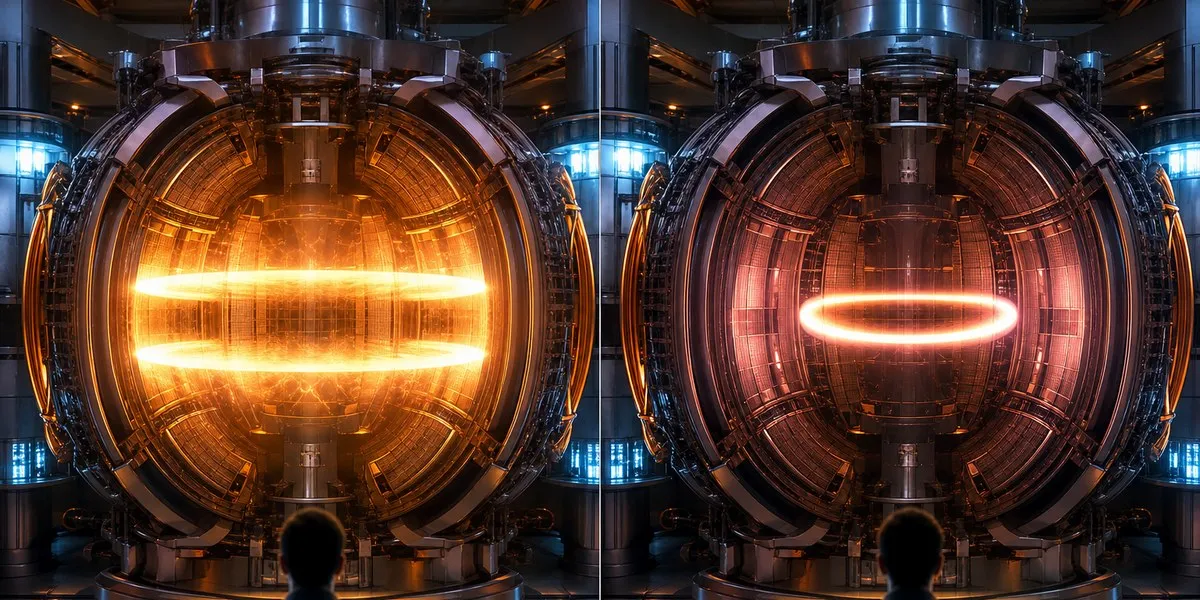
In the United States, physicists at the Princeton Plasma Physics Laboratory of the U.S. Department of Energy (PPPL) have calculated a potentially more efficient path to fusion ignition: first heating the plasma and only then increasing its density. This sequence may require significantly less energy than approaches involving initial plasma compression, ScienceDaily reports.
The work by Luis Delgado-Aparicio, Masayuki Ono, and Jonathan Menard was published in the journal Physical Review Letters. The researchers expanded the Lawson criterion, a mathematical condition describing whether plasma can remain hot and dense long enough to sustain a fusion reaction without additional external heating.
Additional factors for ignition
In the new model, the scientists considered four processes that may affect achieving and sustaining ignition: helium buildup as a reaction product, impurities entering from the reactor’s inner lining, synchrotron radiation emitted by electrons in magnetic fields, and heat losses from the plasma.
More current news is available on the UA.News Telegram channel Telegram.
The authors analyzed the so-called Cordey saddle, a region at the boundary between plasma that requires external heating and plasma capable of sustaining the reaction with its own heat. For the assessment, they used the Q factor, which compares fusion reaction power with external heating power. In idealized plasma with pure fuel, this region corresponds to approximately Q = 5, but impurities and strong magnetic fields can raise the required value.
The impact of tungsten and next tests
According to the team’s calculations, tungsten impurity at a concentration of one part per 10,000 can approximately double the pressure required for ignition. Tungsten is used for the inner walls of more than a dozen next-generation fusion facilities because of its resistance to high temperatures, but its entry into the plasma may complicate reactor operation.
The study is theoretical: the proposed approach has not yet been tested experimentally. The PPPL team plans to study it using computer simulations. The findings may be applicable in the design of tokamaks and stellarators, where plasma is confined by strong magnetic fields.




