
Afanasy Pilkevich, co-founder of Spilqa (spilqa.com), explains when crowdfunding can complement a bank loan, how to evaluate a project before investing, and what platform the team is preparing to launch.
Afanasy Pilkevich has over 19 years of experience in finance and investments. For about 12 years, he worked at an investment and development holding company, where he focused on finance, financial instruments, and the operations of investment funds and asset management companies. He later worked in financial and legal structuring, organized real estate financing and sales, managed asset transactions, and advised Ukrainian developers. He served on the supervisory boards of investment funds. He is currently a co-founder of Spilqa. UAB Spilqa is in the process of obtaining authorization from the Bank of Lithuania as a crowdfunding service provider. Authorization has not yet been granted, so the platform is not currently providing services.
In an interview with UA.News, Afanasy Pilkevich discussed the key issues to address when discussing project financing when a bank loan is insufficient, what investors should verify, and how the Spilqa model is planned to be structured. The following is a direct quote.
Where to Start with Financing
I begin the conversation about financing not with where to get the money, but with four questions: How much funding is needed? What exactly is it needed for? When is the money needed, and for how long? And how will the project repay it?
The last question is the most important. A developer can repay a loan through the sale of real estate—individual units or the entire property—rental income, or refinancing. Each option has its own terms and risks. If the source of repayment is unclear, taking on additional debt merely postpones the problem.
An approved loan isn’t the same as cash
A bank loan remains the primary and usually the cheapest source of funding for a well-prepared project. But an approved loan does not mean the money is in the account today.
A good example is the publicly disclosed agreement between the Polish company INPRO and mBank in April 2025 for the construction of a residential complex in Gdańsk. To receive the first tranche of funds, the developer had to confirm that 30.3 million zlotys had already been invested—covering the land and a portion of the costs—and confirm pre-sales amounting to 20% of the total usable floor area. These are the terms of a specific agreement, not a market standard. But they clearly illustrate a practical issue: what the developer must pay for out of pocket before the bank begins providing financing.
The bank then typically disburses funds in tranches—after confirming that the work has been completed. A contractor may request an advance payment. Or roads and utilities may need to be built for the entire town, while the loan covers only the first phase. That’s why I recommend starting with a cash flow schedule: when payments are due, when the money will actually become available, and where the debt will be repaid from.
Another common mistake is focusing solely on the interest rate. It’s important for a developer to calculate how much money will actually be deposited into the account after fees, what payments will need to be made, and on what dates. The advertised interest rate alone doesn’t show this.
Where Does Crowdfunding
Fit In?
Lending-based crowdfunding is when a developer raises a loan not from a single bank, but from many private investors through a regulated platform. It can supplement a bank loan or cover a specific phase: purchasing land before bank financing is secured, project preparation, bridging the gap until the next tranche, or refinancing.
For a developer, this type of funding is usually more expensive than bank financing. However, there’s no need to give up a stake in the project, as is the case with a partner, and funds can be raised for a specific purpose. This may be of interest to small and medium-sized developers, companies entering a new market that do not yet have a credit history there, and sometimes even large players when they need to quickly finance a specific stage.
However, the higher cost of this financing is justified only if the project is capable of covering its full cost and repaying the funds. If the project is already financed by a bank, it’s worth checking whether the loan agreement allows for additional debt and collateral, and whether the bank’s consent is required. And even with the bank’s consent, the loan remains debt, not the developer’s equity.
The European Regulation on crowdfunding covers offers from a single project owner of up to 5 million euros over 12 months. For many small and medium-sized projects, this is sufficient.
How to Invest in Real Estate Projects Through Crowdfunding
To participate in financing a residential complex, warehouse, or the renovation of a commercial building, an investor can contribute to a portion of the loan alongside other investors. In the loan model, the investor becomes a lender to the company implementing the project. The agreement specifies the interest rate, term, and repayment schedule. Ownership of the property does not transfer to the investor.
For investors, this is an opportunity to spread their funds across multiple projects.
What an investor
should check
We begin our project evaluation by examining the source of repayment. First, we determine where the borrower plans to obtain the funds for repayment and what will happen if that plan fails. Then, we assess whether the interest rate is commensurate with the risk. Investors should ask themselves these same questions before making a decision.
Second is collateral. A first-lien mortgage gives priority over holders of subsequent liens on the property. Actual repayment also depends on the sale price, costs, and the applicable foreclosure procedure. Therefore, it’s not just the property appraisal that matters, but also any other encumbrances and how easily the property can be sold.
Third—who is implementing the project: the team’s experience, completed projects, and the company’s financial condition.
And fourth—the liquidity of the investment itself. The loan is provided for a specific term, and it may be difficult to exit it early.
This is a high-risk investment. Return of funds is not guaranteed; such investments are not covered by the bank deposit insurance system, and an investor may lose some or all of the funds invested. Therefore, it is important to diversify investments across projects and not to invest money whose loss would be critical.
The regulations also provide for certain protective mechanisms. In particular, investors who do not qualify as experienced under these rules have four calendar days to withdraw their investment offer without providing a reason or incurring a penalty.
How the Spilqa
Model Is Planned
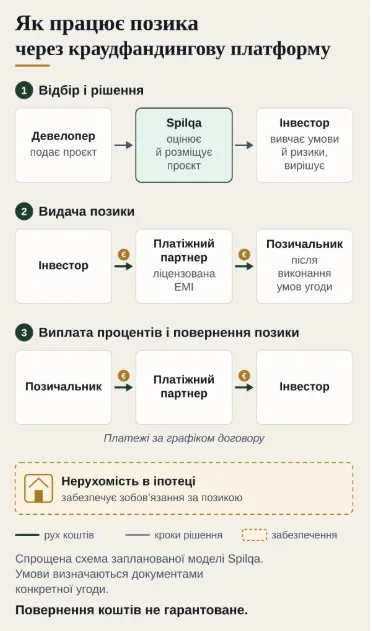
Spilqa is a lending-based crowdfunding platform for real estate development projects that is preparing to launch.
We plan to use a first-lien mortgage on existing real estate—land plots, residential, or commercial properties—as standard collateral in favor of investors. The procedure for securing the collateral and representing investors in the event of foreclosure will be determined by the terms of each specific agreement.
Prior to the offering, we will evaluate the borrower, the project budget and timeline, the source of repayment, and the collateral. We plan to present the results to investors in the form of a risk rating. Details of the methodology may be refined during the authorization process. The rating helps assess risk but does not guarantee the return of funds. Before making a decision, the investor will receive a document containing key information about the offer: who is raising funds, for what purpose, under what loan terms, what collateral is provided, and what the main risks are. Once operations begin, we will disclose default statistics in accordance with regulatory requirements.
Funds will not pass through the platform’s own accounts. We plan to process payments through a licensed electronic money institution (EMI). Such an institution facilitates payment transactions and is required by law to protect clients’ funds using legally mandated methods. Investors will have an account in their own name; funds will be reserved during the fundraising process and disbursed to the borrower once the conditions are met. This protection does not eliminate the risk of the loan not being repaid after it is granted to the developer.
The planned minimum investment amount is €100. In my opinion, the size of the initial investment is also important from a psychological standpoint: it’s easier to start with a smaller amount.
Under the planned model, the developer will pay the main fees. According to the planned terms, the debt administration fee will be charged on the overdue amount. The investor will pay it only after receiving compensation interest—or a portion thereof—from the borrower, at the time of its distribution.
License and Why Lithuania
On October 12, our legal advisors reported that they had submitted Spilqa’s application for authorization to the Bank of Lithuania. The single European framework for crowdfunding is relatively new—it has been in effect since November 2021. Authorization in one country allows us to operate in other EU member states after providing the required notification to the regulator.
For us, Lithuania is our first market—not just a place to obtain a license. A mature lending-based crowdfunding market has already taken shape here. As of November 11, 2026, there were 17 licensed crowdfunding service providers listed in the Bank of Lithuania’s registry. In 2025, €379.4 million in funding was raised through Lithuanian providers—a 36.3% increase from the previous year. There are payment institutions, consultants, developers, and investors here who are already familiar with this tool, and the country itself is known for its digital government services and openness to fintech. We want to build partnerships here and help local projects raise funds.
Our next target market is Poland. Going forward, we’ll consider other EU countries, particularly Spain and Portugal—as local partners, expertise, and a sufficient number of high-quality projects become available.
We will begin operations after receiving authorization. The timeline for this depends on the regulator.
Ukrainian Developers and Investors
We support businesses with Ukrainian roots and plan to pay special attention to the needs of Ukrainian developers and investors. At the same time, we want to work with local developers, investors, and partners and adopt the best local practices. A common language facilitates communication, but financing decisions will be based on project quality and risk assessment.
A team may have completed projects in Ukraine, but its new company in the EU may not yet have a local credit history. This can complicate financing for the first project. Lending-based crowdfunding can supplement bank financing or cover a specific phase. During our evaluation, we plan to consider the team’s experience—including projects completed in Ukraine—along with the budget, collateral, and source of repayment.
For a Ukrainian investor, this is an opportunity to diversify a portion of their investments across different markets and earn contractual interest on loans for projects in the EU. The interest rate on such a loan may be higher than on a deposit in the same currency, but it’s important to compare them while taking into account the risk of default and the fact that exiting the investment early may be difficult. Investing in a project outside Ukraine reduces the direct exposure of that portion of the portfolio to war-related risks in Ukraine. If a person is saving and planning expenses in euros, a loan in euros reduces currency mismatch; if the return is calculated in hryvnia, the exchange rate will be a factor. It is also important for the investor to know who the borrower is, where the property is located, what law applies, and how the collateral is structured.
A separate point concerns funds from Ukraine. Documents regarding income received and documents regarding the subsequent movement of funds answer different questions. The legality of the income does not mean that the transfer can be made by any technically available method: currency regulations and the requirements of the institution receiving the funds are what matter. Therefore, the structure of the transaction should be verified before the transfer, not after.
The same applies to taxes: citizenship, a residence permit, and tax residency are different things. Taxes depend on the investor’s country of tax residency, the type of income, and international tax treaties.
I’ve personally tried using European platforms and realized how important it is to understand in advance who can open an account and how to fund it. We want to make the platform accessible to Ukrainian investors. Specific eligibility will depend on the country of residence, applicable requirements, and the verification processes of the platform and payment partner. For money transfers from Ukraine, you’ll also need to take into account current foreign exchange regulations.
Next Steps
Looking ahead, we’re considering a model where investors can share in the financial returns of projects. This is a separate area that we’ll develop in accordance with regulatory requirements. We are also exploring the potential of AI tools that would help investors navigate project documents and terms. We will test specific features before launch.
But right now, the most important thing is a solid foundation. We’re building this business to last for decades, so the quality of our first projects, clear rules, and a reputation backed by our track record are crucial to us.
We’re ready to openly disclose who owns the platform, who’s on the team, and the principles we operate by.