
China's auto industry is pushing European manufacturers out of key markets — Daily Sabah
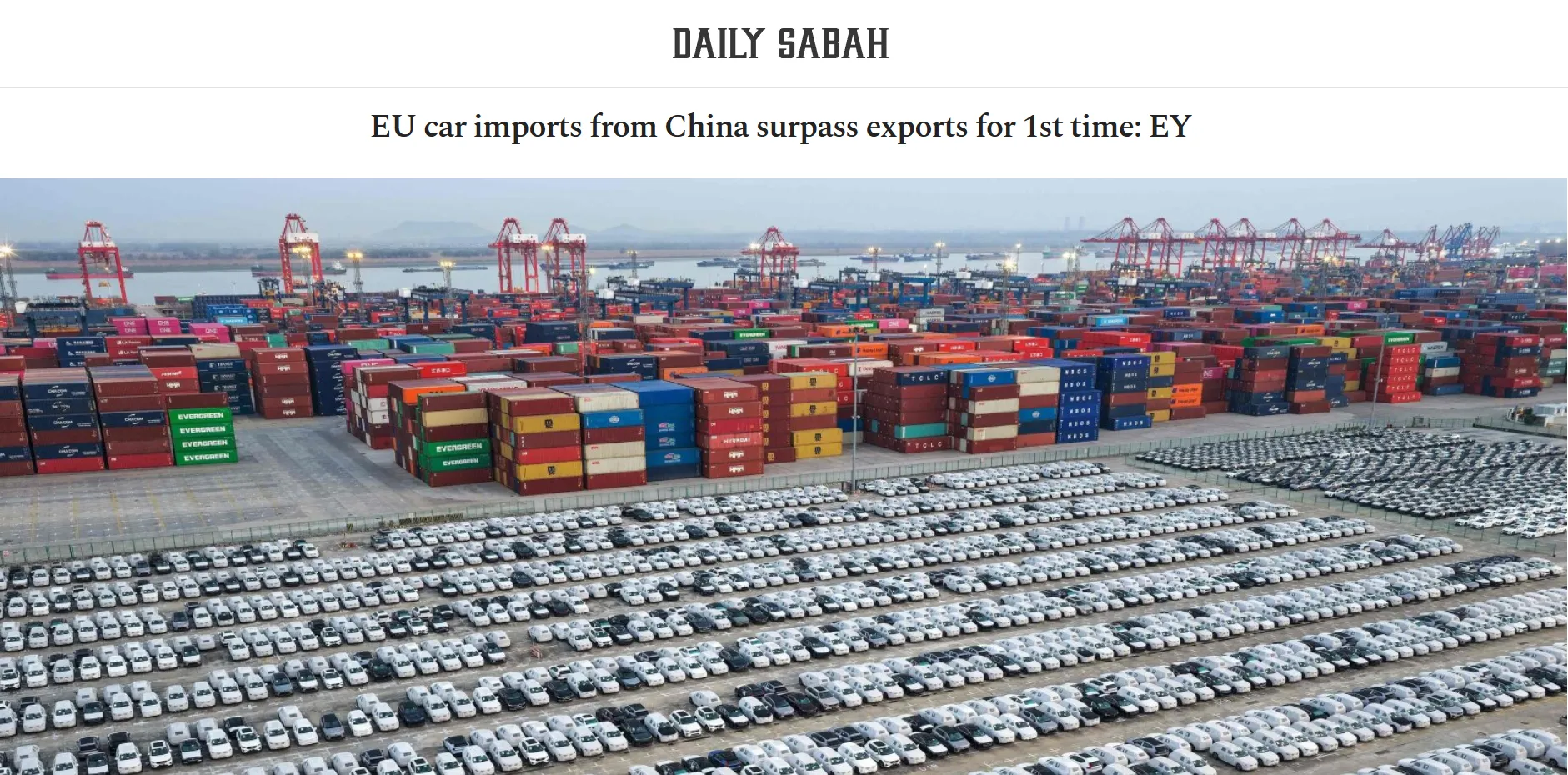
The global automotive market is undergoing a historic shift in the balance of power in China’s favor, putting unprecedented pressure on European giants.
This is reported by Daily Sabah.
According to an analysis by consulting firm EY, for the first time in history, the volume of imports of cars and components from China to the European Union has exceeded exports in the opposite direction.
Last year, automotive exports from the EU to China fell by a staggering 34%, dropping to €16 billion.
At the same time, imports of Chinese cars and parts rose by 8%, reaching €22 billion, which indicates the rapid expansion of Asian brands into the European domestic market.
The situation is particularly alarming in Germany, which is traditionally considered the continent’s leading automotive powerhouse.
In 2025, China ranked only sixth among export markets for German cars, although it had previously been a key destination for premium brands.
The gap between German exports and imports narrowed from €30 billion in 2022 to €13.6 billion in 2025.
Analysts predict that if current trends continue, these figures could even out completely as early as 2026, depriving Germany of its status as a net exporter in trade with China.
The automotive components segment remains the area where Chinese suppliers have the strongest influence, particularly the production of batteries for electric vehicles.
This creates a technological dependence of European factories on Chinese raw materials and components, which is critically important during the transition to “green” transportation.
The financial performance of the German automotive sector already reflects these negative trends: the industry’s total revenue declined by 1.6% in 2025.
Profits for leading manufacturers and suppliers plummeted, forcing companies to resort to drastic cost-cutting and optimization measures.
The number of jobs in the German automotive sector has fallen to its lowest level in 14 years—only 725,000 people are currently employed there.
Giants such as Mercedes-Benz, Volkswagen, Bosch, and ZF Friedrichshafen have already launched large-scale workforce reduction programs to maintain profitability.
Parts suppliers have been hit the hardest, with their revenues falling by 4% and their workforce shrinking by more than a tenth in a short period.
Since 2019, this segment has lost about 73,000 jobs, accounting for nearly a quarter of the total workforce.
As a reminder, global auto giants are resisting a full transition to electric vehicles.
Additionally, the war in Iran will accelerate the global rise in popularity of electric vehicles.


