
From Shakira to Madonna: How Performances by Global Stars Have Become an Integral Part of the World Championships
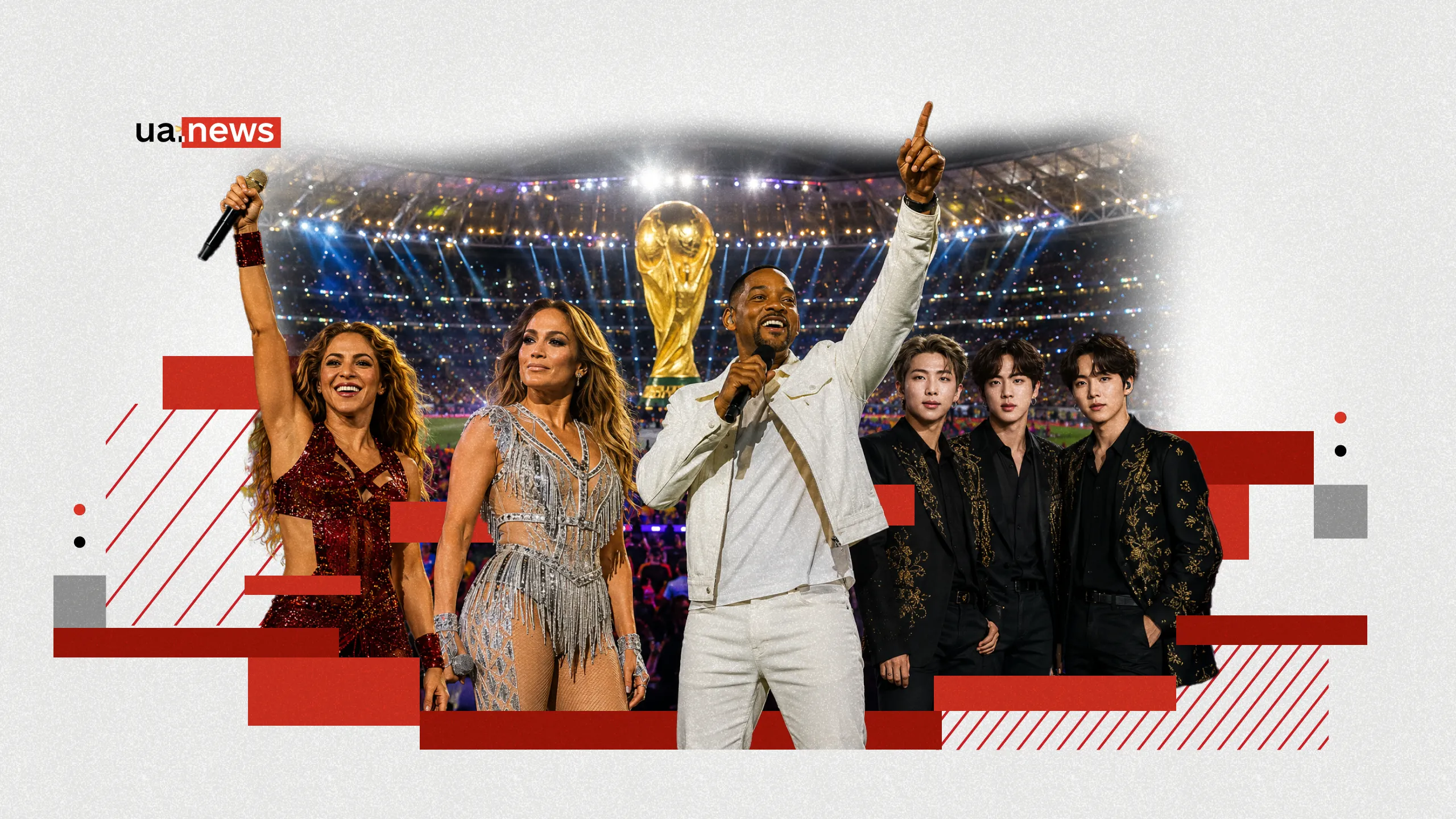
The 2026 World Cup final hasn’t taken place yet, but there’s already just as much discussion surrounding it as there is about the match itself. The reason is not only the battle for the gold medals, but also FIFA’s unprecedented decision to hold a full-scale halftime show during the final for the first time in history, similar to the Super Bowl.
Moreover, the global media is actively discussing the possibility that the traditional 15-minute halftime break could be extended to nearly half an hour to allow all invited artists to perform.
While musical performances at World Cups were previously limited to the opening or closing ceremonies, FIFA is now effectively changing one of soccer’s most conservative traditions.
UA.News explains how music has gradually become an integral part of the World Cup, which of the most famous artists have performed at the world’s premier soccer tournament, and what scandals have accompanied these shows.
Why the 2026 World Cup Final Is Already Being Called Historic
Just a few years ago, the idea of holding a separate halftime show during the World Cup final seemed like science fiction. In soccer, there was an unwritten rule: maximum focus on the game, minimum distractions. That’s why, for decades, FIFA organized large-scale concerts only before the start of a match or after it ended.
However, following the Club World Cup in the U.S., where the format featuring a major musical show received positive feedback from TV broadcasters and sponsors, FIFA decided to take it a step further.
The organization has officially confirmed the first-ever Halftime Show during the World Cup final. It is being produced in collaboration with the charity Global Citizen, and Coldplay frontman Chris Martin has been named the musical curator.
According to the organizers, several global superstars are set to take the stage. Among the announced artists are Shakira, Madonna, BTS, Justin Bieber, Burna Boy, and other performers. The show is expected to be broadcast to a multibillion-person television audience and will be one of the largest musical events of the year.
Precisely because of the large number of artists and the complexity of the production, reports have begun to surface that the traditional 15-minute halftime show may be extended to approximately 30 minutes.
FIFA has not yet released official regulations on this matter, but the discussion itself has already sparked mixed reactions. Some fans are eagerly awaiting the new format, while others fear that soccer is gradually beginning to emulate American sports, where the spectacle often becomes just as important as the game itself.
However, if you take a closer look, it becomes clear that the union of soccer and the global music scene is far from a recent development. In fact, this story began more than two decades ago and, during that time, has given the world dozens of legendary performances, official anthems, and songs that have outlasted the World Cups themselves.
2002 World Cup: The First Step Toward the Modern Format
The first World Cup of the new millennium, co-hosted by Japan and South Korea, was landmark not only because it was the tournament’s debut in Asia. It was then that FIFA began actively promoting the idea of an official musical brand for the tournament.
The official song of the World Cup was “Boom,” performed by American singer Anastacia. The song quickly made its way onto European charts and became one of the first official soccer songs to achieve truly global popularity.
At the same time, the opening ceremony was still quite different from today’s shows. The organizers opted not for a long concert featuring dozens of celebrities, but for a blend of traditional Asian culture, dance performances, and contemporary music. For FIFA, it was an experiment that demonstrated that soccer and the big stage could coexist successfully.
It was after the 2002 World Cup that the organization began to pay increasing attention to the official tournament soundtracks. Since then, nearly every World Cup has had its own theme song, which has become an integral part of the promotional campaign.
2006 World Cup: Germany Raised the Bar Even Higher
Four years later, Germany hosted the World Cup and decided to make the tournament’s opening ceremony much more spectacular. The organizers combined soccer history, modern technology, and performances by international artists, demonstrating that the ceremony could be a world-class event in its own right.
The official song of the tournament was “The Time of Our Lives,” performed by the British quartet Il Divo and American singer Toni Braxton. The song was played at virtually all of the tournament’s official events and quickly became one of the symbols of the German World Cup.
At the same time, the opening ceremony was not limited to just the artists’ performances. A large-scale theatrical spectacle unfolded on the field of the stadium in Munich, featuring hundreds of dancers, musicians, drummers, and representatives of various cultures from around the world. Special attention was paid to the history of soccer and the legends of the World Cup.
It was after the tournament in Germany that it became clear that the musical component was no longer a secondary element. FIFA increasingly relied on popular artists to promote the tournament, and official songs began racking up hundreds of millions of streams.
However, the real breakthrough didn’t happen until four years later. In 2010, one song exceeded all expectations to such an extent that many people remember it even better than the World Cup final itself.
2010 World Cup: How Shakira Created the Biggest Soccer Hit of the 21st Century
While previous official World Cup songs were successful primarily among soccer fans, in 2010 FIFA managed to achieve what no one had ever done before. The song “Waka Waka (This Time for Africa)” became a global musical phenomenon that has long transcended the world of soccer.
The World Cup in South Africa was historic in its own right—it was the first time the tournament had been held on the African continent. The organizers faced a difficult task: to showcase modern Africa—its culture, rhythms, and traditions—to the world, while also creating a song that would resonate with billions of people. They chose Colombian singer Shakira, who was already considered one of the world’s biggest pop stars at the time.
The South African band Freshlyground also participated in the recording of the song, giving it a distinctive African sound.
“Waka Waka” premiered shortly before the tournament began, but it really exploded in popularity during the World Cup itself. The song was played in stadiums, on TV broadcasts, in fan zones, and in advertising campaigns around the world.
The music video, featuring footage of soccer legends and the excitement of fans, quickly racked up hundreds of millions of views and eventually surpassed the mark of several billion.
Today, “Waka Waka” remains the most popular official song in the history of the World Cup. It is still used during soccer broadcasts, sporting events, and even amateur tournaments. For many fans, this song has become the musical symbol of soccer, even though more than a decade and a half has passed since its premiere.
However, it wasn’t without controversy. Some critics reproached FIFA for having the official song of the first African World Cup performed not by a local artist, but by an international celebrity from Latin America. Further debate arose over the song’s use of motifs from the Cameroonian song “Zangalewa,” although the original song’s authors later confirmed that they had granted permission for such use.
2014 World Cup: Brazil, Jennifer Lopez, and the First Serious Complaints About the Show
After South Africa’s triumph, expectations for the World Cup in Brazil were extremely high. A country associated with carnivals, samba, and music seemed like the perfect setting for a new, spectacular show.
The official song of the tournament was “We Are One (Ole Ola),” performed by Pitbull, Jennifer Lopez, and Brazilian singer Claudia Leitte. The song was presented at the opening ceremony before the first match of the World Cup.
Despite the star-studded lineup of performers, it failed to replicate the phenomenon of “Waka Waka.” The song garnered millions of streams but did not become as much of a cultural phenomenon as Shakira’s hit. Many music critics called the song too “commercial” and felt it failed to capture the true spirit of Brazil.
The opening ceremony itself sparked just as much controversy. Some Brazilians felt that the organizers did not sufficiently showcase the richness of local culture, and that the emphasis on international pop stars pushed national traditions into the background.
Against the backdrop of mass protests against the enormous costs of hosting the World Cup, criticism of the musical show only intensified.
However, for FIFA, this tournament served as yet another confirmation: big names remain one of the main tools for promoting the World Cup. Just four years later, the organization once again invited global celebrities, but this time it opted for a completely different style and a new audience.
2018 World Cup: Will Smith, Nicky Jam, and a Focus on Global Pop Culture
The 2018 World Cup in Russia took place amid challenging political conditions. Following the annexation of Crimea and the deterioration of relations between Russia and the West, the global media’s attention was focused not only on soccer but also on the reputational risks surrounding the tournament. Despite this, FIFA decided not to deviate from its usual formula: a major championship must be accompanied by great music.
The official World Cup song was “Live It Up,” recorded by American actor and rapper Will Smith, one of the most famous Latin American artists, Nicky Jam, and Albanian singer Era Istrefi. The song was unveiled on the eve of the final, and the artists themselves performed at Moscow’s Luzhniki Stadium before the decisive match between France and Croatia.
Unlike previous World Cups, FIFA opted not for a single megastar performer but for a mix of different musical styles. Latin American rhythms, pop music, and hip-hop were meant to highlight the global nature of the World Cup, which was watched in virtually every country.
However, it was not possible to replicate the success of “Waka Waka.” Despite tens of millions of views and streams, “Live It Up” did not become as recognizable among fans. Some critics noted that the song was “too generic” and lacked the emotional connection to the tournament itself that had made Shakira’s song a cult classic.
At the same time, the World Cup in Russia demonstrated that musical performances have now become an integral part of the World Cup’s television coverage. The opening and closing ceremonies drew hundreds of millions of viewers, and clips from the concerts garnered a massive audience on YouTube and social media.
For FIFA, this provided yet another reason to further develop the entertainment program.
2022 World Cup: Qatar, BTS, and the Most Controversial World Cup in Music
While Russia hosted the tournament amid difficult political conditions, the 2022 World Cup in Qatar became one of the most scandal-ridden in history even before it began. Human rights organizations have for years criticized the country over the treatment of migrant workers and restrictions on the rights of women and members of the LGBTQ+ community.
As a result, any cultural event held as part of the tournament automatically found itself in the global media spotlight.
Despite the criticism, FIFA did not back down from its large-scale concert program. The highlight of the opening ceremony was the performance by Jung Kook—a member of the world-famous band BTS—who performed the tournament’s official song, “Dreamers,” alongside Qatari singer Fahad Al-Kubaisi.
The performance instantly became one of the top trending topics on social media. For millions of BTS fans, it was a historic moment, but not everyone viewed it positively. Some fans of the South Korean group criticized Jung Kook’s participation in the ceremony, stating that the artist should not have supported a tournament surrounded by so much controversy.
Criticism was also directed at other artists. Some musicians openly refused to participate in events related to the World Cup, citing human rights concerns. Others, on the contrary, emphasized that sports should unite people regardless of politics.
Despite all the debate, the opening ceremony in Qatar set records for online views, and “Dreamers” quickly topped the music charts in many countries. For FIFA, this was further confirmation that the modern World Cup has long been not only a sporting event but also a cultural phenomenon on a global scale.
However, the more popular the musical performances became, the more controversy they generated. Some were dissatisfied with the choice of artists, others with the use of pre-recorded tracks, and still others were convinced that soccer was gradually giving way to show business. It is precisely these debates that have largely led to the mixed reaction to FIFA’s decision to hold a full-scale halftime show during the 2026 World Cup final.
Why music shows are almost always accompanied by scandals
The larger the World Cups became, the more attention was drawn not only to the matches but also to everything happening around them. While in the early 2000s the main topic of discussion was the official songs, the focus later shifted to the performers themselves—their political views, fees, costumes, and even the length of their performances.
One of the most common complaints is that FIFA is increasingly relying on global pop stars rather than artists from the host country. Such criticism was already being voiced during the 2010 World Cup in South Africa, when Shakira performed the official song.
Similar debates arose in Brazil in 2014, where some local musicians felt that international performers had effectively “overshadowed” national culture.
Another topic that regularly resurfaces during every World Cup is the use of pre-recorded vocals. Due to the complexity of television broadcasts, tight time constraints, and the technical characteristics of the stadiums, organizers often use pre-recorded vocals or individual backing tracks.
As a result, after every opening ceremony, discussions arise on social media about whether the performance was entirely “live.”
The commercialization of soccer remains a separate issue. Whereas music used to be merely a backdrop for the sporting event, it has now become one of FIFA’s key marketing tools.
Official songs rack up hundreds of millions of streams on streaming services, concert performances generate television rights revenue, and major brands use them in advertising campaigns.
That is precisely why the news of a possible extension of the halftime break in the 2026 World Cup final has sparked such a mixed reaction. For supporters of the new format, this is a logical evolution of the tournament, which must remain the largest sporting event on the planet.
For critics, it’s another step toward soccer increasingly resembling an American sports spectacle.
What Bookmakers and Analytical Models Are Predicting Ahead of the 2026 World Cup Final
Although the final is traditionally considered the most unpredictable match of any World Cup, most bookmakers and statistical models still see a clear favorite.
According to the 2026 World Cup Odds aggregator, which compares estimates from the Opta Supercomputer, the Kalshi prediction market, and Polymarket, the Spanish national team heads into the final with a 56–58% chance of winning. Analysts estimate their opponent’s chances of winning the title at approximately 42–44%.
Prediction markets offer a similar assessment. Specifically, according to Polymarket data aggregated by soccer analyst Neil Payne, immediately before the final, Spain had about a 58% chance of becoming world champions, while its opponent had about a 42% chance.
Statistical models attribute this advantage not only to the quality of play but also to the numbers. Spain reached the final having conceded only one goal in seven matches, keeping six clean sheets and never having to play extra time.
The team’s physical freshness and the tournament’s best defense are the main arguments in its favor. At the same time, their opponent has repeatedly demonstrated the ability to come back during matches, so even a 42 percent probability means that they win in about four out of ten simulations of the final.


