
HD Hyundai tests uncrewed vessel off Long Beach — Korea Herald
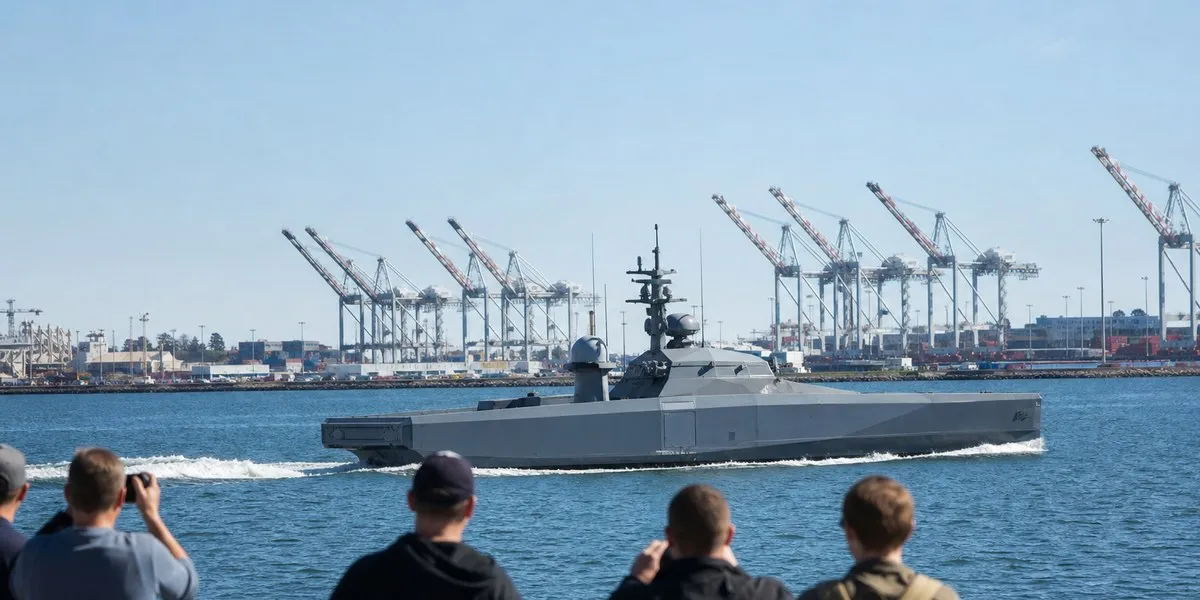
South Korean shipbuilding company HD Hyundai tested the autonomous capabilities of an uncrewed surface vessel off Long Beach, California, United States. The demonstration was conducted jointly with U.S. defense technology company Anduril Industries, Korea Herald reports.
According to HD Hyundai, this was the first demonstration of its kind conducted by a South Korean company in U.S. waters. The event was attended by about 40 representatives of the U.S. Navy and Coast Guard, the American Bureau of Shipping, the South Korean Navy and South Korea’s Defense Acquisition Program Administration, as well as executives from HD Hyundai and Anduril.
Autonomous operation scenarios
The demonstration lasted three and a half hours. The vessel carried out simulated scenarios involving autonomous navigation, mission reassignment, formation operations and responses to engine malfunctions. The test was controlled from a shore-based center, where participants monitored the system’s decisions and mission execution in real time.
More current news is available on the UA.News Telegram channel Telegram.
A modified 368-ton uncrewed vessel previously operated by the U.S. Navy was used for the test. It was fitted with VAone software for autonomous control of military vessels from HD Korea Shipbuilding & Offshore Engineering and Anduril’s Lattice platform, which uses artificial intelligence to manage autonomous missions.
Combining two systems
VAone combines HiNAS Prime autonomous navigation technology, developed by HD Hyundai subsidiary Avikus, with systems for monitoring equipment condition, detecting malfunctions and automatically responding to failures. The software also includes functions for autonomous damage detection and response.
HD Hyundai said the combination of VAone and Lattice demonstrated the possibility of creating an uncrewed vessel that autonomously controls navigation, engine operations, damage control and weapons. The company plans to use the demonstrated technologies to participate in U.S. Navy programs for uncrewed surface vessels and in the global market for autonomous platforms.




