
China plans to launch the Chang’e-7 mission to the Moon’s south pole
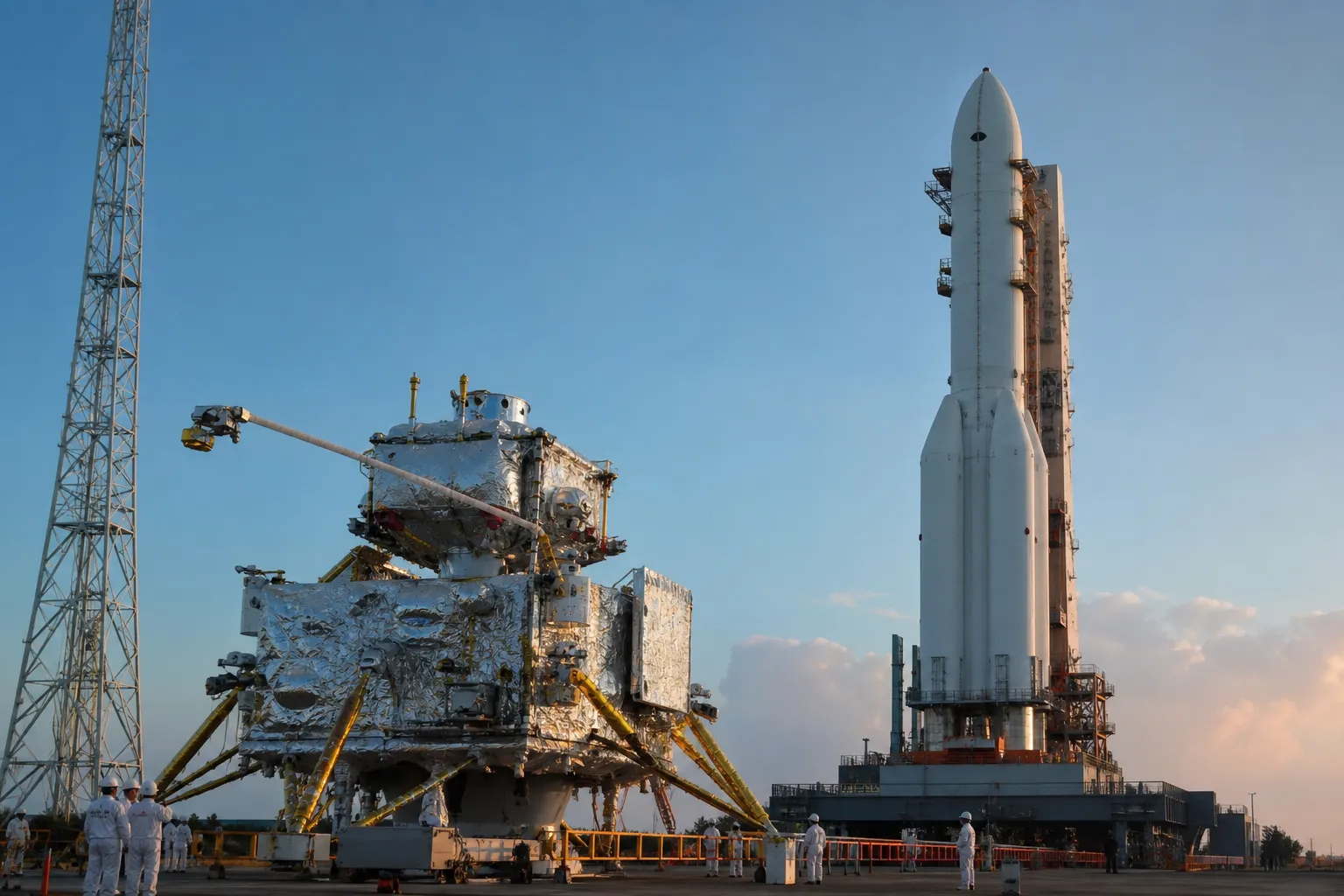
China plans to launch the Chang’e-7 unmanned lunar mission on August 24, Beijing time, using a Long March 5 Y14 launch vehicle from the Wenchang Space Launch Site. The mission consists of an orbiter, a lander, a rover, and a hopper. The lander is scheduled to touch down near the rim of the Shackleton crater in the region of the Moon’s south pole, according to Space.com.
After launch, the orbiter will operate in lunar orbit for several months and is scheduled to separate the lander at the end of the year to attempt a landing. The mission will study the environment and resources of the south polar region and is also intended to support preparations for China’s first crewed lunar landing, which is planned for 2030.
After separating from the lander, the rover is expected to move between sunlit areas and shadowed craters in search of water ice deposits. For landings on slopes, it will use active shock absorption technology. The landing module is also expected to feature China’s first image-based navigation system for deep space.
For more breaking news, follow the UA.News Telegram channel.
James Ged, a professor of geological sciences at Brown University, called Chang’e-7 the most ambitious, comprehensive, and complex robotic lunar mission ever attempted. The next Chinese mission, Chang’e-8, scheduled for launch around 2028, is set to test technologies for constructing habitation modules from lunar soil. Both projects are linked to plans for establishing an International Lunar Research Station.
Chang’e-7 will also carry instruments from international partners. Among them are a Russian instrument for detecting lunar dust and measuring plasma parameters, an Italian laser retroreflector, the LunaHcam camera, developed by the space agencies of Bahrain and Egypt; the Thai-Chinese MATCH instrument for studying high-energy particles; and a Swiss dual-channel Earth radiation spectrometer. The lander will carry the ILO-C wide-angle optical telescope, developed by ILOA Hawaii and the Space Research Laboratory at the University of Hong Kong.




