
Chinese scientists develop fuel cell with fourfold higher power
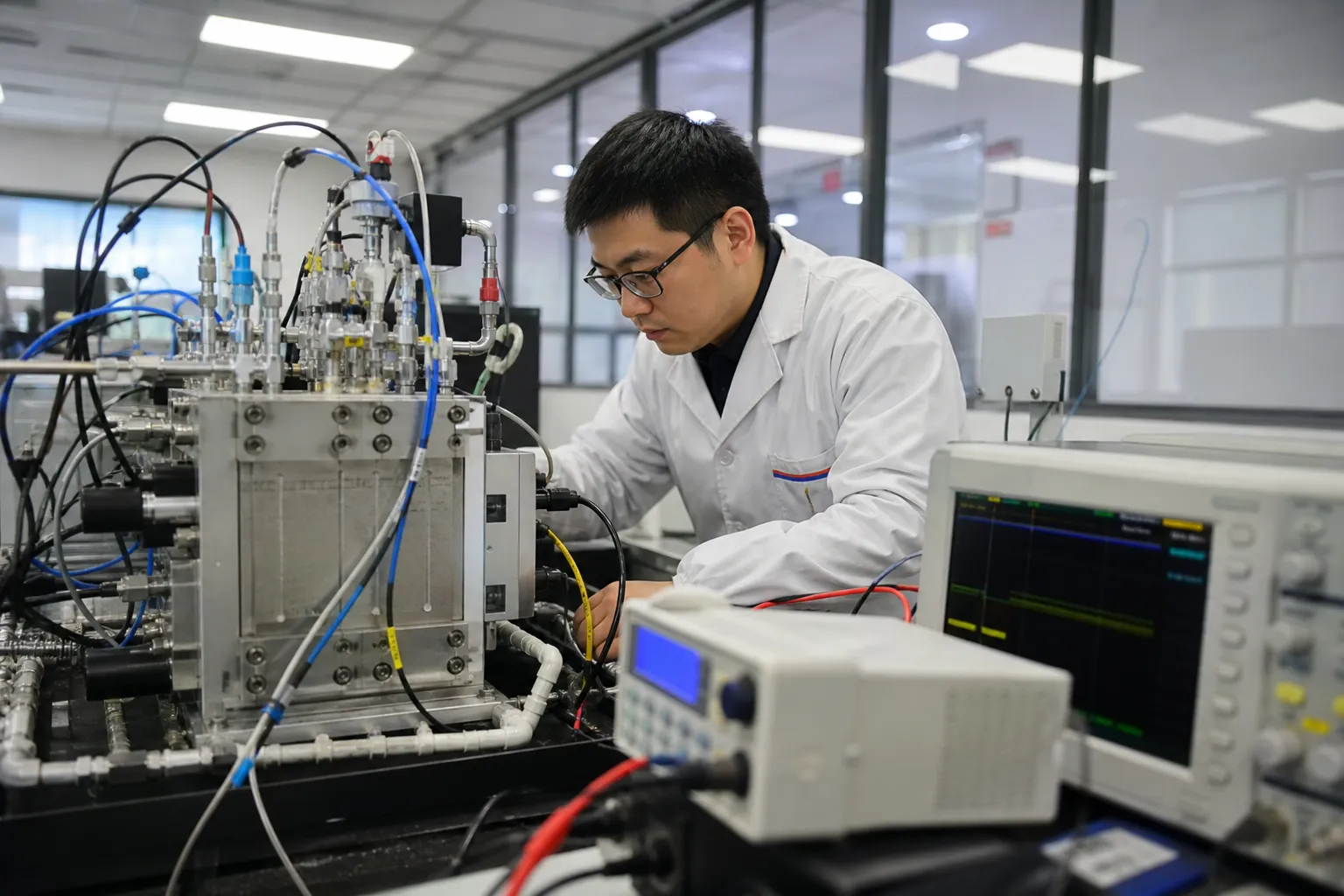
Scientists at the Beijing Institute of Technology in China have developed a hydrogen fuel cell design that, under standard operating conditions, delivered four times higher power than conventional systems. The South China Morning Post reports on the findings of the study, published in the peer-reviewed journal Science.
Accelerating proton movement
The development concerns proton-exchange membrane fuel cells, which are already used in hydrogen vehicles. In such devices, the chemical energy of hydrogen is converted into electricity, while water is the product of the reaction. One of the key limitations is the speed at which protons move within the catalytic layer, where chemical reactions take place.
The team created a Brønsted acid–Lewis base interface. Under this approach, protons move to the catalyst surface not directly, but through intermediate sites. Laboratory tests showed that proton diffusion increased tenfold, proton conductivity rose by 6.5 times, and activation energy was reduced by more than half.
More current news is available on the UA.News Telegram channel Telegram.
Power and durability
The new cell achieved a power output of 0.75 watts per square centimetre at a voltage of 0.7 volts, using a small amount of platinum, an expensive catalyst commonly used in hydrogen fuel cells. Calculated per mass of platinum, the device delivered 6.9 kilowatts of power per gram of metal, exceeding the performance of modern fuel cells, the publication notes.
After 30,000 operating cycles, the design retained 63% of its initial peak power. For conventional systems, this figure was 30%. The researchers believe the technology could be useful for complex tasks, including space missions using liquid oxygen.
At the same time, the technology still needs to be tested outside the laboratory: researchers must demonstrate the feasibility of its industrial production, affordable cost, as well as long-term safety and reliability.




