
Model explains Venus’s lower haze as cosmic dust — Ars Technica
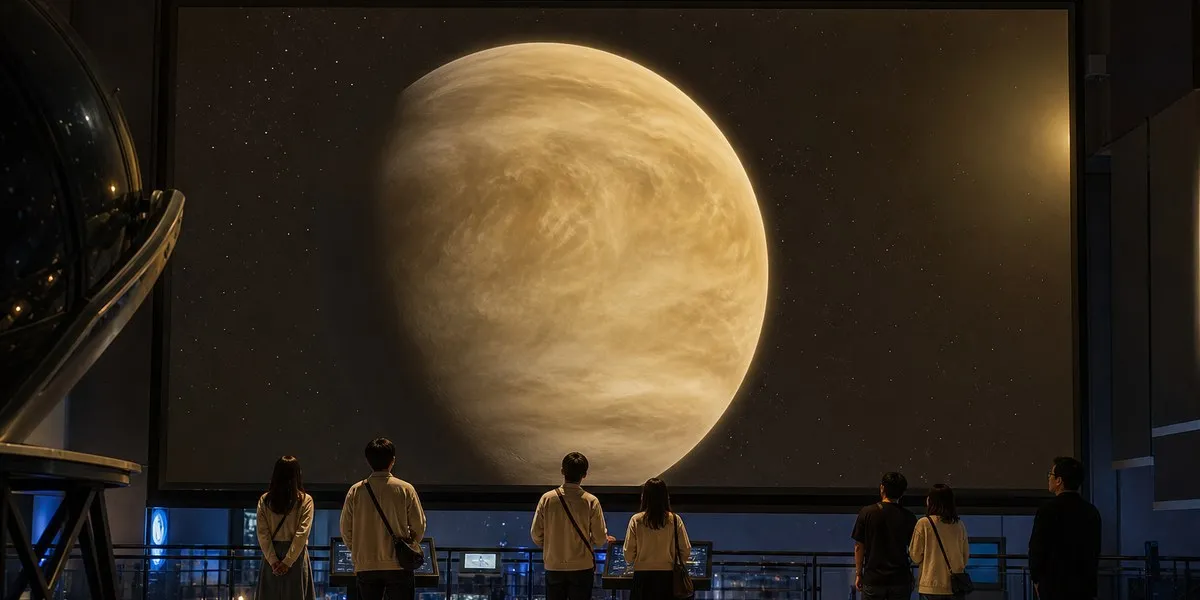
A research team led by planetary scientist Hiroki Karyu of Tohoku University in Japan has created a microphysical model explaining the origin of Venus’s yellowish lower haze. According to the results, it is formed by particles of cosmic dust left behind after meteorites burn up in the Venusian atmosphere, Ars Technica reports.
The lower haze in the planet’s atmosphere was first detected by the Venera and Pioneer Venus spacecraft in the 1970s. For a long time, volcanic ash was considered one possible explanation, but modeling showed that neither volcanic nor surface dust would interact with atmospheric components in a way that could form the observed particle layer.
Sulfuric acid condensation
When meteoroids pass through Venus’s atmosphere, they heat up due to collisions with gas particles and leave cosmic dust behind. Drops of sulfuric acid condense on the surface of these particles, similarly to how water vapor condenses on aerosols during cloud formation on Earth.
According to the scientists’ calculations, dust particles may stick together into larger clusters even before acid condensation. Such particles become heavier and descend into lower, hotter layers of the atmosphere, where temperatures can reach 100 °C. There, sulfuric acid evaporates, while the exposed dust particles remain and form the haze.
More current news is available on the UA.News Telegram channel Telegram.
A possible explanation for ultraviolet absorption
The model also links the haze to a long-standing mystery concerning a substance that absorbs ultraviolet radiation in Venus’s atmosphere. Meteorites contain magnesium, silicon, and iron, but iron compounds proved to be promising ultraviolet absorbers. Data from the Venera and Vega missions had previously indicated the presence of iron in the atmosphere, while the Pioneer Venus Large Probe mass spectrometer detected iron sulfate.
The researchers found that the properties of iron sulfate match the characteristics of the haze. At an altitude of about 40–50 km above Venus’s surface, sulfuric acid droplets cannot attach to particles because of a nucleation barrier. Rising hot currents carry such particles to the upper cloud layer, where they cool and can become part of sulfuric acid particles.
The authors of the study, published in Nature Astronomy, believe that cosmic dust is an important component of planetary climate. Similar processes may help study the formation of clouds and haze on Jupiter, Saturn, Neptune, and exoplanets.




