
Astronomers record gamma-ray burst with 27 days of activity — Space.com
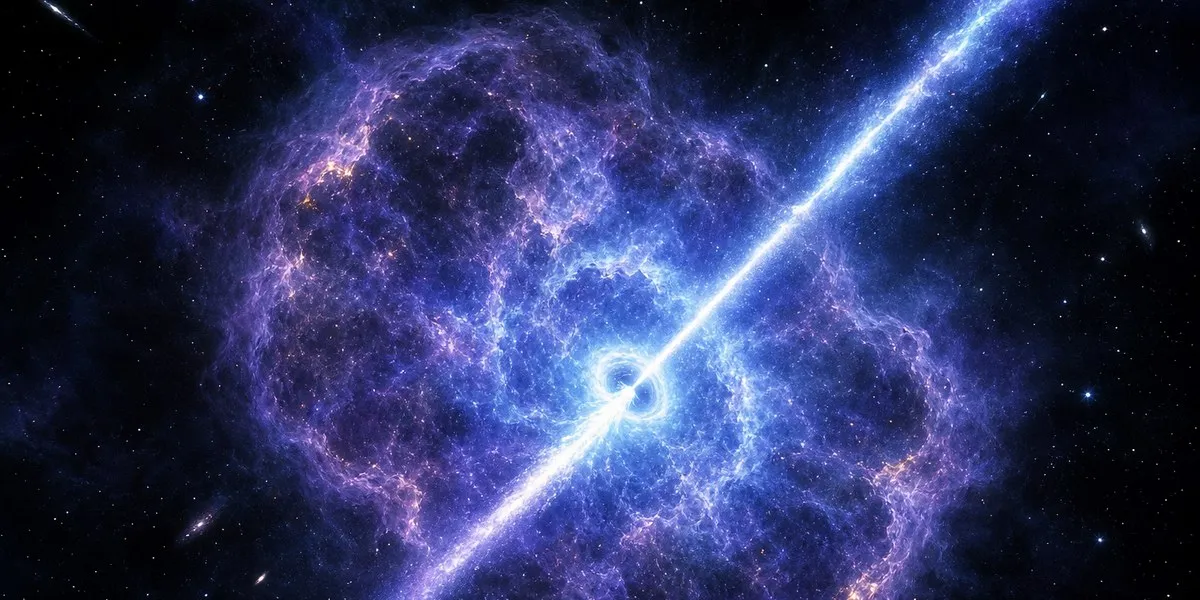
Astronomers have detected the ultra-long gamma-ray burst GRB 220706A, whose X-ray flares lasted for about 27 days after the initial explosion. This is approximately 20 days longer than the previous record for delayed X-ray flares, Space.com reports.
GRB 220706A was recorded on July 6, 2022. According to study participant Benjamin Gompertz, an astrophysicist at the University of Birmingham, X-ray flares after gamma-ray bursts are common, but they had previously been observed only during the first few days. In the GRB's own reference frame, the activity lasted about 27 days, while the previous record for a delayed flare was around six days.
Unknown energy source
GRB 220706A belongs to a rare class of ultra-long gamma-ray bursts whose energy source remains unexplained. Researchers also observed a supernova associated with this event. The collapse of a massive star is usually linked to long gamma-ray bursts, but it alone does not explain either the very late X-ray activity or the supernova's unusual brightness.
More current news is available on the UA.News Telegram channel Telegram.
One possible explanation is the formation of a magnetar, a neutron star with an exceptionally powerful magnetic field. This version is supported by the similarity of the supernova to an event associated with another ultra-long gamma-ray burst, GRB 111209A, recorded in 2011. Another hypothesis suggests an interaction between the gamma-ray burst jet and the supernova with dense shells of matter that the star may have ejected near the end of its life.
Possible role of a large star
Gompertz also suggested that the source of such a prolonged burst could have been a star considerably larger than those usually associated with gamma-ray bursts. According to the team's estimate, a blue supergiant star with a radius of approximately 1,000 solar radii could have been needed to power GRB 220706A.
Scientists note that ultra-long gamma-ray bursts are difficult to detect because satellites in low Earth orbit periodically lose the object from their field of view. Such events are likely more active in the X-ray rather than gamma-ray range. The team's study has been published on the arXiv platform and has not yet undergone peer review.




