
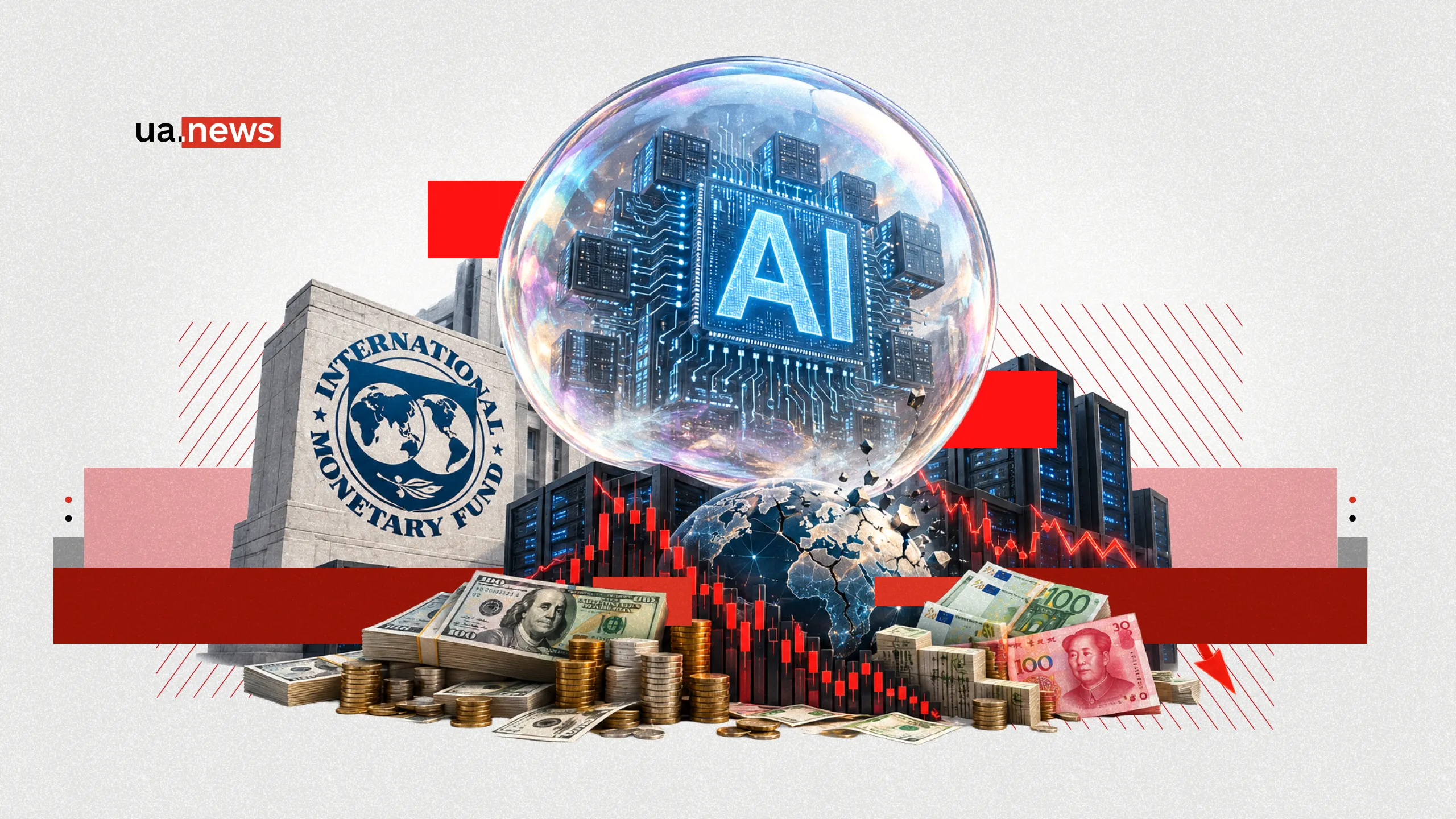
The IMF has warned of the risk of an AI bubble: what will happen to the global economy if the investments don't pay off
22 October 2026 14:34The global economy is increasingly dependent on investments in artificial intelligence, which support business activity, stock markets, and the profits of technology companies. At the same time, the International Monetary Fund warns that if expectations regarding AI profitability are not met, an asset revaluation could trigger a massive crash in financial markets. These risks are exacerbated by rising debt financing, the interdependence of technology companies, and the concentration of capital among a small number of players.
In its October World Economic Outlook, the IMF forecasts a slowdown in global growth to 3.1% in 2026, followed by a recovery to 3.4% in 2027. The Fund cites the technology boom—largely driven by AI—as one of the factors supporting economic activity. However, this same boom could become a source of problems if investments in infrastructure and technology development grow faster than the actual economic returns they generate.
UA.News explains why the IMF is concerned about a possible overheating of the AI market, what is driving the investment boom, which companies and countries may be the first to suffer, and why a potential stock market correction does not necessarily have to escalate into a new global financial crisis.
Why the IMF Is Warning About the Risk of an AI Bubble

In its report on global financial stability, the IMF identified three key risks to global financial markets: a potential correction in AI-related assets, a sharp rise in government bond yields, and cyber threats. In the case of AI, the main concern lies not in the technology itself, but in how sustainable the money invested in it and the expected returns will prove to be.
The Fund notes that financial markets are currently showing resilience thanks to economic growth, strong corporate earnings, and optimism about new technologies. However, high company valuations could change rapidly if investors decide that future returns from AI will be lower or come later than expected.
During the presentation of the report, Athanasios Vamvakidis, Deputy Director of the IMF’s Monetary and Capital Markets Department, articulated this contradiction as follows: “Global financial markets have weathered numerous shocks and very high uncertainty surprisingly well—largely thanks to positive growth surprises, strong corporate earnings, and optimism about AI.” At the same time, he cautioned: “Resilience is not the same as safety.”
This is an important distinction. The IMF does not claim that a collapse of the AI market is inevitable, nor does it deny the technology’s potential benefits. The Fund highlights another issue: even a promising technology can become the basis for a financial bubble if asset prices and investment volumes outpace actual business performance.
How the AI boom became one of the drivers of the global economy

The current wave of investment in AI involves more than just money from venture capital funds and tech startups. It encompasses the construction of data centers, the purchase of graphics processing units, semiconductor manufacturing, network deployment, energy infrastructure, and software development. Large companies are investing in computing power, hoping to sell new services, automate work, and increase productivity.
These investments generate economic benefits even before all the expected advantages of AI become a reality. When a company orders servers, it supports chip manufacturers; when it builds a data center, it creates demand for construction work, electricity, cooling, and equipment. Suppliers generate revenue, hire employees, and invest in their own expansion. This creates a cycle in which the investment demand of one group of companies becomes revenue for another.
Silvana Tenreiro, the IMF’s chief economist and director of the Research Department, explained during the presentation of the October forecast that the global economy is simultaneously influenced by two opposing factors. The war in the Middle East and rising energy prices are creating a negative supply shock, while the technology boom—primarily driven by AI—is stimulating demand, prices, trade, and investment.
That is why the fund views AI not merely as a separate technology sector, but as a factor influencing the overall dynamics of global GDP. If infrastructure spending drops sharply, the economic consequences will be felt not only by model developers. Chip manufacturers, construction companies, electricity suppliers, and other participants in the technology supply chain will receive fewer orders.
At the same time, this model has a fundamental vulnerability: spending on AI infrastructure is already supporting economic activity, while the full scale of future returns remains uncertain. If the technology truly boosts productivity and helps companies earn more, current investments may pay off. If, however, profits turn out to be lower than forecast, cost cuts could send a negative shockwave through the entire economy.
What’s Fueling the Bubble: Money, Debt, and Mutual Obligations
One of the biggest problems highlighted by the IMF is not simply the scale of investment, but how it is financed. At the start of the investment boom, companies with large cash reserves and stable revenues from their core businesses played a significant role. However, the demand for computing power is growing, and building infrastructure requires ever-larger sums.
According to the Fund’s estimates, the share of the largest technology companies—the so-called hyperscalers — in global investment-grade corporate bond issuances has risen from less than 1% to 10% since the active ramp-up of AI investments began in 2024. At the same time, the free cash flow of some large companies is shrinking due to significant infrastructure development costs, making debt financing more important.

This does not mean that large technology companies have already lost their financial stability. The IMF emphasizes that the industry’s major players continue to post strong profits. But if companies continue to spend money faster than their revenues are growing, they will become more sensitive to borrowing costs, demand for computing power, and investor sentiment.
The situation is even more challenging for smaller computing service providers that build data centers and lease out capacity. Some of these companies have a higher debt burden and lower profitability than the tech giants. For them, a drop in service prices or customers canceling planned orders could deal a much more severe blow.
The IMF also highlights the financial ties among players in the AI market. According to the report, 14 publicly disclosed deals since 2023 involved approximately $300 billion in total equity investments by major tech players in less financially stable companies, supplemented by about $650 billion in debt financing. In return, the parties assumed future revenue commitments totaling about $1.4 trillion—specifically, through chip orders and the use of cloud services.
Such agreements can be entirely rational if demand truly grows. Large companies provide financing to their partners and, in return, gain access to the necessary capacity and future services. But this arrangement also creates interdependence: one company invests in another and spends money on equipment or infrastructure, while the investor expects to eventually become a customer of its services.
If these expectations are met, all participants can benefit. However, if a key project fails to attract customers or generate the planned revenue, the value of the investment may plummet as the prospects for future contracts deteriorate. It is precisely these interconnections that can exacerbate a crisis: financial losses in one segment spread to partners, creditors, and suppliers.
Is This Really a New Dot-Com Bubble?

Comparing the current AI boom to the internet bubble of the late 1990s has become a central theme in the discussion of technology investments. Back then, investors poured money into internet-related companies, anticipating rapid growth in the digital economy. Some business models proved unsustainable, and the crash of tech stocks in the early 2000s wiped out significant market value.
The similarity lies in the fact that, both then and now, the market values not only current profits but also the future potential of new technology. However, there are also differences between the two periods. Today, the AI sector is led by large corporations with established businesses, substantial revenues, and real customers. Therefore, the mere fact of high valuations or massive investments does not in itself prove that the entire market is a bubble.
In 2025, IMF Chief Economist Pierre-Olivier Gourincha explained to Reuters that the current investment boom could end with a correction similar to the one experienced by internet companies. At the same time, he pointed out that a significant portion of the spending is financed by the tech companies’ own funds, rather than exclusively through loans.
“This is not debt-financed, which means that in the event of a market correction, some shareholders and equity holders may suffer,” he noted.
This conclusion is important, but the situation has changed: in a more recent report from October 2026, the IMF specifically highlights the growth of debt financing and the interdependence of participants in the AI ecosystem. In other words, the risk is not limited to a possible drop in stock prices. If the debt burden continues to grow, a market correction could make it harder for some companies to service their debts and access new capital.
It is telling that even the leaders of financial and technology companies assess the scale of the danger differently. BlackRock CEO Larry Fink warned that halting the construction of data centers could hurt economic activity.
“If some kind of moratorium is imposed in this country, we’ll end up in a recession,” he said, explaining just how significant the contribution of infrastructure investment has become.
What will happen if the investment boom begins to fade?
The most likely scenario is not necessarily the sudden bankruptcy of the largest tech companies. A correction could begin much earlier: investors might decide that future AI-driven revenues do not justify current valuations, stock prices would fall, and companies would revise their infrastructure budgets. A chain reaction would then follow.

The first to suffer may be companies whose business models depend most heavily on a steady influx of capital and rapid growth in demand. If investors begin demanding faster returns on their investments, new data center operators and less profitable computing power providers will find it harder to secure financing. Some projects may be postponed, scaled back, or canceled.
Equipment manufacturers, electricity providers, construction companies, and other businesses that were counting on sustained expansion of AI infrastructure will feel the next blow. If orders decline, they may lose revenue, revise their hiring plans, and cut back on investments. For regions where data center construction has become a major source of economic activity, this will mean fewer new jobs and less tax revenue.
At the same time, the decline in tech stocks could affect investors, pension funds, and households that hold these assets directly or through investment products. When portfolio values decline, people may cut back on spending, and companies may become more cautious about expanding their businesses. This is how a financial correction spreads from the stock markets to the real economy.
The most dangerous scenario would be a combination of falling asset prices and high debt burdens. Companies that have borrowed against future earnings may face problems precisely when lenders and investors become more cautious. If such difficulties arise simultaneously among many interconnected companies, they can reinforce one another.
Who Will Be Hit the Hardest
The United States is likely to bear the brunt of a sharp market correction, as it is home to a significant portion of leading AI developers, major cloud platforms, and capital invested in technology companies. Falling stock prices could reduce the value of investors’ assets, while cuts in infrastructure spending could weaken demand for chips, servers, and energy capacity.
However, the consequences will not be limited to the U.S. market. The production of semiconductors, electronics, and data center equipment is concentrated within international supply chains. Therefore, Asian economies—which fuel the tech boom with components and manufacturing capacity—may also experience a decline in orders.

According to the IMF, Asia’s developed stock markets—which are particularly sensitive to fluctuations in the value of global technology companies—may prove to be the most vulnerable to a correction in AI stocks. The eurozone, the United Kingdom, and most emerging markets, on average, are less directly exposed to such a scenario. However, this does not guarantee them protection: due to international investment portfolios and financial market linkages, losses could spread to countries with a smaller share of the technology sector.
For countries that do not derive significant revenue from chip manufacturing, AI development, or data center construction, the risk may manifest differently. If global growth slows, companies will cut back on investment, demand for goods and services will weaken, and governments will find it harder to finance social programs and infrastructure development. Economies with high public debt, expensive borrowing, or limited financial reserves may be particularly vulnerable.
Why Ordinary Consumers May Also Feel the Impact
At first glance, the decline in tech stocks may seem like a problem for stock markets and large investors. But the AI boom affects the broader economy through jobs, investment, consumer spending, and the cost of financing.
If companies begin to scale back projects, this will affect the demand for workers in the tech sector, construction, energy, and equipment manufacturing. Lower profits and poorer prospects may prompt businesses to postpone opening offices, launching new products, or modernizing production. As a result, even companies that do not work directly with artificial intelligence will feel the slowdown.

Another channel of impact is lending. If financial institutions and investors become more cautious following a market downturn, raising capital could become more expensive not only for tech startups but also for other companies. This could curb investment and job creation.
At the same time, there is also an opposite scenario. If AI truly boosts productivity, reduces costs, and helps create new products and services, its economic benefits could prove significant even after a correction in market valuations. That is why it is important to distinguish between a potential drop in stock prices and a failure of the technology itself.
What the IMF Proposes and Whether a Crisis Can Be Avoided
The IMF is calling on regulators to monitor more closely the debt burden within the AI ecosystem, the interdependence of companies, and the risks arising from excessive reliance on borrowed funds for investments in financial assets. Among the possible tools, the Fund cites tighter controls on margin lending, risky exchange-traded products, and other mechanisms that could exacerbate a market downturn in the event of a sharp shift in sentiment.
Separately, the fund warns of other threats to financial stability: high public debt, a potential rise in bond yields, and cyber risks. If several of these problems arise simultaneously, they could exacerbate one another. For example, rising costs of government borrowing could worsen financial conditions for businesses just when tech companies need additional capital.

At the same time, the IMF is not calling for a halt to investments in AI. Its warnings primarily concern financial risks and the system’s ability to withstand potential shocks. For investors, this means the need to assess not only the technology’s prospects but also actual revenues, debt, and companies’ ability to turn costs into profits.
The key question is whether the economic returns from AI will catch up with the amount of capital invested. If companies can boost productivity, generate sustainable demand, and ensure profitability, the current boom could lay the foundation for sustained technological growth. If, however, the market overestimates the speed and scale of these changes, the correction could be painful even without the bankruptcy of the largest players.




