
NASA has discovered a new material that can withstand the extreme conditions of space
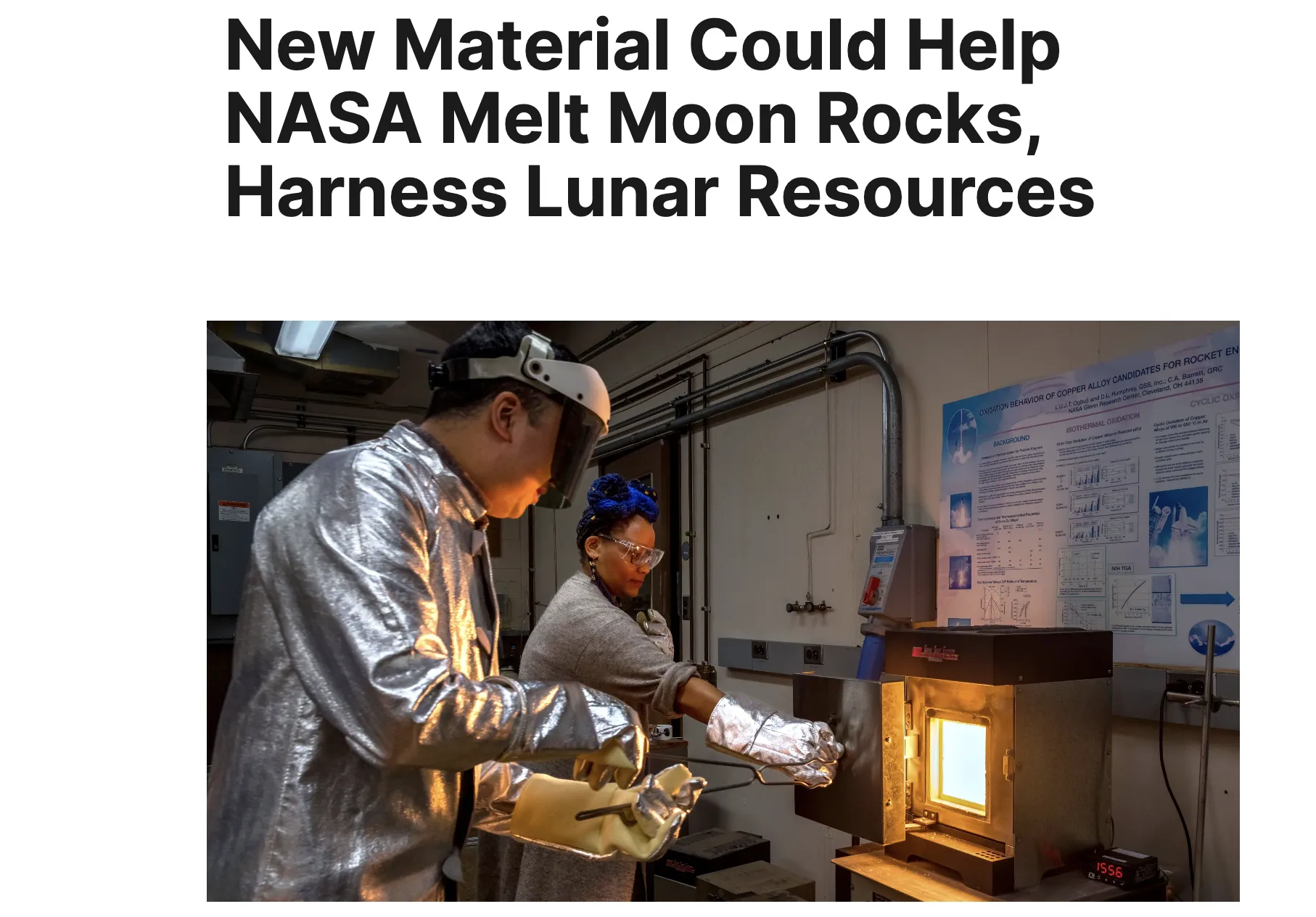
NASA scientists have announced the discovery of a new substance that exhibits high resistance to extreme conditions. According to the researchers, the material is not listed among the more than one million known compounds in X-ray databases and has the potential to withstand exposure to molten lunar soil, making it a promising candidate for future space missions.
The substance can withstand contact with molten lunar soil, exhibits high corrosion resistance, and is significantly cheaper than platinum, which is typically used in high-temperature processes. The material is based on scandium oxide, which, while not cheap, is significantly more affordable than precious metals.
Materials scientists James Stokes from NASA’s Glenn Research Center and technologist Kevin Yu from the Jet Propulsion Laboratory spent six months studying how various substances react to molten lunar dust. During one of the experiments, they mixed this dust with scandium oxide and fired the mixture in a furnace. The resulting substance did not match any known entry in the databases—it was a new compound.
Since the material’s properties were unknown, the team started their research from scratch. They combined eight basic oxide components, ground them in ethyl alcohol, and sintered them at a temperature exceeding 1590 °C. The powder changed color from pink—which the researchers compared to “strawberry milk”—to beige, indicating that the reaction was complete.
Potentially, the material could be used on the Moon to create pipes and tanks in rock processing systems, helping to extract metals, oxygen, and fuel components directly on site. On Earth, it could also find use as a lighter and more efficient thermal insulator, particularly in coatings for jet engine blades.
Researchers plan to further refine and reduce the cost of production, and it is quite likely that Earth-based applications will emerge before lunar ones.
Previously, the Japanese Hayabusa-2 probe delivered organic compounds from the asteroid Ryugu. And NASA researchers have detected organic compounds, including sugar molecules, in samples brought back from the asteroid Bennu.
The Curiosity rover has identified more than 20 types of organic molecules, including a nitrogen-containing compound structurally similar to the building blocks of DNA.


