
Scientists present Lumina to model the early Universe — Der Spiegel
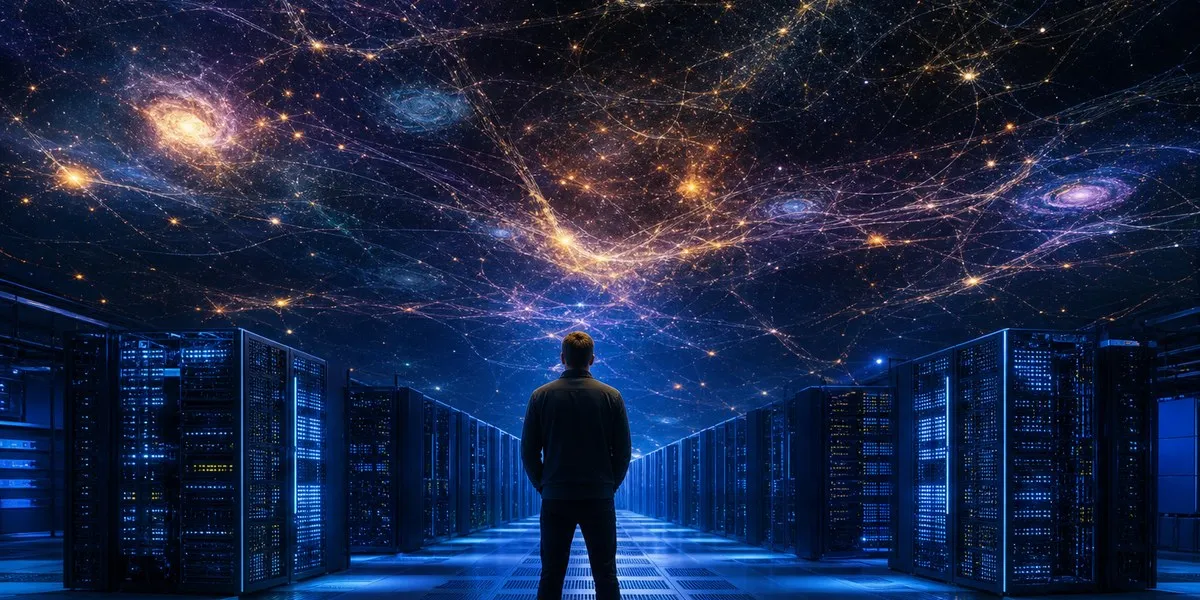
An international team of scientists has presented the Lumina computer simulation, which models the first two billion years after the Big Bang. Its volume is 100 times greater than that of previous simulations of the early Universe, Der Spiegel reports. The study results were published in the Monthly Notices of the Royal Astronomical Society journal.
How the model works
Lumina recreates the interaction of gas, dark matter and light, as well as the process of star and galaxy formation. According to current astronomical understanding, about 400,000 years after the Big Bang, matter in space cooled sufficiently for hydrogen and helium to form, while space became transparent to light. Radiation from that period is now detected as cosmic background radiation.
Random fluctuations formed denser concentrations of dark matter, which accounts for about 80% of the mass of the cosmos. Hydrogen and helium were drawn to these concentrations, contributing to the emergence of the first stars and galaxies. At the same time, intense radiation from stars and active galactic nuclei heated the surrounding gas and restrained galaxy formation.
More current news is available on the UA.News Telegram channel Telegram.
Reionization of hydrogen and helium
Researchers call this stage reionization: radiation stripped electrons from hydrogen and helium atoms, turning them into ions. Lumina became the first simulation to examine not only the reionization of hydrogen but also the reionization of helium and to directly show its impact on the development of the Universe.
More than 15,000 graphics processing units of the Frontier supercomputer at Oak Ridge National Laboratory were used for the calculations. Scientists plan to use the model to study the movement of hydrogen and helium between galaxies, the impact of Big Bang radiation on cosmic development, and the evolution of regions of active star formation. The simulation's large volume also makes it possible to reproduce rare objects that have already been observed with telescopes but had not previously appeared in computer models.




