
Scientists have found evidence of a collision between the Milky Way and a dwarf galaxy
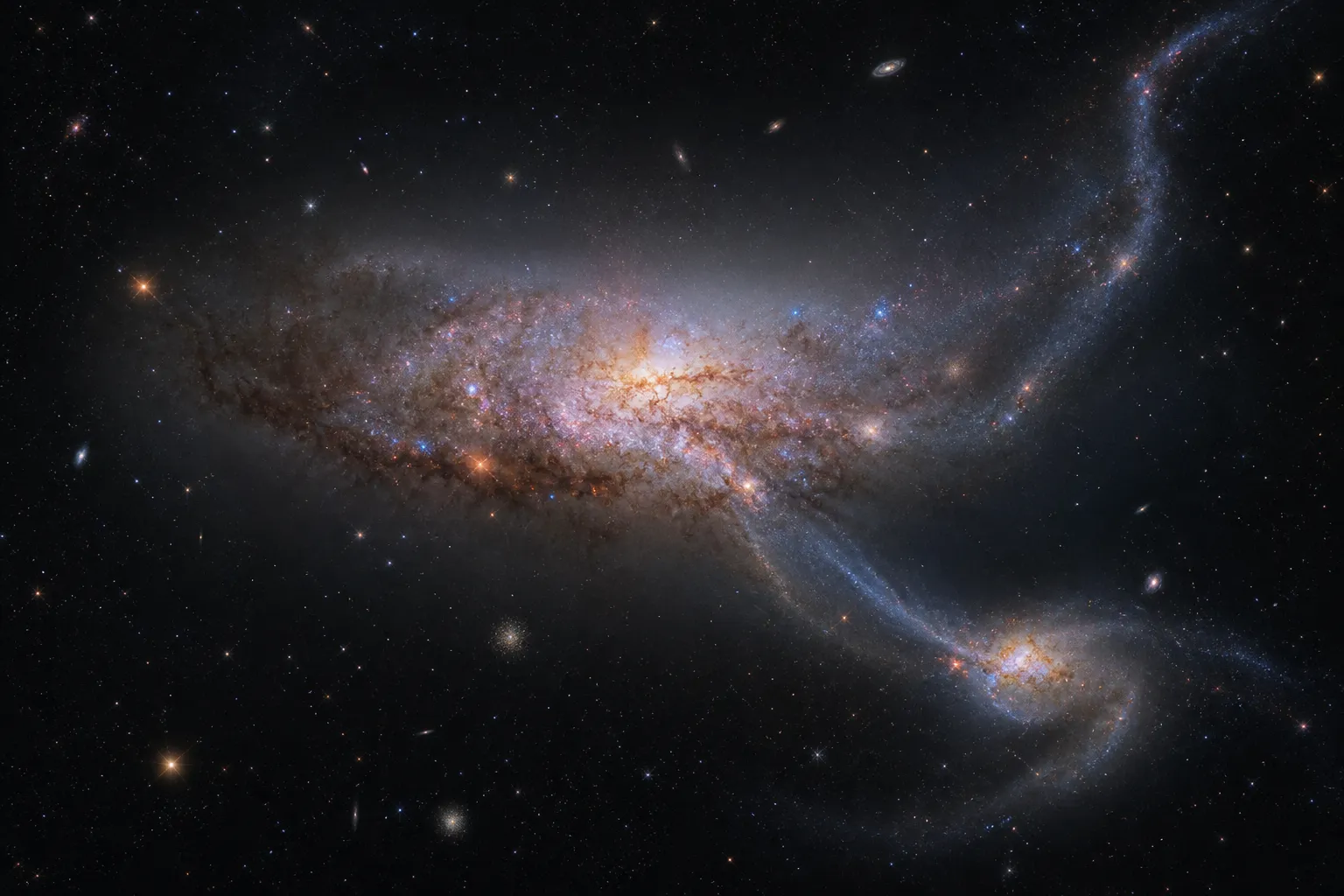
Astronomers have found evidence that 11.8 billion years ago, the Milky Way collided with and merged with a dwarf galaxy that researchers have named LKH, according to Space.com. The merger was reported on August 17 in the journal *Nature Astronomy*.
A team of scientists led by Davide Massari of the Observatory of Astrophysics and Space Science in Bologna reached this conclusion after studying globular clusters. The scientists discovered a third group of such clusters, which, according to their estimates, did not form in the Milky Way or in the Gaia–Sausage–Enceladus galaxy, with which our galaxy merged approximately 10 billion years ago.
The name LKH is derived from “Low-energy,” “Kraken,” and “Heracles”—a reference to three previous scientific papers on early mergers in the history of the Milky Way. According to the team’s findings, the newly discovered group of globular clusters entered our galaxy before the merger with Gaia–Sausage–Enceladus took place.
For more breaking news, follow the UA.News Telegram channel.
The age and heavy-element content of the clusters were determined using images from the Hubble Space Telescope. In astronomy, these elements are defined as all elements heavier than hydrogen and helium. These data were combined with measurements from the European Space Agency’s Gaia mission. Study co-author Chiara Zerbinati of the University of Bologna noted that this allowed researchers to identify a group of clusters that differs from the others and, according to the team’s assessment, originated in the LKH.
Based on the number and mass of globular clusters that entered the Milky Way, the scientists estimated the total mass of LKH to be 500 million solar masses. This is slightly more than the mass of the Sagittarius dwarf galaxy, which the Milky Way is currently absorbing, but about ten times less than that of the Small Magellanic Cloud.
At the time of the merger, which occurred approximately two billion years after the Big Bang, the Milky Way was significantly smaller. Researchers believe that LKH contributed a significant portion of its stars, gas, and dark matter to the Milky Way. The collision may also have triggered a new burst of star formation and influenced the galaxy’s chemical evolution.




