
Twenty years ago, Putin visited Novhorod-Siverskyi with the nuclear launch button
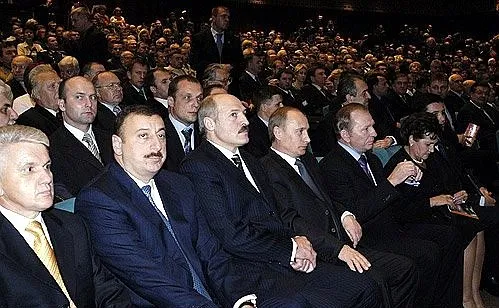
Twenty years ago, Novhorod-Siverskyi in the Chernihiv region hosted the presidents of Ukraine, Russia, and Belarus and was considered a symbol of the so-called “Slavic brotherhood.” At that time, Russian dictator Vladimir Putin visited the city carrying a nuclear command briefcase and allegedly promised that this region would never suffer from Russian weapons. Today, however, this border town regularly suffers from attacks by the Russian Federation.
This is reported in a piece by “Suspilne.”
June 2004. Novhorod-Siverskyi, the hometown of then-President Leonid Kuchma, is preparing for a historic event—his meeting with Alexander Lukashenko and Vladimir Putin. The city was spruced up for the occasion: fences were repaired, streetlights were replaced, and even the stadium was spruced up so that dust from the presidential helicopters wouldn’t blow into people’s faces.
Natalia Razumeiko, who worked in the district state administration at the time, recalls the presence of foreign intelligence services with a mix of irony and horror.
“The FSB was there... Our people said back then that the guards were carrying this little black briefcase, chained to their arms. Everyone was whispering, ‘That’s Putin’s button following him around.’ We used to laugh: ‘Oh, Putin’s whole button,’ the woman recalls.
While the presidents were visiting the Transfiguration Monastery, snipers were on the roof of the newly built “Slavyansky” hotel, which, according to locals, was built on the site of mass executions during World War II. It was during that visit that a legend was born, one that has reassured the people of Novgorod for years. Putin liked Kuchma’s hometown so much that he allegedly promised that this city would never suffer from Russian weapons.
“Putin said: ‘If you come to visit me in my hometown, I don’t have a place as beautiful as this to show you.’ He really liked it,” recalls Ms. Natalia.
Even after the full-scale invasion in 2022, rumors circulated that the city would not be shelled. Many stubbornly called the first strikes on the local high school in May 2022 an “accident.”
The turning point came in the fall of 2025. The dictator’s favor, which had been spoken of for decades, turned out to be nothing but empty words. The Russians began systematically targeting civilian infrastructure: substations, the police station, and the tax office. The head of the district military administration, Oleksandr Seliverstov, notes that the enemy’s tactics have changed—now the city is being attacked with FPV drones and “Shaheds,” in an attempt to intimidate the population.
“They strike at random. They’re trying to provoke resistance, discontent with the authorities... After a strike, they spread messages in groups: ‘Look, the authorities aren’t protecting you,’” says Oleksandr Seliverstov.
Memories of the “bread and salt” welcome for the aggressor now evoke only revulsion.
“It’s hard for me to talk about this, but I had to give flowers so that Putin could lay them where the names of the fallen Chaykiv residents are... Now it’s an unpleasant fact in my life,” concludes Natalia Razumeiko.
Earlier, the Kremlin officially confirmed Russian dictator Vladimir Putin’s visit to China, which will take place on May 19–20. The trip will occur just a few days after the summit between Chinese leader Xi Jinping and U.S. President Donald Trump in Beijing.
Chinese leader Xi Jinping has accepted an invitation from U.S. President Donald Trump and will make an official visit to the United States this fall.


