
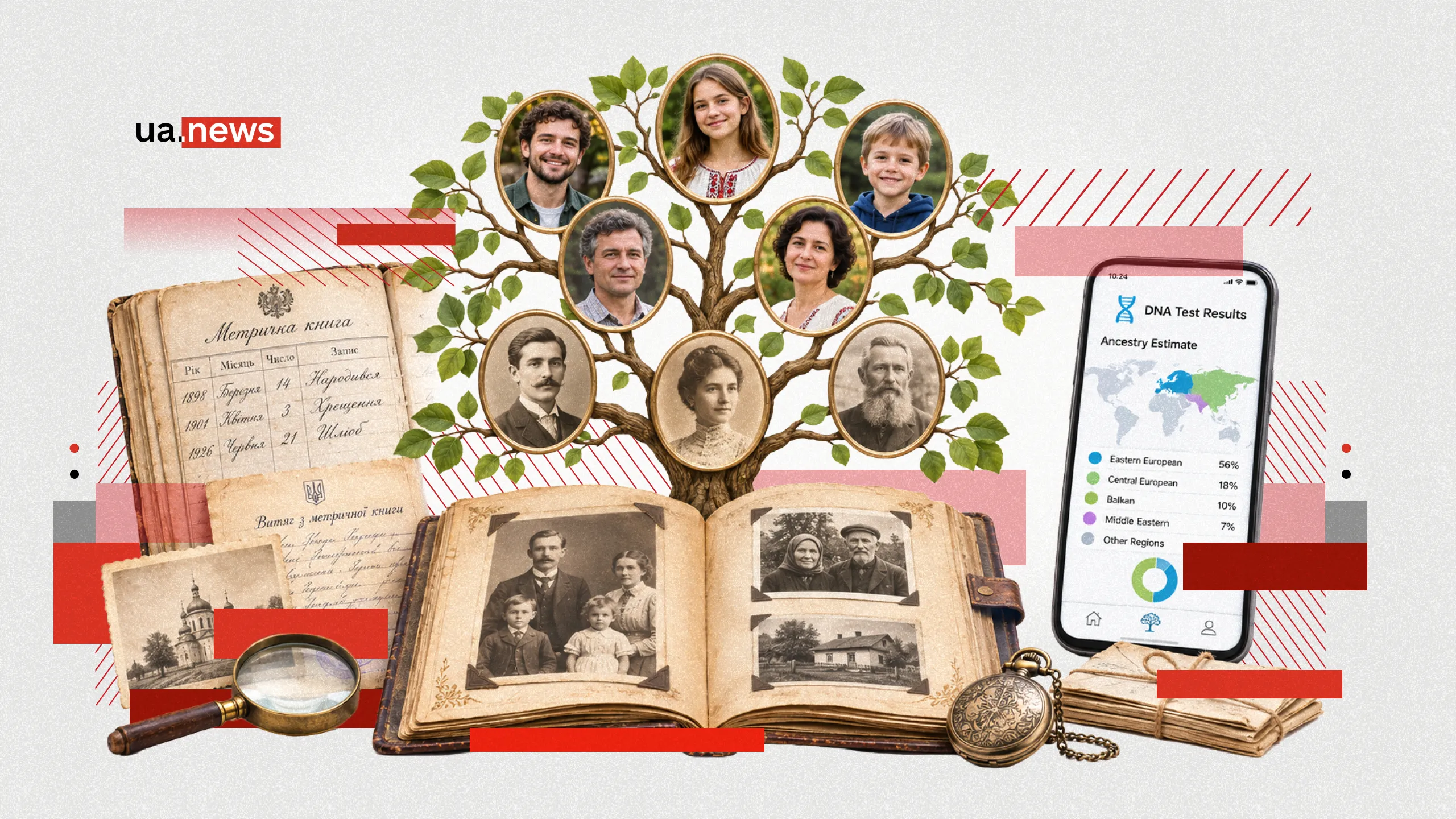
Ukrainians are taking an increasingly active interest in their family history: they are searching for archival documents, compiling family trees, and undergoing DNA testing. One of the catalysts for this trend was the full-scale war, which forced many to rethink their identity.
At the same time, the digitization of archives and technological advancements make it possible to research one’s family history even without a background in history. Under the right circumstances, it’s possible to independently identify the names of ancestors who lived more than two centuries ago.
UA.News has looked into where to start when searching for your ancestors, how to work with state archives, which digital services to use, and what DNA tests can reveal about a person’s origins.
Genealogy as a Global Trend: Why Ukrainians Are Searching for Their Roots

Genealogy is a historical discipline that studies people’s origins, family ties, and the history of lineages. An entire industry of digital archives, professional research, and DNA testing has sprung up around it. The MyHeritage database alone contains tens of billions of historical records and over nine million genetic profiles.
According to Viktor Doletsky, a genealogist and founder of the “Praschur” Center for Genealogical Studies, Ukrainians’ interest in family trees has been reviving since the end of the Soviet era. At the start of the invasion, interest temporarily declined, but it has grown noticeably since the spring of 2023. On the eve of winter 2026, the genealogist observes a slowdown in this process.
According to Doletsky, the promotion of genealogy by researchers themselves is also contributing to the growing interest in this hobby. He links Ukrainians’ return to their family histories to overcoming the consequences of Soviet policies and expects interest to begin rising again in the spring of 2027.
Ethnologist and Candidate of Historical Sciences Anna Nikolaeva notes that during times of major social upheaval, people feel a particularly acute need for self-identification.
“The Russian-Ukrainian war has prompted many to rethink not only their national identity but also their own family history. After all, throughout the 20th century, wars, famines, repression, deportations, Soviet policies, and Russification disrupted the continuity of family memory in many Ukrainian families,” explains the ethnologist.
Forced resettlement and the destruction of homes during the war also pose a threat to the loss of family archives.
“People are beginning to realize that they shouldn’t put off talking to their grandmother or grandfather until later, because that ‘later’ might never come,” notes Nikolaeva.
First leads: family photos, documents, and relatives’ memories

It’s best to start your research not with a DNA test or an archive, but by talking to relatives. You should ask not only your grandparents, but also their brothers, sisters, and children.
During these conversations, you should gather the following information:
- full names, surnames, and patronymics of ancestors, including women’s maiden names;
- exact or approximate dates of birth, marriage, and death;
- the towns and villages where relatives were born and lived;
- religion, occupations, and social status;
- the names of ancestors’ brothers, sisters, husbands, wives, and children;
- information about military service, repression, deportation, and emigration;
- burial sites of family members.
Your ancestors’ places of residence and religious affiliations will help you identify the appropriate archive and religious community.
Anna Nikolaeva advises recording the memories of older relatives—preferably on video, with their consent—and also asking about their daily lives, occupations, and family traditions.
Look through old passports, birth and marriage certificates, military ID cards, employment records, letters, and photographs. The backs of photographs may contain names, dates, and the names of towns and villages.
It’s a good idea to photograph both sides of the documents, name the files, and make backup copies. Inscriptions on family gravestones can help clarify the years of your ancestors’ lives.
“Family legends are worth recording, but be sure to verify them,” Nikolayeva emphasizes.
If several relatives give different accounts of the same event, don’t be quick to dismiss any of the versions. Make a note of who provided each piece of information and when. This will help you understand the source of any discrepancies as you continue working with the documents.
From Family Memories to Your Own Family Tree

Start building your family tree with yourself, gradually adding your parents, grandparents, and previous generations. For each person, create a profile card with biographical information, family relationships, and sources. Flag unconfirmed facts and keep conflicting versions on file until they can be verified.
You can create a family tree on MyHeritage, FamilySearch, or the free Gramps program, which stores data on your computer. Check if you can export in GEDCOM format to transfer your family tree between services. Do not publish information about living relatives without their consent.
Keep a research journal, recording the records you’ve reviewed, inquiries you’ve made, and even unsuccessful searches.
Choose one family branch and the closest ancestor for whom information is missing. Formulate a specific goal: to find their parents, birth record, or marriage record.
Searching for the Right Archive: Where to Start and Where to Go

There is no single database of all ancestors in Ukraine. Documents are distributed among central, regional, and specialized archives.
Determine the historical name of the settlement and its administrative affiliation during your ancestor’s lifetime. Modern regional boundaries do not correspond to former provinces and counties, so documents may be stored in different institutions.
For church records, determine the religious denomination and parish. If there was no church in the village, residents may have attended a church in a neighboring settlement.
Start with the regional archive’s website: check the guides, fonds descriptions, and catalogs of metric books. If necessary, contact the Central State Historical Archive of Ukraine in Kyiv (CSHAU) or Lviv (CSHAL).
More recent records of births, marriages, and deaths may be kept at local civil registry offices. These records are transferred to archives after 75 years of storage. Proof of kinship may be required to obtain certain documents.
Registry books, census records, and other sources of information about ancestors

Before you begin searching for ancestors in the archives, it’s important to understand how the documents are organized there. All materials are grouped into fonds, which consist of documents from a specific institution, organization, or individual. Each fonds has one or more inventories listing the archival files. In turn, a file may contain a birth register, a census, or other historical documents.
To request materials in the reading room, you must know their archival references—the fonds number, inventory number, and file number.
Keep in mind that archival catalogs typically list only the document’s title, the locality or religious community, and the time period covered by the records. Therefore, the absence of an ancestor’s last name in the catalog does not necessarily mean that there is no information about them in the archive. You may need to review the contents of the relevant file yourself.
The most useful sources for genealogical research are:
- Parish registers—church records in which births, baptisms, marriages, and deaths were recorded. They allow you to determine the names of parents, place of residence, age, and social status of your ancestors.
- Confession records—documents that can be used to determine who was part of a family, how old its members were, and what family ties existed among them.
- Census records—materials from population censuses conducted in the Russian Empire in the 18th and 19th centuries to keep track of taxpayers. They help trace changes in family composition over several generations.
- Farmhouse registers—records of rural households, particularly useful for genealogical research in the 20th century. They contain information about family members, their years of birth, and the household.
When working with these documents, it’s best to move gradually from one generation to the next. Once you have found a birth record for an ancestor, you should note the names of their parents and begin searching for records of their marriage or birth. If a person’s exact date of birth is unknown, you can estimate it based on a death record, which often includes the age of the deceased.
It is advisable to keep all the information you find along with the name of the archive, as well as the fund, inventory, file, and page numbers where the relevant record is located. When working with digitized documents, you should also save links to them.
It is especially important not to jump to conclusions about kinship between people based solely on identical last names. To confirm a family relationship, you must cross-reference several pieces of information: age, place of residence, and the names of parents, spouses, and other family members.
Working with State Archives: From Submitting a Request to Receiving Documents

You can browse archival documents on your own or request a paid search by the institution’s staff. First, check if online copies are available.
On the archive’s website, find the section for public inquiries and review the procedure for submitting genealogical requests. In your request, include your contact information, the ancestor’s name, details about relatives, the location, the approximate time period, and the purpose of the search. The Central State Historical Archives of Ukraine (CDIAK) asks that you provide information on at least two related individuals.
Clarify the cost, turnaround time, and availability of digital copies, including payment details. The CDIAK, in particular, does not accept requests to compile complete family trees.
If the archive was unable to find the desired record, it is worth clarifying whether any documents from the relevant period have been preserved at all. The absence of a record in the reviewed file and the absence of the file itself are different situations, and the further direction of the research will depend on which one applies.
In an interview with UA.News, Ihor Bohak said that he received the search results from the State Archives of Ivano-Frankivsk Oblast in about two weeks. Researching one family line cost him about 1,600 UAH.
Millions of Documents Online: The Digitization of Ukrainian Archives

In 2020, the State Archives Service began collaborating with the American organization FamilySearch International. In 2022, a large-scale digitization of genealogical documents was launched at the Central State Archives of Ukraine (CSAU).
On June 30, 2026, at the roundtable discussion “Restoring Forgotten Names,” CDIAK Director Yaroslav Faizulin announced that over 15 million digital copies had been created and that approximately 20% of the institution’s collections had been digitized. By the end of the year, the plan was to increase this figure to 25%. The archive’s oldest parish register dates back to 1706.
Digitization does not mean that a document can be found by last name: often, only images of the pages are available. Check the title pages, years, parish names, and alphabetical indexes. If the exact date is unknown, review records from several adjacent years.
When working with a parish register, first locate the relevant section: births, marriages, or deaths. Save not only the portion containing your ancestor’s entry but also the full image of the page and its page number. The column headings and adjacent entries can help decipher illegible words.
Searching for Ancestors Online: Ukrainian and International Services
- FamilySearch. A free international platform. After registering, search by your ancestor’s first and last name. If there are no results, go to the catalog and search by the name of the settlement. Access to individual copies is limited. If the settlement you’re looking for isn’t listed in the catalog, check its historical name in another language and the names of neighboring parishes.
- “Kachyn Inspector.” A Ukrainian volunteer project. Allows you to search archival records by town name, year, details, and document type, and access online copies.
- “Ridni.” A map showing the distribution of Ukrainian surnames. Helps identify possible regions for your search.
- Inter-Archival Search Portal. Search Ukrainian archive catalogs by the names of localities, institutions, fonds, and cases.
- UAGenealogy. A guide to Ukrainian genealogical resources.
The Central State Archives of Ukraine (TsDIAC) also operates the “Arkhium” system, where you can search for cases, view digital copies, and request non-digitized materials to be brought to the reading room.

Beyond the Metric Books: Stories of the Repressed, Prisoners of War, and Emigrants
To search for repressed relatives, contact the Sectoral State Archive of the Security Service of Ukraine (SBU). In your request, specify the person’s name, years of life, place of residence, and known circumstances of their arrest.
Files from repressive agencies may contain questionnaires, photographs, interrogation transcripts, and inventories of confiscated property. Bohak gained access to the files of two repressed relatives and found his great-great-grandfather’s fingerprint. Testimonies in such materials may have been obtained under duress.
To search for military personnel, specify the branch of service, the period, and the place of enlistment. Check lists of prisoners of war and the wounded. This is exactly how Bohak confirmed a family legend about his great-great-grandfather’s capture during World War I.
To search for emigrants, check ship passenger lists, censuses, and immigration documents. Be aware of possible changes in the spelling of names after relocation.
MyHeritage: From an Israeli Startup to a Global Genealogy Platform

One of the most well-known international platforms for genealogical research is MyHeritage, founded in 2003 by Israeli entrepreneur Gilad Yafet. Over the years, this small tech startup has grown into a global genealogy service, and in 2021, it was acquired by the American investment firm Francisco Partners.
To get started with the platform, simply create an account and enter the information you already know about your family members. If you’ve previously created a family tree in another program, you can import it into MyHeritage using the GEDCOM format.
Based on the information you enter, the system will automatically search for possible family connections using several technologies. Specifically, Smart Matches finds matches between different users’ family trees, Record Matches cross-references information about ancestors with historical documents, and DNA Matches helps identify potential relatives based on genetic test results.
In addition to searching for ancestors, the platform offers tools for restoring family archives. Using artificial intelligence, users can enhance the quality of old photographs, colorize black-and-white photos, and even animate them.
At the same time, the matches suggested by the system should be viewed with a critical eye. Users may make mistakes when compiling their own family trees or copy unverified information from other people’s family trees. Therefore, even the presence of identical information in several family trees does not guarantee its accuracy. Before adding a new ancestor, it is necessary to cross-check dates, places of residence, and family relationships, as well as find documentary evidence.
MyHeritage’s business model is based primarily on the sale of DNA tests and paid access to advanced genealogy tools and databases of historical documents. However, it is not necessary to purchase a subscription right away. First, it’s a good idea to explore the available collections and determine whether they contain records from the towns where your ancestors lived. To expand your search, you can also use other international genealogy services, such as Ancestry and FamilyTreeDNA.
DNA Testing: Procedure, Cost, and Options

Three main types of DNA tests are used in genealogical research, each with its own characteristics. An autosomal test allows you to find relatives through both the paternal and maternal lines, making it the most versatile tool for tracing your family tree.
A Y-DNA test helps trace ancestry through the direct male line, since the Y chromosome is passed from father to son. To research this branch of the family tree, women need to involve a suitable male relative. A mitochondrial DNA test, in turn, allows you to trace the direct maternal line, since children inherit mitochondrial DNA from their mother.
The genetic testing procedure itself is quite simple and requires no special preparation. For example, MyHeritage offers special kits for collecting biological samples on your own. All the user needs to do is register the kit in their account, use a special swab to collect a cell sample from the inside of their cheek, and send it to the lab for analysis. Once the sample has been processed, the results become available in the user’s account.
The standard price for a MyHeritage DNA kit is $89.
To gain more insight into your family’s origins, it’s a good idea to involve older family members in the genetic testing, with their consent. The fact is that with each generation, some genetic information is not passed down to descendants. Therefore, test results from parents, grandparents, or great-grandparents can help identify distant relatives with whom a genetic connection is difficult to establish based on the test results of younger family members.
Lost Documents and Family Secrets: How to Overcome Challenges During the Search

Due to wars and fires, some documents have not survived. While searching for his great-grandfather, born in 1924, Bohak found parish registers for 1923 and 1925, but not for the year he needed.
In such a situation, check records of marriages or deaths, as well as the births of the ancestor’s children, brothers, and sisters. Look for duplicate parish registers, documents from neighboring parishes, censuses, and military records.
In historical documents, Bogak also discovered an older variant of his last name—Bolgak. Therefore, check for different spellings, especially in other languages. To transcribe manuscripts, you can use Transkribus, other AI tools, and assistance from genealogy communities. Verify your results against the original. Start with recurring words and headings to get used to the handwriting.
If your search hits a dead end, note the gaps and move on to another branch.
Researching Hundreds of Years Back: The Possibilities and Cost of Ancestral Research
According to Viktor Doletsky, you can trace your family tree back seven to ten generations on your own. Anna Nikolaeva notes that under favorable conditions, it’s possible to trace your family tree back to the early 18th or even the 17th century, while on other branches, you may not be able to go further back than the mid-19th century.
Thanks to archival documents from the Ivano-Frankivsk region, Ihor Bohak was able to trace one of his family lines back to 1796.

The initial stages of research can be conducted free of charge. Costs arise when ordering archival searches, copies, travel, subscriptions, or DNA testing. Before hiring a professional genealogist, clarify the scope of work, the list of archives to be searched, the cost, the possibility of obtaining certified copies, and the payment terms in case the documents cannot be found.
Anna Nikolaeva emphasizes that the main goal of genealogical research should not be the number of generations discovered, but rather an understanding of who the ancestors were, how they lived, and what historical events influenced their fates. According to the ethnologist, even researching just a few generations can help a person better understand their own origins and recognize their connection to their family’s history.
“You can know the names of your ancestors going back three hundred years and yet know almost nothing about these people. Or you can thoroughly research the histories of three or four generations and, as a result, gain a much better understanding of your own family and yourself,” Nikolayeva emphasizes.




