
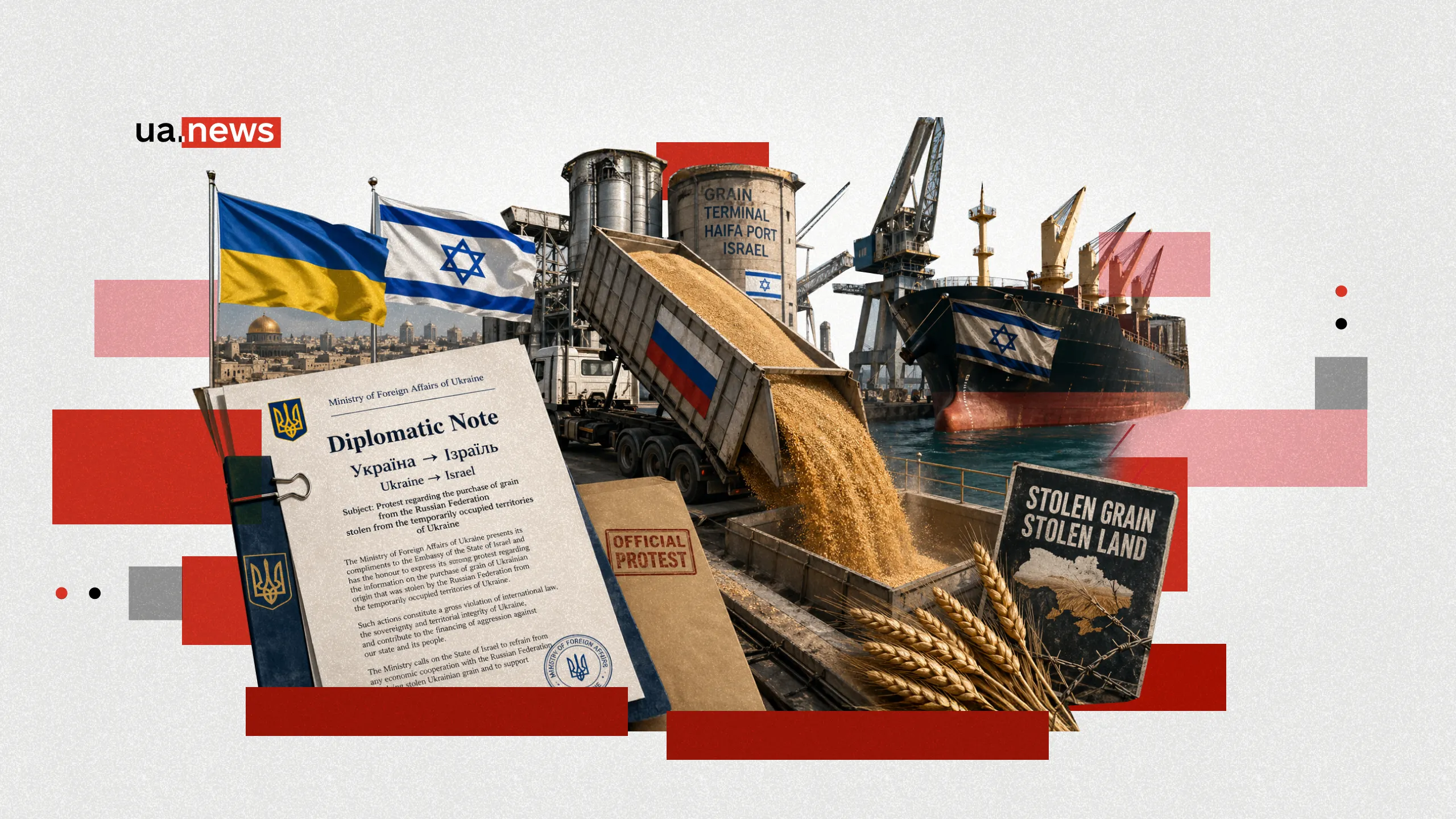
International relations are a complex and multifaceted process that does not always develop in a linear fashion and does not always change for the better. Sometimes, conflicts, misunderstandings, and diplomatic tensions arise even between fairly close countries that have traditionally cooperated constructively for a long time. It seems that this is exactly what happened recently between Ukraine and Israel.
A few days ago, Kyiv and Tel Aviv found themselves in a state of public diplomatic conflict. It was all over Ukrainian grain. The problem is that, according to Ukraine, the grain was exported from territories temporarily occupied by Russia and unloaded in Israel, at the port of Haifa. The Ukrainian side lodged a protest through private channels, but this led to nothing. After that, the standoff spilled over into the public sphere.
As of now, it appears that the conflict is gradually subsiding. Israel did not accept another ship allegedly carrying grain from the temporarily occupied territories; it has already left Israeli territorial waters. At the same time, the Israeli side claims that Kyiv has still not provided sufficient evidence that the grain actually came from territories occupied by Russia. In other words, the problem still exists and has not been fully resolved.
What is actually happening between the two countries? Why did this happen? What should be done to prevent such situations from recurring? UA.News political analyst Mykyta Trachuk, together with experts, examined the issue.
The “Grain War” Between Ukraine and Israel
According to media reports, four shipments of Ukrainian grain—allegedly illegally exported from the temporarily occupied territories—have already been unloaded in Israel this year alone. As of April 27, another ship, the PANORMITIS, arrived at the port of Haifa despite Ukraine’s protests.
Ukrainian diplomats told the media at the time that they were monitoring such ships and would not ignore the situation. Kyiv warned of international consequences and threatened a “full range of diplomatic and international legal measures.” At the same time, according to the Ukrainian side, Israel did not respond appropriately to all calls.
Following this, the Israeli ambassador was summoned to the Ukrainian Ministry of Foreign Affairs. This was stated by Minister Andriy Sibiga. According to him, Kyiv “cannot understand” Tel Aviv’s lack of response. Israeli Ambassador Michael Brodsky, with whom UA.News conducted an extensive interview, was even handed a note of protest.
The conflict then finally spilled into the public sphere. The Israeli Foreign Ministry has already reacted sharply to the situation. It told its Ukrainian counterparts that Kyiv had not provided evidence that the grain came specifically from the occupied territories, and also criticized Sibiga for his “Twitter politics” (the Ukrainian minister had posted about the situation on social media platform X).
“Diplomatic relations, especially between friendly states, are not conducted on Twitter or in the media. Accusations are not evidence. Evidence to support the accusations has not yet been presented. You did not even submit a request for legal assistance before turning to the media and social media,” Israeli Foreign Minister Gideon Saar wrote indignantly, noting nonetheless that the matter would be reviewed.
However, the conflict continued to escalate. Even the Chief Rabbi of Ukraine appealed to Israel, asking it to refuse grain from the temporarily occupied territories. And President Zelenskyy announced—no less—the imposition of sanctions against Israel over this situation. The head of state called it “buying stolen goods.”
“In all normal countries, the purchase of stolen goods is an act that carries legal liability. This applies… to grain stolen by Russia. Another ship carrying such grain has arrived at an Israeli port and is preparing for shipment… The Israeli authorities cannot be unaware of which ships and with what cargo are arriving at the country’s ports… Ukraine will impose sanctions against those who directly transport this grain, and against those… who are trying to profit from this criminal scheme,” Zelenskyy stated.
The president also called for the EU to impose sanctions. Meanwhile, the Ukrainian Prosecutor General’s Office requested the arrest of the vessel PANORMITIS.
Ultimately, this led to Tel Aviv refusing to unload the ship carrying grain allegedly exported from the temporarily occupied territories. Importers are concerned about potential European sanctions. They also complained that the Israeli government is remaining silent and not providing clear instructions.
Subsequently, Ukraine also confirmed the refusal to unload the ship. The PANORMITIS sailed into neutral waters, and Kyiv announced that it was closing the criminal case and lifting the sanctions. At the same time, the Ukrainian side is still seeking the arrest of the ship. Israel, despite having made a tactical concession to Ukraine, still believes there is insufficient evidence and that the situation requires further investigation. In other words, the conflict is far from over.

Why did this happen?
This case is not an isolated incident, but merely one instance of a systematic practice carried out by Russia’s “shadow fleet,” which deals not only in oil but also in many other types of cargo. Investigations have been published on multiple occasions detailing how the scheme that allows Moscow to profit operates.
A key element is the STS (ship-to-ship) transshipment method on the open sea. Grain harvested in the occupied territories is first transported by small vessels sailing from closed Ukrainian ports to large floating grain storage facilities or directly to bulk carriers waiting in the roadstead south of the Kerch Strait.
That is when the “magic” of disappearance occurs: during these operations, the vessels turn off their automatic identification systems, which is a gross violation of international maritime law. Thus, the true origin of the grain is lost at sea, and on paper it becomes “Russian.” According to the Prosecutor General’s Office, since the start of the full-scale invasion from the temporarily occupied territories, over 1.7 million tons of agricultural products worth more than 20 billion hryvnias have been illegally exported in this manner.
Why, then, has Israel found itself at the center of the scandal? The answer is painfully pragmatic: the country is a major grain importer, and the Russian offer often proves economically attractive to local traders. In this context, the PANORMITIS is far from the first vessel. It is precisely this “tacit tolerance” of questionable cargoes that provoked Ukraine’s sharp reaction this time.
However, the Panormitis’ departure from Israeli waters does not mean the end of this story. Rather, it is a starting point for a more systematic confrontation. The investigation will clearly continue—as will attempts to seize this vessel and others like it.
The conflict surrounding this grain has once again highlighted a global problem: in modern warfare, weapons are not just missiles and drones, but literally anything. The trade in stolen grain—if it truly involves produce from the temporarily occupied territories—is direct (even if unintentional) financing of Russian aggression, disguised as ordinary commerce.

Expert Opinion
Political scientist and director of the Ukrainian Institute of Politics Ruslan Bortnik emphasizes: in this situation, we still do not know for certain—and cannot know—who is right and who is at fault. We need to examine documents that we do not have.
“Israel claims that Ukraine has not substantiated that this grain originated specifically from the occupied territories. Ukraine claims that this grain was supplied specifically from the occupied territories to Israel and some other countries in the region. The problem is that without the documents, we cannot confirm or refute this. And this is not the first crisis of this kind. The fact that it has entered the public sphere creates a burdensome backdrop for interstate relations and may be a manifestation of several processes.
First and foremost, it reflects the deterioration of relations between Israel and Europe. Israel believes that Ukraine is taking a hardline, negative stance toward Israel because the latter’s relations with Europe are deteriorating. And that Ukraine is, in a sense, aligning its position accordingly. Second, there is the developing cooperation between Ukraine and the new Syrian government, which remains anti-Israeli—this too may cast a shadow over these processes. Third, we cannot rule out that certain interests of individual companies are driving this conflict, because grain from the occupied territories is supplied by Russian companies, and it is taking the market share of some Ukrainian companies. And business interests may indeed be the driving force behind this. “It seems to me that the government is currently trying to create a situation in which Israel will be forced either to apologize, making Ukraine look strong, or to compensate Ukraine in some other way—for example, by providing additional military or financial support,” Ruslan Bortnik concluded.


