
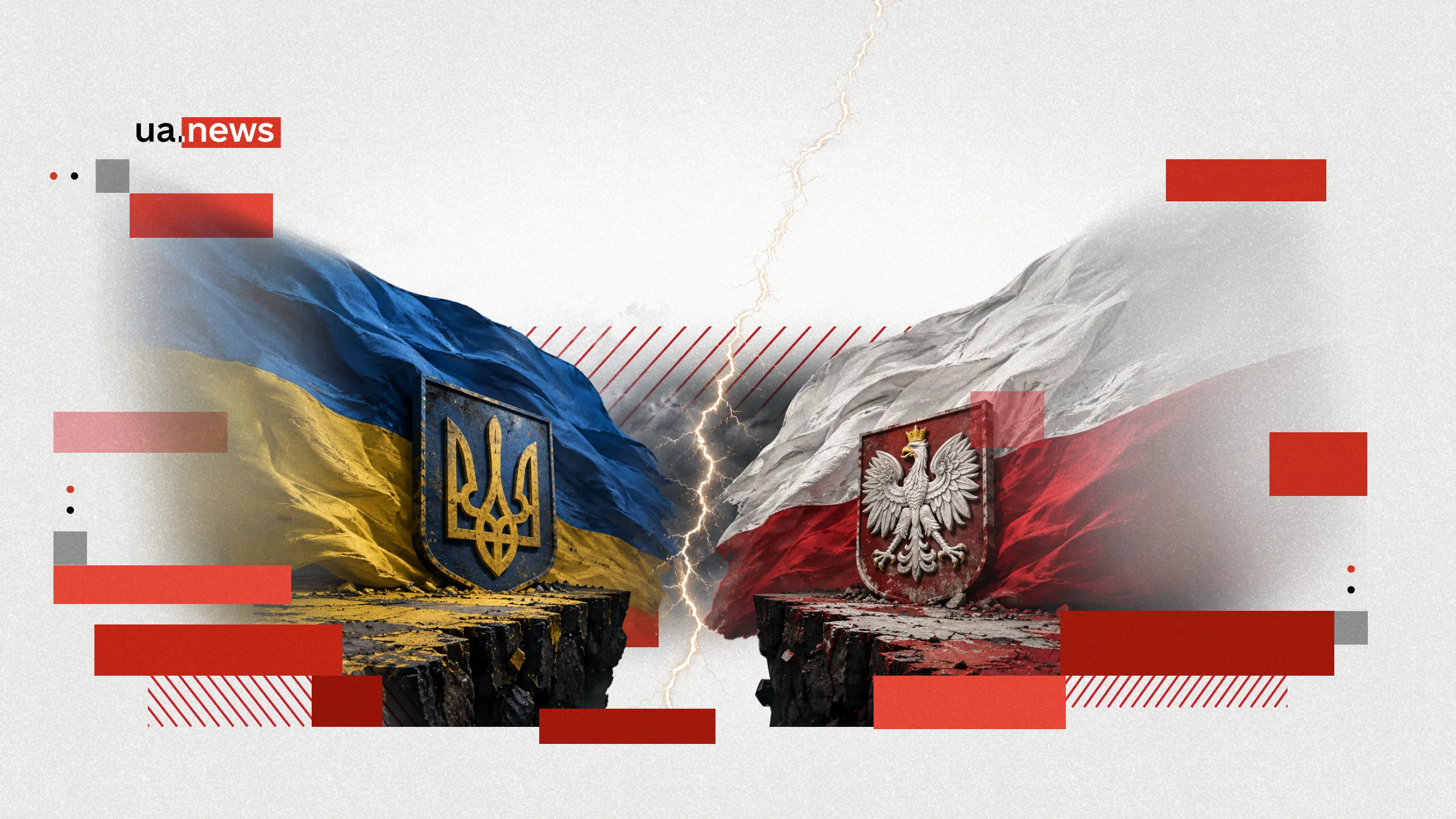
Relations between Ukraine and Poland are currently in yet another serious crisis. What until recently seemed like an example of unprecedented solidarity—military and financial aid, open borders for refugees—is now falling apart before our eyes.
Gone are the warm embraces of politicians and joint press conferences against a backdrop of flags. Ahead lie cold and harsh statements, the demonstrative removal of Ukrainian flags in Polish cities, and threats to strip President Zelenskyy of Poland’s highest honor—the Order of the White Eagle.
The escalation was triggered by yet another historical “pot” that both sides recklessly smashed. Kyiv’s recent symbolic moves—naming one of the Ukrainian Armed Forces brigades after UPA heroes and reburying one of the OUN leaders, Andriy Melnyk—provoked a very negative reaction from Warsaw.
But the problem is not just about history. Behind the historical disputes lies a far more pragmatic issue: fierce economic competition—for agricultural markets, for European subsidies, for the status of the main regional leader, and so on. However, no matter how compelling the objective reasons may be, the current deterioration of relations over figures and events from nearly a century ago is irresponsible and counterproductive for both sides. All the more so when the real enemy—Russia—is just waiting for this.
So what is currently happening between Ukraine and Poland? What is the state of our relations? How should we act to eliminate the causes of future conflicts? UA.News political analyst Mykyta Trachuk, together with experts, examined the issue.
The spark that ignited the fire: ill-advised moves on both sides
It all began with decisions by the Ukrainian authorities that were perceived in Poland as a deliberate provocation. In May, Zelenskyy bestowed the honorary title “in the name of the UPA Heroes” on one of the Special Operations Forces units. But for the vast majority of Poles, the UPA are not heroes, but people who killed them—the Poles—in large numbers. This brings to mind, first and foremost, the Volhynia tragedy and other high-profile mass killings of the Polish civilian population. It was to be expected that such a move would provoke sharp rejection in Warsaw, but Kyiv seems to have either consciously taken the risk or underestimated the depth of Poland’s historical trauma.
That same month, a solemn reburial ceremony was held for Andriy Melnyk—one of the leaders of the OUN, whose activities in Poland are also viewed extremely negatively. The National Military Memorial, the presence of high-ranking officials, and the lavish ceremony—all of this further enraged the Polish side.
Even considering Ukraine’s right to have its own perspective on its history, the timing and manner of such actions still raise questions. When a country is in the midst of a major war, when it needs the constant support of its closest neighbor and NATO ally—was it really necessary to hold lavish reburials of controversial historical figures right now? Perhaps it would have been more pragmatic to postpone such gestures until better times?
However, history knows no subjunctive. What happened, happened.
To be fair, Warsaw’s reaction also turned out to be disproportionately emotional. Polish President Karol Nawrocki threatened to strip Zelenskyy of the Order of the White Eagle, awarded in 2023. Former President Lech Wałęsa demonstratively removed the Ukrainian pin from his chest, stating:
“By honoring the UPA bandits, the President of Ukraine has insulted me and all the Poles who were killed.”
In several cities, including Lublin, Ukrainian flags were removed from government buildings. There was also talk that Ukraine should not be allowed to integrate into the EU because of its glorification of the OUN-UPA. But the most symbolic blow was the rerouting of the Ukrainian president’s plane from Rzeszów to Chișinău (Moldova): a silent acknowledgment that feeling at home in Poland was no longer possible. And although each of these steps had its own internal logic for those who took them, together they created the impression that Warsaw is also deliberately destroying the very bridge between itself and Kyiv that had formed in recent years.
After all, does removing the flag from City Hall really help solve shared problems? Doesn’t this just play into the hands of a third party? Or perhaps, once Lech Wałęsa stops wearing a pin with a yellow-and-blue flag, will Ukraine suddenly reverse its entire ideology of the past 12 years and transform into a completely different state? In the realm of symbolic gestures, the essence and meaning of real politics and real actions aimed at solving existing problems—rather than provoking new conflicts—are often lost.

Economic competition as the real cause
Historical memory in this conflict is important, but it is only the tip of the iceberg. Lying much deeper is systemic economic rivalry: Ukraine and Poland are direct competitors in the European market, and there is no escaping this reality.
The most striking example is the agricultural sector. Since 2023, Polish farmers have been regularly blocking the border to protest against imports of Ukrainian grain. Their arguments are understandable: cheaper Ukrainian products, produced without adhering to strict European standards, are driving down prices within Poland, threatening to ruin local farms.
But the Ukrainian position is also understandable: in wartime, when seaports are blocked or under constant shelling, land-based exports are a matter of economic survival. In reality, however, both countries are competing for the same European food market, and after Ukraine joins the EU, this competition will only intensify.
The second area of competition is EU funding. Kyiv is constantly in need of money: tens, or better yet, hundreds of billions of euros. This money is, one way or another, drawn from the EU’s common budget, and thus other countries receive less. For decades, Poland has been one of the main beneficiaries of European funds, and the emergence of such a powerful competitor as Ukraine inevitably reduces Poland’s “share of the pie.” This is where simple arithmetic comes into play, only at the state level.
That is precisely why purely pragmatic interests are often hidden behind historical disputes.
Stopping the Slide into the Abyss
An attempt to “put out the fire” was the visit to Warsaw by the head of the Office of the President, Kyrylo Budanov, in early June. The trip was urgent and almost unannounced—a sign that Kyiv had finally realized the seriousness of the situation. Budanov met with Defense Minister Vladyslav Kosiniak-Kamysh and the leadership of the Polish Ministry of Foreign Affairs, trying to convey a simple message: it makes no sense for either side to ruin relations over events that took place nearly a century ago.
It is extremely difficult to analyze the results of the visit due to a lack of information. Overall, it can be described as averting the worst-case scenario—that is, a diplomatic rupture was avoided—but a palpable residue, as they say, remains. Interestingly, there were also level-headed voices in Poland actively urging the government not to escalate the conflict with Ukraine, as doing so is simply inappropriate at this time.
So there is hope that sooner or later Kyiv and Warsaw will turn the page on a chapter of history tied to events from a distant past that, by and large, interests no one—and will be able to leave it behind for good. Especially since far more important and pragmatic challenges and problems lie ahead.

Expert Opinions
Political scientist Maksym Honcharenko believes that Ukraine, as a sovereign state, has every right to research, honor, and interpret the role of its own historical figures. Therefore, the state’s reluctance to put itself in a position where it must “seek permission” for its own vision of historical memory is entirely understandable. Concessions on this issue may be perceived not merely as historical and ideological disputes, but as concessions regarding sovereignty and identity. The state will try to avoid this during the war, the expert notes.
“But the Polish side is also important, with which Ukraine shares an unprecedented level of alignment of interests—especially in the field of security. The UPA is a sensitive topic for Poland, and it is precisely on this point that their policy of historical memory directly confronts the Ukrainian vision. But is this critical? No. Recently, the issue of historical claims has been used in Polish politics more as rhetoric and a ‘mandatory agenda.’ A striking example is the confrontation between “Law and Justice” and “Civic Platform,” where historical issues are articulated with roughly the same perspective. In fact, it’s starting to resemble a race—who cares more about national memory—but it’s still just rhetoric… Yes, the topic is sensitive and will provoke a predictable outcry from the Polish side. But that’s all there is to it. Poland will not overhaul its foreign policy over the names of Ukrainian units. Just as the dozens of streets and alleys named after Bandera, Konovalets, and Shukhevych did not prevent Poland from understanding the need to support Ukraine in the war and the closeness of the two countries’ interests,” Maxim Goncharenko is convinced.
Political analyst and director of the “Third Sector” Center, Andriy Zolotaryov, holds a somewhat different view. In his opinion, in this case with Poland, Ukraine has once again “stepped on a rake.”
“For Poland, the OUN-UPA issue is very sensitive; for the Polish right, it’s a major trigger. And while such anti-Ukrainian sentiment was purely marginal 15 years ago, it has now entered the mainstream. And we are essentially helping the Polish right-wing, which is fighting for the legacy of the Kaczyński brothers. And in the context of war, we are more interested in good relations with Poland than the Poles are with us. And why did this happen? Bandera Avenue and Shukhevych Avenue appeared in Kyiv—and nothing happened for many years afterward. But now, against the backdrop of a fierce struggle in Poland over the Kaczynski legacy, the right-wing has become very active. And the president there is the alter ego of our Viatrovych—the former head of the Polish Institute of National Remembrance, Nawrocki. And he is an openly ideological person. There was no hope that it would be any different.
In fact, one thing followed another: the reburial of Melnyk, the naming of one of the brigades after the UPA. And this created a synergistic effect and led to sharp statements from the Polish side. We’ve heard about proposals to strip Zelenskyy of the Order of the White Eagle, to stop paying for Starlink for the Armed Forces of Ukraine, and even Zelenskyy’s plane was rerouted from Rzeszów to Chișinău. Well, that’s quite telling. At the same time, Ukraine doesn’t understand that this isn’t just a matter of the president’s flights, but also our path to the European Union. Poland could very well block it, just as Hungary did. Playing with ideas of integral nationalism in its modern form and using such sensitive topics could hinder Ukraine’s European integration. So we’ll probably have to take a step back. Budanov tried to smooth over these contradictions, but his visit likely achieved nothing. I think we need to stop playing with issues that damage our relations with our neighbors. “If they don’t understand this at Bankova Street, there will be big trouble,” Andriy Zolotaryov concluded.


