
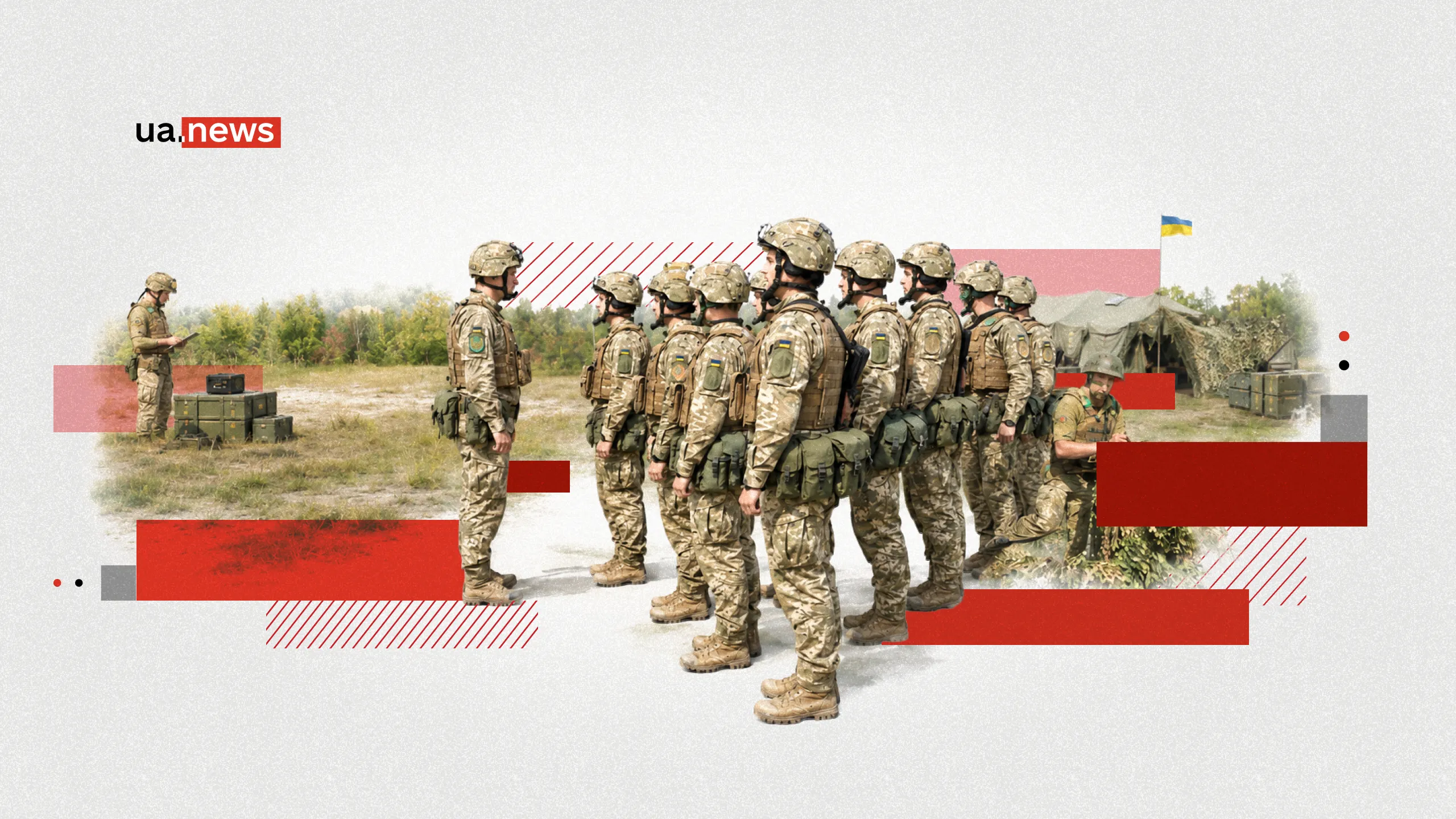
In late August, the head of the Office of the President, Kirill Budanov, made a statement that, if you stop to think about it, makes you want to grab a calculator. The head of the Office of the President said that just to maintain the current situation on the front lines, Ukraine needs to mobilize at least (!) 30,000 people every month.
30,000 per month—that’s 360,000 per year. That’s almost twice the size of Poland’s entire armed forces. This is effectively another massive army that must be found somewhere, outfitted, trained, and integrated into a structure that, according to official statements, already numbers nearly 900,000 people. At least if we are to believe President Zelenskyy, who has repeatedly stated that the current strength of the Ukrainian Armed Forces is about 880,000.
This is a massive fighting force, ranking among the top 7 largest armies in the world. It’s simply a colossal number of people. And here a paradox arises that is very difficult to explain: if we have nearly a million military personnel, and the official permanent losses are relatively (!!) small—then why is such a frantic pace of mobilization necessary? Why recruit 360,000 a year—and that’s the bare minimum? Where, exactly, are all these people going? UA.News political analyst Mykyta Trachuk, along with experts, looked into the matter.
Complicated arithmetic: “resurrected” dead and statistical manipulation
Another warning sign that something is amiss with the official statistics emerged back in July. President Zelenskyy, speaking with Western journalists about Ukraine’s casualties, acknowledged that the situation was “complicated,” but still cited a figure: 50,000 killed and 400,000 wounded. Compared to the enemy’s losses (which are tens of times greater), this seems, to put it mildly, overly optimistic—if not downright fantastical. Especially considering the fact that in February of this same year—that is, six months earlier—the president spoke of 55,000 Ukrainian defenders killed.
A logical question arises: how could the number of fatalities, after six months of active combat, not only fail to increase but actually decrease by 5,000? Is this a statistical error, a mix-up in the numbers, or a miracle—the resurrection of the dead? The answer to this question remains unclear.
This discrepancy casts doubt on the rest of the figures as well. Indeed, Owen Matthews, a British columnist for *The Telegraph*, commenting on Budanov’s statement about the need to mobilize 30,000 people per month, wrote explicitly: this “implies casualties that far exceed the officially acknowledged figures.” If we take as a basis the figure of 50,000 Ukrainian defenders killed by the enemy, then to maintain full strength, it is indeed necessary to replace those killed and those who have been lost due to injuries (especially severe ones that prevent a return to duty). But let’s be clear: 30,000 per month equals 360,000 per year. This means that every year, one way or another, the army loses (through deaths, serious injuries, permanent medical discharge, or other causes) 40% (!) of its current personnel.
Perhaps the official figure of 50,000 killed is just the tip of the iceberg, and the actual number of dead and maimed is an order of magnitude higher? Although it’s worth noting here that military losses are by no means limited to combat casualties, such as the wounded and killed. The Armed Forces of Ukraine are losing hundreds of thousands of soldiers for entirely different reasons.
The Armed Forces’
“Gray Zone”: Absenteeism, Desertion, and “Shabuning”
It is incorrect to attribute the entire personnel shortage solely to potential combat losses. There is another massive aspect of the problem: unauthorized absence from units (AU), desertion, and so-called “shabuning”—when service members seek ways to avoid service by transferring from combat units to the rear, training centers, or support units, using connections, health issues, and/or corruption schemes. In some cases, such individuals serve only on paper.
This vast “gray zone” erodes even more human potential than combat operations. The number of criminal cases involving desertion in Ukraine is breaking records. People who are formally in the military receive benefits but do not physically carry out combat missions and whose whereabouts are generally unknown remain a “headache” for the General Staff. They are the “dead souls” of the modern army. Their existence on paper creates the illusion of full strength, yet on the front lines, this strength is not felt. And there are hundreds of thousands of such soldiers who have joined the Special Forces or have simply deserted from the ranks of the Armed Forces of Ukraine.
Add to this the shortage of personnel even in rear units. Information from the field provided by active-duty soldiers confirms that there is a shortage of personnel not only in combat specialties. Headquarters, support services, and maintenance units are also running low on personnel. This debunks the myth that the problem lies solely in Ukrainians’ unwillingness to join the infantry. The problem is systemic: there is a shortage of personnel everywhere, across the board.
880,000 in the ranks—but where are they?
It’s obvious that during wartime, our own casualties are, to put it mildly, underreported. It’s also clear that far from all 400,000 wounded have returned to active duty. Hundreds of thousands are on medical leave, have deserted, or are stuck in a “limbo” between units and hospitals. And then there’s “shabuning,” fake registrations, and “dead souls”…
Taking these facts into account, the overall picture becomes clearer. 880,000 is a very rough, approximate, “roster” figure—as the Ukrainian Armed Forces soldiers themselves say, a “paper army.” This includes the entire massive administrative apparatus: the General Staff, command structures, logistics, training centers, the TCC, security, communications, and so on. These are the people who also work daily to defend the country, but who aren’t necessarily holding an assault rifle in a trench somewhere near Druzhkivka or Kupiansk.
But the logical question—where do all these people actually go?—doesn’t go away, even if it becomes easier to understand. If we start with 880,000, add 30,000 each month (360,000 per year), and subtract the questionable official casualty figures (50,000 killed), then by the end of the year the army should number over 1.2 million people. Right now, that seems like a fantasy. So, people are “vanishing” en masse not only due to combat losses, but also due to injuries, non-combat losses (ranging from illnesses to mental disorders), self-defence, desertion—and, it seems, a total mess in the accounting system.
The key problem facing the Ukrainian army is not the number of people, nor their alleged physical shortfall (and let’s not forget that some of those mobilized are sent not to the Armed Forces of Ukraine but to other law enforcement agencies). The problem is that the Armed Forces’ massive administrative structure, which has expanded to enormous proportions over the years of war, is ineffective at managing this significant human potential. And this is an entirely objective criticism, necessary even during wartime, since ultimately, the side with the more effective command and control system prevails in the conflict.
Incidentally, in his statement, Budanov also mentioned the coercive “busification,” from which, in his opinion, we must gradually move away (although the head of the Presidential Office directly acknowledged that it will not be possible to completely avoid this during the war). But the problem with this logic is that even if we completely eliminate the “busiks” and replace them with polite recruiters, the target of 30,000 will not be met if the system continues to eat itself from within—through corruption in official positions, desertion, “shabuninism,” and so on.
It is impossible to solve the problem of a shortage of personnel on the front lines simply by ramping up the pace of rounding up men on the streets. It is impossible because there are holes within the system itself through which these people “leak out” faster than they can be recruited. Sometimes it’s pointless to bail water out of a boat—you have to plug the hole in the bottom first.

Opinions of Experts and Military
Personnel
Serhiy, a machine-gunner serving on the Kharkiv front, says he personally hasn’t encountered a shortage of personnel in rear-area positions. But there really is a massive shortage of combat personnel.
“It’s true. We’re critically short-staffed. The ‘paper army’ is very draining on people, so as a result, some people leave for civilian service, for example. We’re also short on officers. There are a lot of vacant combat positions in our unit. But the administrative positions—again, specifically in our unit—are all filled. No one is stupid enough to go on an assault, but sitting somewhere in the rear? People are more than happy to do that. Although ‘rear’ is a very relative concept these days,” the soldier noted.
But Ruslan B., a former car dealer who is currently serving in the State Border Guard Service, describes a somewhat different situation.
“Fortunately, I serve deep in the rear. I handle paperwork, help with record-keeping and accounting. A general-purpose clerk, you might say. I’m not fit for the front lines because I’m 52 years old, and my health isn’t what it used to be. But I can say for sure that even in the rear, we’re understaffed—up to 30 percent. Let me repeat: in the rear! I won’t even comment on combat positions. Clerks, accountants, IT specialists—we’re sorely short on rear-echelon specialties. So when you ask me, ‘Where have all the people gone?,’ I have… the same question in return. I’ve been serving for two years now, and I still don’t understand this,” Ruslan B. shares emotionally.

Political
scientist and director of the Ukrainian Institute of Politics Ruslan Bortnik notes: today, this is one of the most pressing problems and one of the most pressing questions—where are the people in the Armed Forces of Ukraine going? But there’s some hard math here.
“There is no monthly mobilization at the level of 30,000 that Budanov spoke of. In fact, mobilization falls short of that figure by about 30 percent. That is, we’re talking about roughly 20,000 per month. Most of these are people who have been forcibly mobilized; there are very few volunteers among them. And that is why a significant portion of these people later commit acts of insubordination or desertion. This occurs at various stages: either while they are at training centers or after they have been deployed to their military units. In other words, roughly speaking, a significant portion of the 20,000 mobilized may not actually reach the combat units.
In addition, the Armed Forces of Ukraine continue to discharge personnel due to health issues, accumulated injuries, and casualties—both those killed in action and those missing in action. If we factor in an additional 10–20% of such discharges, we end up with a very complex demographic and personnel equation. At the same time, the ratio of the wounded to the killed and missing in action, according to various estimates, may be approximately 5 to 1. And so, the hard math is this: the strength of the Armed Forces of Ukraine has been gradually declining since 2022,” explains the political analyst.
According to the expert, in 2022, the strength of the Ukrainian Armed Forces was estimated at approximately one million personnel. Today, technological solutions make it possible, to some extent, to hold sections of the front line that were previously defended by units with significantly larger numbers. But this works both ways, Bortnik points out. Russia is also actively using modern infiltration tactics—sending small groups into the gaps between Ukrainian positions. Thanks to a combination of firepower superiority and infiltration tactics, Russia continues to advance on certain sections of the front.
“That is precisely why Budanov is right to speak of the need for mobilization at a rate of 30,000 per month. But it is impossible to consistently mobilize these 30,000 within the current system without reforming it. A comprehensive reform of the mobilization system is needed. The problem cannot be solved at the same level of thinking at which it arose. That is precisely why the government today faces an extremely difficult crossroads. In order to take any of the possible paths, additional funds are needed, first and foremost. It is necessary to increase payments to service members, raise salaries, provide various forms of social support, and fulfill social obligations to service members and their families. Accordingly, it is necessary to seek additional financial support from Western partners.
Sooner or later, the government will have to either lower the mobilization age and reduce the categories of individuals exempt from service, or carry out a large-scale reform of mobilization and recruitment. It is also necessary to address the issue of demobilization. A reasonable term of service must be established—for example, three, four, or five years—after which a service member should be granted a guaranteed right to demobilization. Today, this is not being done because the influx of new service members into the Armed Forces of Ukraine is extremely low. But this influx cannot be restored without resolving the demobilization issue. A vicious cycle arises… Therefore, the government will have to either take unpopular measures and strengthen mobilization mechanisms, or find additional funds to boost soldiers’ motivation and improve the effectiveness of recruitment. “This is precisely the crossroads our country finds itself at today,” Bortnik noted.
The political analyst concludes: if the current trend continues, the strength of the Ukrainian Armed Forces will continue to decline. Consequently, Russia’s advantage will grow. And by exploiting this advantage, Russia will continue to advance on the front lines.
In summary, if there is a shortage of personnel not only at the front but also in the rear—where the risks are still far lower than on the front lines—this means, first and foremost, that the command structure itself does not correspond to the new realities. An army of a million on paper and a shortage of personnel in the trenches and in administrative positions—this is a symptom of bureaucratic bloat and incompetence. The Ukrainian army, it seems, needs a thorough audit: how many people are actually fighting, how many are providing support, and how many are simply listed on the roster or are in fact located who knows where.
That is why today the question “where are the people going?” only seems, at first glance, to be very simple—even somewhat mundane or amateurish. In reality, however, it is of fundamental importance, and it is the state’s military and political leadership that must address it first and foremost. It is physically impossible to survive a war of attrition with such numbers—and this is a key challenge for Ukrainian statehood.


