
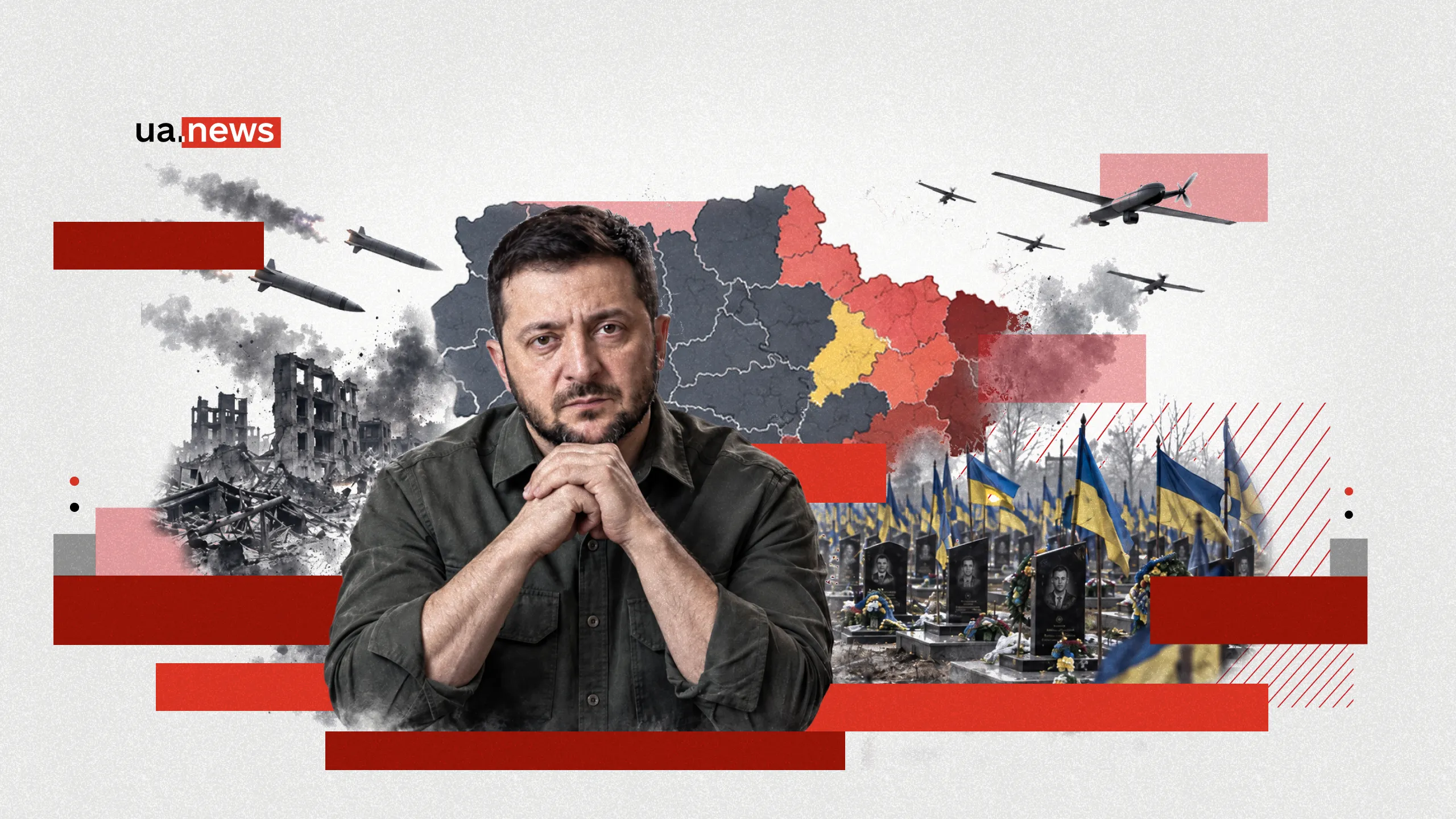
On September 15, Ukrainian President Volodymyr Zelenskyy stated in an interview with CBS News that there can no longer be a so-called “win-win” situation in this war—that is, a victory for both sides. Victory for everyone ended on the very first day of the war. In other words, virtually everyone has long since lost due to the enormous number of casualties and the extensive destruction. Instead, Zelenskyy outlined what he considers to be the only realistic solution—peace, meaning a ceasefire along the line of contact, a halt to hostilities “to save lives,” and a subsequent diplomatic process mediated by partners.
What does this mean? Is this a shift in Ukraine’s position—or perhaps an acknowledgment of what has long been obvious? And most importantly: if victory is impossible for both sides, what, then, should be considered a victory for Ukraine? UA.News political analyst Mykyta Trachuk, together with experts, examined the issue.
“There will be no mutually beneficial solution”: What exactly did Zelenskyy say?
The president made the statement during an interview on CBS News. Zelenskyy emphasized that following the start of the full-scale invasion and the colossal losses on both sides, there can be no talk of any “mutually beneficial” outcome in the end.
“To be honest, there won’t be a win-win—that is, a victory for both sides. It won’t happen. Because there have been an enormous number of casualties on both sides. A victory for both sides ended on the first day of the war,” Zelenskyy noted.
The president made it clear that he sees the path to peace in a complete ceasefire along the line of contact, after which a diplomatic process could begin. Zelenskyy noted that Ukraine is ready to take such a step if the Russian side agrees to a ceasefire without setting conditions.
In the interview, the president also acknowledged the reality once again: negotiations will undoubtedly take place sooner or later, because Putin cannot occupy all of Ukraine, and Ukraine lacks the strength to de-occupy all of its territory. This statement, in essence, encapsulates Kyiv’s current position: there is no military path to complete de-occupation, but there will also be no recognition of the occupied territories as Russian. The only way forward is to cease hostilities.
“The most important victory for everyone—not just for Ukraine and Russia—is peace. To stop this war. For the world, victory means peace… And it’s a victory for human lives,” Zelenskyy noted.
Is this a change in position?
The short answer: no. At least, not a fundamental shift. What we’re hearing now from Zelenskyy is more of a public articulation of what has been taking shape over the past few years, as it became finally clear: Ukraine is currently physically incapable of regaining all its territories by military means.
A partial shift in public rhetoric began with Donald Trump’s return to power. It became particularly noticeable sometime in the middle to late 2024. Zelenskyy began to speak more and more often about the fact that Ukraine currently lacks the strength to return to its 1991 borders. This was no longer news: it was more a matter of acknowledging reality—something that the military and relevant experts themselves had stated repeatedly.
At the same time, it is important to distinguish between the de facto state of affairs and the de jure position. Ukraine’s official position has not changed: the state does not recognize the occupation of its territories and continues to declare its intention to reclaim them—if not by military means, then through diplomatic channels. In the same CBS News interview, Zelenskyy emphasized this point separately. But in reality, the president has long been speaking of his readiness to discuss a ceasefire based on a so-called “Korean scenario,” where each side remains where it is. Such rhetoric has been characteristic of the head of state for several years now, but each time he points out that Russia does not agree with this position. Therefore, the current statement is not “betrayal,” not “capitulation,” or anything of the sort. It is simply a statement of objective reality.
What does a Ukrainian
victory even look like?
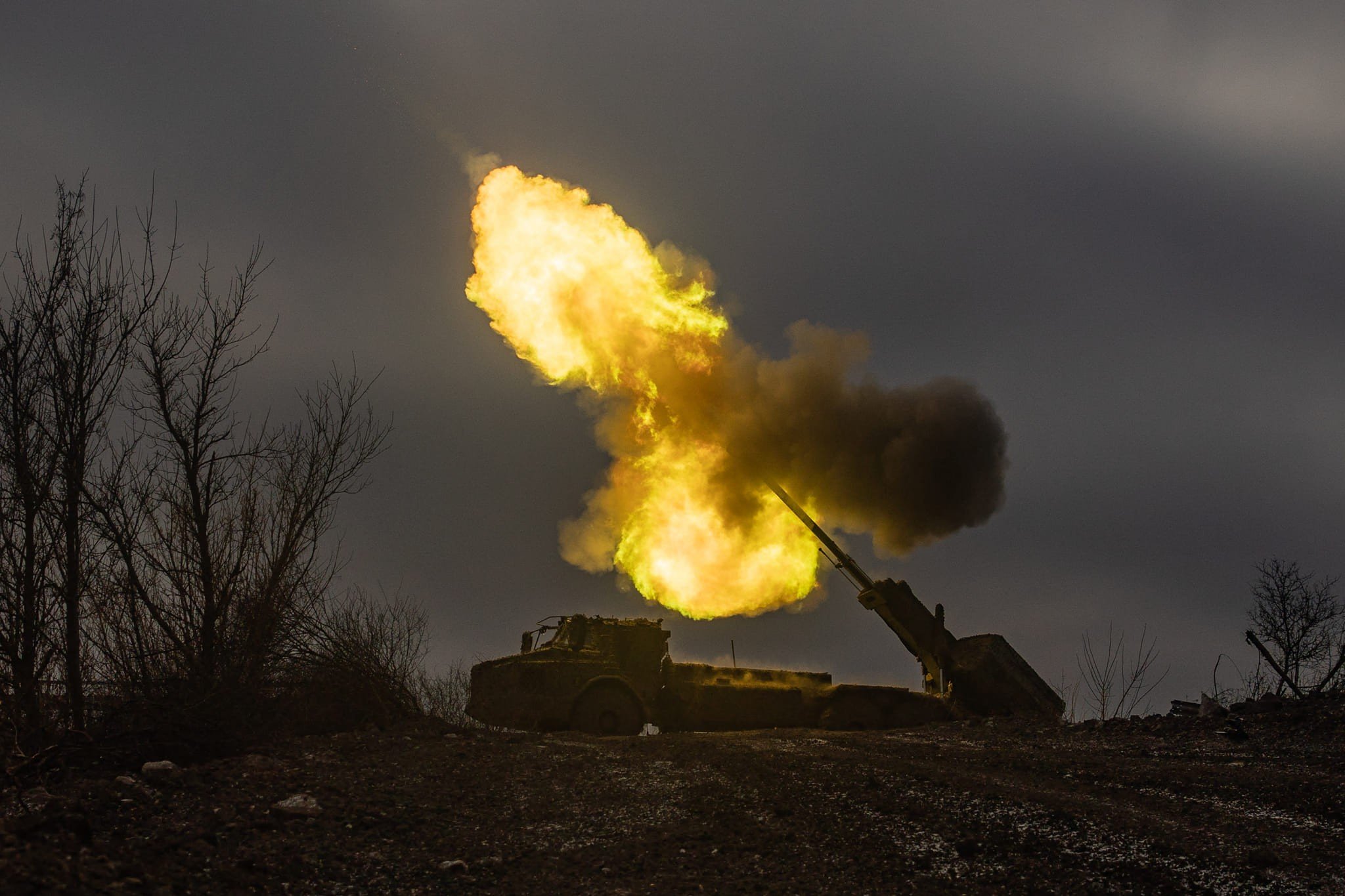
And here we come to the most difficult question: what, in fact, should be considered a victory in this war? The tragedy lies in the fact that the goals of both sides are surprisingly vague, unclear, and, moreover, constantly changing. We won’t even get into Russia right now: their so-called “special military operation goals” are pure abstraction, merely a pretext to continue waging an endless war. But what about Ukraine?
Should we consider it a victory that Ukraine has survived as a state? Absolutely. What’s more: in case anyone missed it, 2022 was four years ago. Ukraine had already survived back then. Kyiv won this phase of the war as early as the spring of 2022, when the Russians withdrew from the capital. Since then, the existential threat, if not gone, has at least receded into the background. So it turns out that in terms of the state’s survival, victory was achieved back in 2022.
Could it be that, for Ukraine, victory means those very same 1991 borders? Perhaps. But who says the war will end there? Why wouldn’t Russia be able to continue shelling Ukraine, or gather its forces and launch a new offensive? And after all, the 1991 borders are an official goal solely in the sense that they are simply state borders, and the state does not recognize their occupation. That’s normal and natural. But at the same time, everyone—from rank-and-file soldiers to experts and the president himself—says that the 1991 borders, as things stand now, are an unrealistic goal. So there’s simply no point in talking about it.
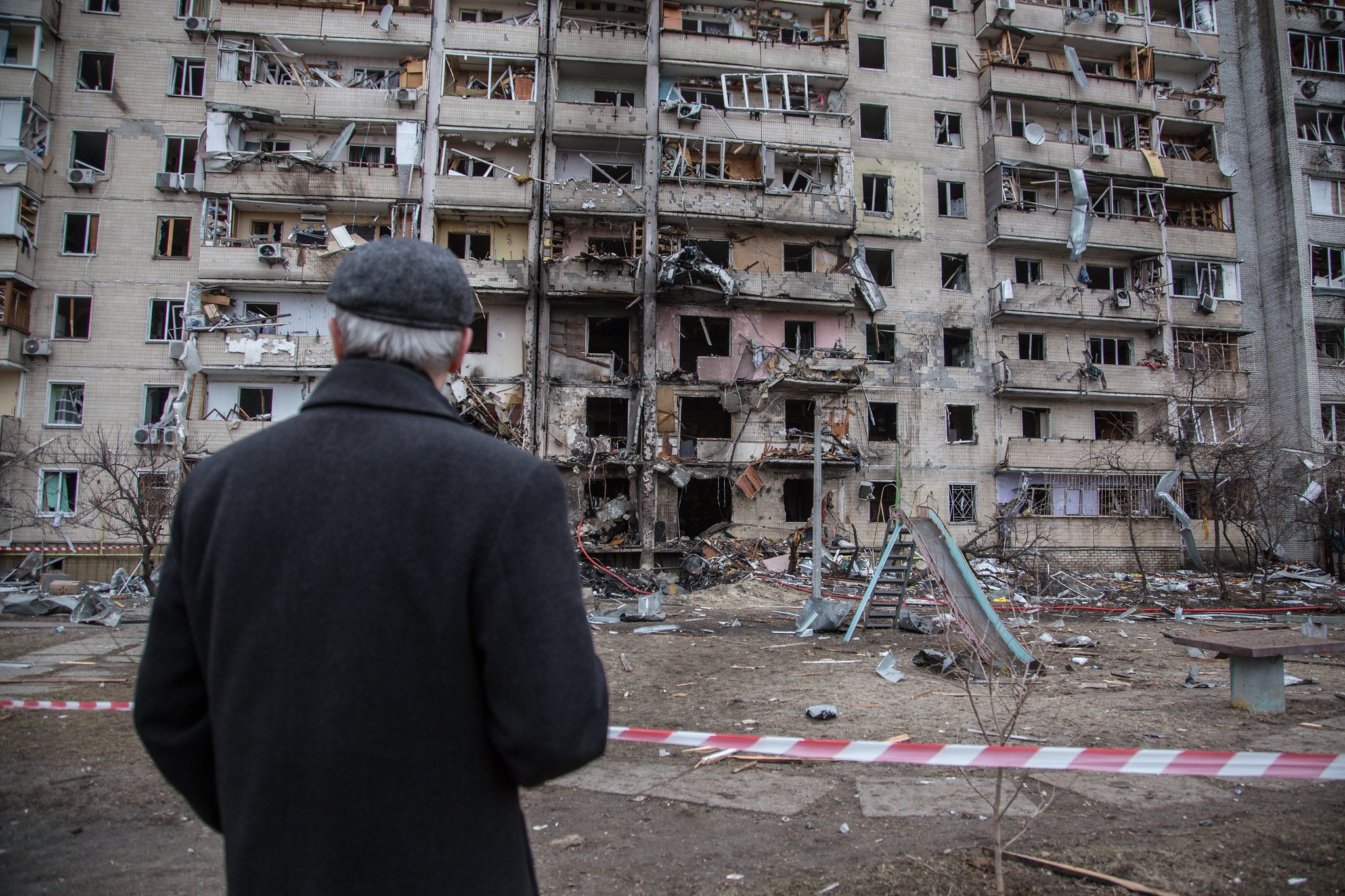
And in general: for some reason, we talk a lot about territory, but very little about people—about how many have already died, how many more will die, and so on. The demographic situation in Ukraine is catastrophic. No one knows exactly how many people are left in the country, but it’s clear that the population has long since fallen below 42 million. The death rate is four times (!) higher than the birth rate. Ukraine simply cannot afford to bury millions more people for the sake of the 1991 borders. Simply because, within those borders, there will eventually be no one left to live there.

Perhaps Ukraine’s victory lies in joining the EU and NATO, or in the return of people from abroad? But these are merely intermediate goals; they cannot be considered the fundamental objective of the war, otherwise it would amount to a certain degree of confusion of concepts.
Perhaps Ukraine’s victory lies in the defeat of Russia? Yes, that seems entirely logical. But achieving this by military means is currently impossible, especially given Russia’s nuclear status. Moscow could, in theory, withdraw its troops from Ukraine on its own—but a scenario in which the Ukrainian Armed Forces storm the Kremlin, as they did the Reichstag in 1945, and hoist the yellow-and-blue flag over its ruins—is simply not on the horizon. Russia may collapse from within—yes—but it may not. So far, Ukraine’s efforts have not led to internal destruction, and hoping for and relying solely on that is a very dangerous strategy.
It turns out that Ukraine, too, lacks a single, unified vision of victory. Victory in this society is like the truth: everyone has their own. And here, by the way, one cannot help but agree with the president—if, of course, he is speaking sincerely—that Ukraine’s true victory will be peace: peace, development, and life, rather than war, degradation, and death.
This, and nothing else, can truly be considered victory. And Ukraine still has a chance at such a victory. As for the chances of anything else, unfortunately, they are very unlikely as of now.
Expert
Opinions
Political scientist and director of the Ukrainian Institute of Politics Ruslan Bortnik believes that victory is still possible, and the key to this victory lies in the internal destabilization of Russia. However, it must be acknowledged that such a scenario is currently unlikely.
“If Russia, weighed down by the war and sanctions, is approaching a period when a transfer of power will need to be organized—since Putin and his entire inner circle are, let’s say, of a very advanced age—then if Russia becomes destabilized, Ukraine will be able to win this war and even de-occupy all the occupied territories. But the probability of this remains low. Mathematical models put it at between 7% and about 20%. From the perspective of the next five years, this probability remains low.
Victory is possible not only through internal destabilization. It is possible if major international powers intervene in this war on Ukraine’s side. Of course, this is also unlikely… But as for a “win-win” scenario, I think that any peace will be a win-win for both sides, since it will allow them to redirect the enormous resources currently being spent on defense and the war. In Ukraine, this amounts to over 40% of GDP; in Russia, over 8% of GDP. This will allow those resources to be redirected toward development, the restoration of economic flows, and so on,” Ruslan Bortnik asserts.
The expert emphasizes: of course, everything depends on how the war ends. If the war ends with a peace agreement, it will be a win-win situation, because both Ukraine and Russia can expect rapid development, rapid recovery, significant investments, and the release of capital that will flow into the real sector of the economy. If, however, the war ends in a stalemate, similar to the Korean Armistice, the long-term outlook will be worse.
“But even such a peace—without a decisive resolution, with blocked trade flows, and the risk of a new war—if it lasts for 10 years or more, will also lead to a gradual recovery of the economy, the social system, a model of positive development, and everything else. So I think the president is saying these things today to prepare public opinion in Ukraine—and perhaps some of our partners—for the idea that some model for ending the war is possible. At least, that’s what we’d like to hope for,” Ruslan Bortnik concluded.
Political analyst and head of the “Third Sector” Center, Andriy Zolotaryov, is certain: Volodymyr Zelenskyy has completely lost his way when it comes to the question of victory—and specifically, what Ukraine’s victory actually entails.
“There can be no win-win in this war. In Kyiv, they believe we must wait for Russia to collapse, and then there will be victory. In Moscow, however, they believe that victory means Ukraine’s capitulation and, perhaps, the ‘final resolution of the Ukrainian question’ through the destruction of Ukraine as a state. That is precisely why there can only be a compromise in which neither side has won or achieved the goals they set at the start of the war. And, Volodymyr Oleksandrovych, we’ve heard about the 1991 borders, reparations, and so on. Yes, some things have changed, but everything must be done in a timely manner.
I believe that if Volodymyr Oleksandrovych had raised the issue of simply stopping the war—then that would truly have been a victory. Precisely because Ukraine has survived as a state, because we have not yet lost hundreds of thousands of lives, and because we have not lost an economy that is barely breathing. To present the end of the war as his own victory. It is clear that ending the war on Russia’s terms would be perceived by a significant portion of Ukrainian society as a capitulation and could lead to very serious, if not catastrophic, political consequences in the country. This, in my view, is exactly what Zelenskyy fears as he tries to outlast Trump. And the talk of a “win-win” is just another statement, another public address by the president—ones we’ve heard time and again over the years, but which have brought about little change,” Andriy Zolotaryov asserts.
In
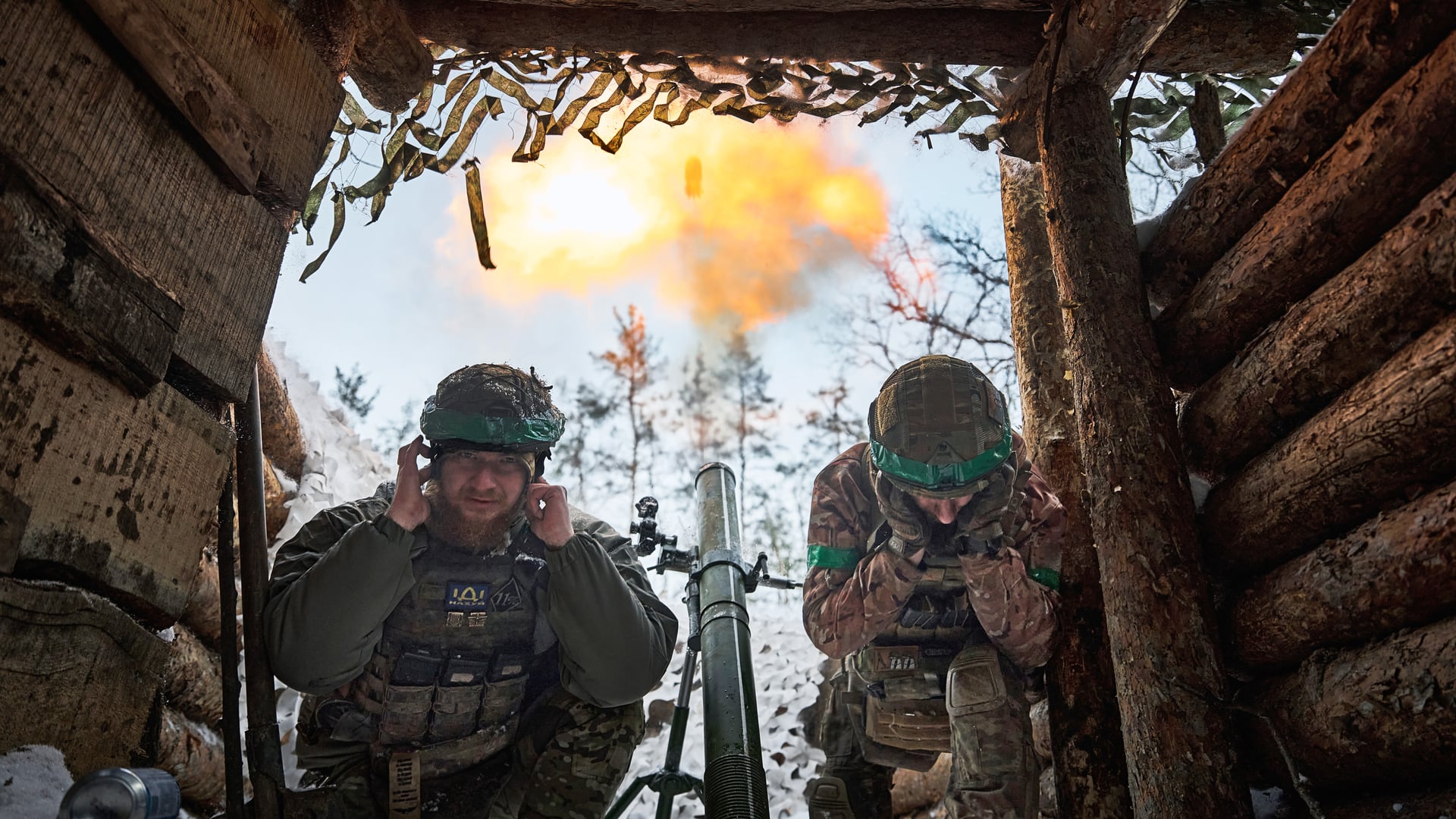
summary, Zelenskyy’s statement does not so much represent a change in position as it does yet another public acknowledgment of reality. Peace appears to be the only possible victory that leaves Ukraine with a chance for the future. This is not “surrender,” but a sober assessment based on reality: horrific losses and destruction, a demographic catastrophe, gradual exhaustion, and so on. The president simply stated what certain military officials, experts, analysts—and ordinary people in their kitchens—have been saying for a long time.
The question isn’t whether victory is still possible for Ukraine. The question is what we’re willing to call a victory. If victory means the 1991 borders or the total defeat of Russia, then that is currently out of reach, and everyone—or almost everyone—acknowledges this. If victory means preserving Ukraine as a state—its people and its future—then it is not merely possible; it has already been partially achieved. And the state’s current task is to ensure that what remains is not lost and to stop the endless conveyor belt of death.




