
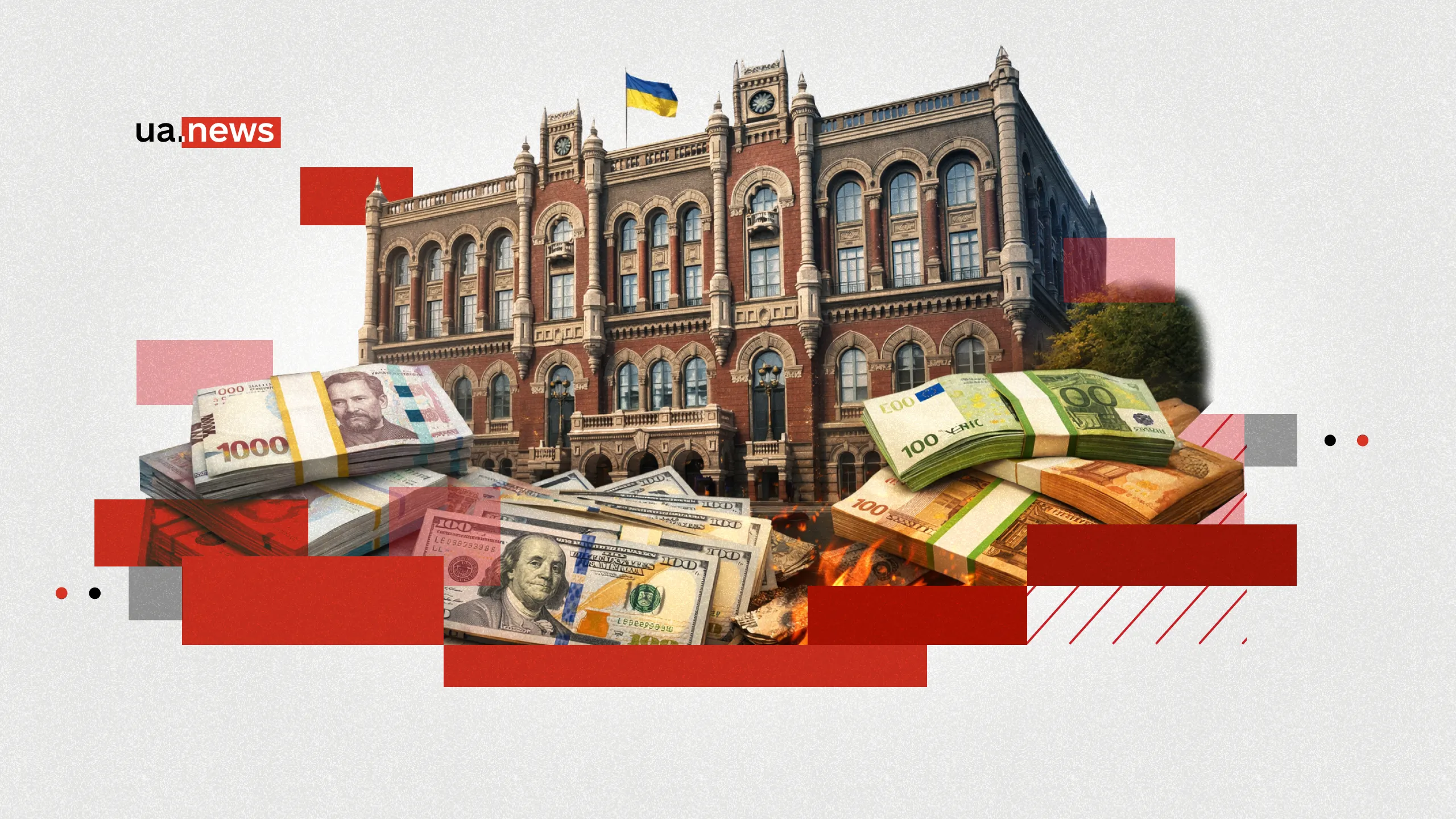
March 2026 became the most intense month for the National Bank of Ukraine since the peak of the currency crisis in late 2024. The regulator was forced to inject nearly $4.8 billion into the market to supply it with foreign currency, curb demand, and prevent a sharp collapse of the hryvnia. This is a record figure over the last 15 months, highlighting the country’s currency deficit. Overall, since the beginning of the year, the National Bank has already spent $12 billion of its reserves. At the end of 2025, total reserves amounted to around $57 billion.
This policy is akin to extinguishing a fire with one’s own water reserves when the fire hydrant (external financing) is shut off. Hungary continues to block a €90 billion EU loan to Ukraine, while a new IMF program has been jeopardized by a parliamentary crisis. What is happening is neither accidental nor temporary. Rather, it reflects deeper problems in Ukraine’s financial system: persistent imbalances and total dependence on external aid.
How long can the NBU continue selling its foreign currency reserves, why is this happening, and what will be the cost of further delays in international assistance? Political analyst Mykyta Trachuk, together with experts, examined these questions.
March sell-off: new figures set a record
In March 2026, the National Bank of Ukraine’s foreign currency interventions reached $4.774 billion, the highest since December 2024, when a historic peak of $5.3 billion was recorded. Combined with January–February interventions, the total amount of currency sold since the beginning of 2026 approaches $12 billion. Nonetheless, as of now, the regulator reports that $51.9 billion remains in its accounts.
What is driving this rush? Multiple factors are at play: from the energy shock caused by rising global oil prices to inflation expectations that prompt businesses to preemptively purchase imported goods. The main factor, however, is the lack of confidence in the future due to delays in external assistance.
As of March 1, 2026, Ukraine’s international reserves had fallen to $54 billion, and by April 1, they dropped another $2 billion. Formally, the current level of reserves appears to provide a solid “cushion” for financial stability. But looking at the dynamics, and considering that March interventions nearly doubled compared to February ($4.7 billion vs. $2.9 billion), it becomes clear that even this “cushion” may not suffice if current spending rates continue.
A separate item of expenditure is debt service. In February, Ukraine spent $804.1 million on servicing and repaying foreign debt and $279.7 million to the IMF. In March, these payments were $123.3 million and $260 million, respectively. In the context of delayed inflows from international partners, these obligations place a heavy burden on Ukraine’s financial system.
Why the NBU is selling reserves
The regulator is forced to act as the main—and often sole—seller of currency in the market due to a structural deficit. Simply put, businesses and individuals want to buy dollars and euros, but there is no one to sell. In March, the interbank market deficit reached a three-month high of $0.96 billion.
Why is this happening? First, due to reduced export revenue. The agricultural sector, traditionally the main source of foreign currency, operates under fuel shortages, partial port blockades, and infrastructure attacks. Second, due to rising imports, both critical (fuel, equipment) and consumer goods. War and economic uncertainty prompt Ukrainians to protect their savings in foreign currency, and businesses to stockpile for “a rainy day.”
Thus, the NBU acts as a balancer, selling reserves to prevent a sharp fall of the hryvnia. Without this intervention, the exchange rate would plummet, instantly driving inflation into double digits and eroding citizens’ purchasing power.
It is important to understand that foreign reserves are not just a “safety net” for currency market corrections. They are also a source of hryvnia for the budget. When the NBU sells foreign currency, it receives hryvnia, which is then used to fund government expenditures.
Thanks to this mechanism, the government can carry out large-scale, socially oriented programs, even if not fully justified from a macroeconomic perspective. In April, one-time payments of 1,500 hryvnias were distributed to vulnerable groups—around 13 million Ukrainians. National cashback programs, fuel subsidies, and other measures are also still in effect.
Effectively, today foreign reserves are “fuel” not only for the currency market but for the entire social system. If reserves are exhausted, the first to suffer will be those whom the state is trying to protect.

EU loan and IMF programs
The main uncertainty for Ukraine’s financial system is the fate of the €90 billion EU loan for 2026–2027. Hungarian Prime Minister Viktor Orbán publicly stated that his country would block the disbursement until Ukraine resumes the supply of Russian oil via the Druzhba pipeline. Supplies were halted after a Russian attack at the end of January 2026, but Orbán insists that this was a “political decision” by Kyiv.
At the EU summit on March 19, 25 of 27 leaders adopted a decision confirming their intention to start disbursing funds in April. This is insufficient, however, as full consensus is required. Budapest and Bratislava abstained, effectively blocking the decision. Orbán stated that “no one can demand a positive response from us” and promised not to support any EU financial aid to Ukraine until Druzhba oil supplies are restored.
External financing problems are not limited to the EU loan. In February, the IMF approved a new $8.1 billion Extended Fund Facility for Ukraine. However, this initiative is also under threat, as Ukraine has not met any of the three key “structural benchmarks” planned for Q1 2026. The Verkhovna Rada failed to pass several bills, such as new taxes required by the Fund, and continues this policy.
Consequences of delayed funding
The absence of the EU loan, the disruption of the IMF program, and delays in other assistance could trigger a systemic financial crisis as early as summer 2026. Several scenarios are possible:
First — baseline pessimistic: The NBU continues selling reserves at the current pace. In this case, they would last for 5.5 months, according to NBU data. This also takes into account debt service payments (around $0.5–1 billion per month) and the potential increase in currency demand due to devaluation expectations. A more realistic exhaustion timeline in this scenario is 6–8 months.
Second — crisis: External financing is completely blocked, and currency demand rises another 20–30% due to panic. In this case, reserves could be depleted within 3–5 months. After that, the NBU would be forced either to sharply devalue the hryvnia (triggering hyperinflation) or impose strict currency controls (banning currency purchases, limiting capital outflows, etc.). Both options would have catastrophic socio-economic consequences.
Third — optimistic, but unlikely: Hungary lifts its veto after the April 12 elections, the first tranches of the EU loan arrive in May–June, and the IMF overlooks missed structural benchmarks and disburses the next tranche. In this case, reserves could not only stabilize but also begin to grow, reaching the NBU’s projected $65 billion by the end of 2026.
Expert opinions
Economist and Executive Director of the Economic Discussion Club, Oleg Pendzyn, believes that there is no immediate catastrophe. In his view, the National Bank of Ukraine (NBU) feels calm and confident while following a well-considered policy.
“Don’t confuse NBU reserves with government obligations. NBU reserves cannot be used to cover the Ministry of Finance’s commitments. So the National Bank is not selling off reserves—it is intervening to support the exchange rate of our national currency, the hryvnia. Selling reserves to support the currency is completely normal. The Ministry of Finance doesn’t get anything directly from this. I also want to point out that in March 2022, the NBU had $22 billion in reserves. Now, after all the interventions, it holds about $53 billion. This amount is unprecedented. We have never had more than $30 billion in foreign currency reserves in the entire history of independent Ukraine. So today, the NBU feels very comfortable and confident. There is no need to worry,” Pendzyn said.
Candidate of Economic Sciences and economic expert at the Ukrainian Institute of Politics, Vadym Syrota, offers a more critical assessment.
“In the early 1990s, Russia had a reformer, Yegor Gaidar, the initiator of the ‘shock therapy’ policy—I call it ‘shock without therapy.’ It feels like his grandchildren are now in our government. Why? Because our economic policy is exactly this ‘shock without therapy.’ Their strategy is to survive the night and endure the day. In the coming months, the illusion of financial self-sufficiency and the ability to sustain the war on our own will fade. Cash gaps will emerge, and dependence on Western aid will become critical. Financing needs for 2026–2029 are $136.5 billion. This includes the €90 billion EU loan, the Ukraine Facility program, cooperation with the IMF, and so on. Without these programs, the money will only last until May. In other scenarios, slightly longer. We have a very short-term planning horizon; we do not have the resources to fund the war ourselves, and our dependence on partners is obvious. These loans only cover cash gaps, like borrowing from a loan shark until payday,” Syrota said.
According to the economist, there is an illusion regarding reserves: that there is enough of them and we can live off them. But this is not currency earned from a well-functioning economy—it is financial aid.
“The NBU lies like a dog on hay on this money. It’s an illusion of currency stability funded by our Western partners, and it is already beginning to break. What is the solution? Rely on our own resources. Look at financial resources: do we have enough to continue this policy, to continue the war? With these needs, we require $52 billion for 2026, and so far only $5.5 billion has been secured. That leaves $46.5 billion. I don’t know where we can get it. Only from Western partners. But this is not a fundamental solution, only a continuation of the current situation.
And the most frightening part is the lack of domestic resources to replace EU aid. Annual budget losses from the shadow economy are $9.8–$12.5 billion. Even with perfect formalization of domestic resources, it still wouldn’t be enough. And in these conditions, talking about another 2–3 years of war is not a realistic view. The main role in winning this war will be played by economists. Whose economic model is more viable, that side will win the war. And unfortunately, under the current situation, I do not see our victory,” concluded Vadym Syrota.
March’s record NBU reserve sales are not just statistics—they are a warning. They reflect a deep structural imbalance: Ukraine consumes more currency than it earns and relies on external aid as the only source of fragile stability. But this is stability on life support: formally alive, but barely. When the aid flow is cut, the full burden falls on the NBU and its reserves.
Time is working against Kyiv. Without incoming financing by July–August, reserves will reach a critical threshold. Ukraine has proven its resilience in the harshest conditions, but the financial system, like any system, has its limits.


