
A laboratory has been opened in Ukraine to search for asbestos in the rubble left behind after shelling
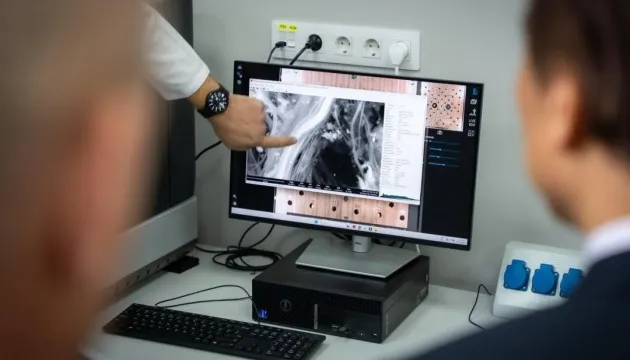
A national laboratory has opened in Kyiv to detect asbestos in building materials and debris from the destruction. The new equipment makes it possible to detect even very fine fibers that are hazardous to human health. Initially, specialists will test materials from UNDP projects that are helping to clear debris following Russian attacks.
A laboratory has been established in Ukraine to help detect asbestos in destroyed buildings and construction debris. It was opened in Kyiv with support from the United Nations Development Program (UNDP) and the Government of Japan. According to him, the laboratory is equipped with a transmission electron microscopy system. It allows for the detection of even the finest asbestos fibers, which are difficult or impossible to see with a conventional optical microscope.
This is crucial for clearing debris following Russian shelling. Some of the damaged buildings contain asbestos-containing materials, and during demolition and dismantling, hazardous fibers can be released into the air.
Why Is Asbestos Dangerous?
Asbestos is a group of natural minerals whose fibers were once widely used in construction. It is found, in particular, in certain types of slate, thermal insulation, and other building materials. As long as these materials remain intact and undamaged, the risk of fibers being released into the air may be lower. However, when a building is demolished, or when materials are cut, broken, or rubble is cleared away, asbestos fibers can be released. They are so small that a person can inhale them without even noticing.
Inhaling asbestos fibers is linked to the development of serious diseases, including lung cancer and mesothelioma—a malignant tumor of the membranes covering the lungs and other internal organs. The danger also lies in the fact that these diseases may not manifest until many years after exposure to asbestos. According to estimates by the World Health Organization and the International Labour Organization, occupational exposure to asbestos causes more than 200,000 deaths worldwide each year. This accounts for over 70% of work-related cancer deaths.
In Ukraine, the use of asbestos was banned in October 2023. However, this does not mean that it has disappeared from buildings constructed earlier. That is why, when demolishing old or damaged structures, it is necessary to inspect the materials and follow safety regulations.
What the New Laboratory Will Test
In the first phase, the laboratory will analyze materials collected as part of UNDP projects on debris management. The test results will help determine which waste contains asbestos and how to handle it safely. According to Viktor Lyashko, during debris clearance operations in eight regions of Ukraine, UNDP helped manage over one million metric tons of debris. Of this total, more than 3,570 metric tons of hazardous waste—including materials containing asbestos—have already been safely separated.
Now, laboratory tests will help determine the composition of the waste more accurately. This will make it possible to better protect workers clearing debris, properly sort construction waste, and determine which materials can be reused. It is important to note that not all debris from the destruction can be safely recycled. Before reuse, it must be tested for hazardous substances. Only then can it be determined which fractions are suitable for further construction work.
Ukraine is preparing to meet European requirements
The opening of the laboratory is also linked to the alignment of Ukrainian standards with European Union requirements. According to the Minister of Health, EU Directive 2023/2668 calls for a tenfold reduction in the permissible concentration of asbestos in the air of the work area—to 0.01 fibers per cubic centimeter. Starting December 21, 2029, EU countries must use electron microscopy to measure asbestos concentrations.
Ukraine is already working on developing the necessary system. The next steps for the new laboratory will be accreditation under the international standard ISO/IEC 17025 and training for Ukrainian specialists. This standard defines the requirements for the competence of laboratories that conduct testing and calibration. Accreditation will confirm that the laboratory operates in accordance with established requirements and can provide reliable test results.
In addition, the Ministry of Economy and UNDP are jointly developing standards for the safe management of demolition waste. Ukraine has already developed national standards for sampling, asbestos detection, and monitoring asbestos levels in the air. Work has also begun on new regulations in the field of circular construction, which involves the reuse of materials.
Why This Is Important for Ukraine’s Reconstruction
According to RDNA5 estimates, as of the end of 2025, 14% of Ukraine’s housing stock had been damaged or destroyed as a result of Russian attacks. This has affected more than three million households. Reconstruction will require a large amount of building materials. Some of the debris from the destruction can be recycled and reused, but to do so, it is necessary to ensure that it does not contain hazardous substances.
Deputy Minister of Economy Olena Kramarenko emphasized that testing the materials is a key requirement for safe reconstruction. “A significant portion of the debris from the destruction can be recycled and reused for reconstruction. However, this requires proper sorting and testing of materials for hazardous substances,” she noted.
According to Kramarenko, the new laboratory will help create conditions for the safe use of recycled materials in construction. This will not only reduce the amount of waste but also protect people’s health and the environment. The project was implemented with financial support from the Government of Japan and with the participation of UNDP in Ukraine. Following its opening, the laboratory will prepare for international accreditation, and its specialists will undergo training.
Thus, the new laboratory should help Ukraine safely demolish damaged buildings, separate hazardous materials, and determine what can be reused during reconstruction. This was announced by Ukrainian Health Minister Viktor Lyashko.
The Verkhovna Rada has passed a law banning the use of asbestos in construction.




