

Taking advantage of the depletion of Ukraine’s air defense capabilities and intelligence shortcomings, Russia is rapidly attempting to “knock out” the energy infrastructure of Ukrainian cities. On October 16, Valery Gerasimov, Chief of the General Staff of the Russian Federation, publicly reported to dictator Putin on the launch of a planned campaign of massive strikes against Ukraine’s energy facilities.
At the same time, Western media have once again raised the issue of a “Russian plan” to create a humanitarian crisis in Kyiv, Kharkiv, and Odesa. Although the Russians have not abandoned their intentions to paralyze normal life in these cities since the start of the full-scale invasion, the situation is particularly risky this time.
Against the backdrop of agreements between the Donald Trump administration and Russia, the deterioration of U.S.-Ukraine relations has reached a climax in recent days. The U.S. is threatening to block the sharing of intelligence and halt arms sales. This makes it much easier for the Russians to carry out energy attacks on Ukrainian cities.
UA.News explains the Russians’ tactics this winter and why Kyiv may prove to be the most vulnerable to energy attacks among other cities.
A New Campaign of Energy Terror
“We have officially launched massive strikes on Ukraine’s energy infrastructure,” announced Valery Gerasimov, Chief of the General Staff of the Russian Armed Forces. Putin responded by saying that the attacks must continue.
It should be recalled that in June 2024, the International Criminal Court in The Hague had already issued an arrest warrant for Gerasimov for his direct involvement in missile strikes on Ukraine’s energy infrastructure in 2022–2023; yet the Russian general continues to commit war crimes and even makes official statements about them.

A few days before the Russian Federation announced its military campaign, some details of the energy terror planned by the Russians had already appeared in Ukrainian and Western media.
“Pressure is mounting in Ukraine’s capital: the economy is on the brink of collapse, and the energy system—which provides heat for homes and keeps toilets functioning—could fail in the coming months,” according to an article in The New York Times published on October 15. According to the publication’s findings, the Kremlin intends to cause a humanitarian catastrophe in three cities with populations of over one million in just one month.
“Kyiv, Kharkiv, and Odesa stand out as the main targets, with plans to cut electricity supplies to these cities by 90%, reduce heating supplies by 90%, and severely disrupt the sewage system,” the NYT writes.
Although the main targets for the Russians are Kyiv, Kharkiv, and Odesa, the “priority” targets also include more than 10 other regional centers and major cities in Ukraine.
The widespread destruction is driven by several factors. Ukraine’s air defense system has been depleted by years of attacks and cuts in U.S. military aid. Russia, on the other hand, has expanded its arsenal of missiles and drones not only in terms of quantity but also technologically—the weapons have become more powerful. At the same time, Ukraine’s energy infrastructure has become so vulnerable after numerous attacks that even a single strike could cause significant destruction.
The American publication paints an apocalyptic scenario that the Kremlin is preparing for Ukrainians this winter, citing a previously known document that was intercepted by Ukrainian intelligence and shared with European partners at the “Energy Ramstein” meeting on September 17.
Earlier, the “Schemes” project received a copy of this document from the Ukrainian Defense Forces. An unnamed representative of the defense sector explained at the time that it was an analytical report for calculating orders and manufacturing weapons, not a final plan for Russian combat operations.
The document describes a campaign of strikes using up to 1,000 missiles, drones, and aerial bombs. The stages of the military operation include strikes on nuclear power plants, hydroelectric power plants, and electricity imports from the European Union. Russia will attempt to “shut down” Ukraine’s three largest nuclear power plants—the Rivne, South Ukraine, and Khmelnytskyi plants—as well as the distribution hubs that connect the plants to the grid.
At the same time, the Russians plan to attack small critical facilities serving various purposes: electrical substations, boiler rooms, wastewater treatment plants, and water supply and sewage systems. In this way, the aggressor country plans to trigger not only large-scale blackouts but also a chain reaction, in which the failure of one facility will exacerbate the damage to others.
A specific number of weapons is allocated for each critical facility, and the use of more powerful weapons is increasing. For example, the Russians are planning to use two “Iskander” missiles to destroy a single nuclear power plant distribution node. For a single hydroelectric power plant—up to 25 “Molniy,” “Geran,” “Dan-T/Banderol” missiles, or three “Kinzhal” missiles. The same amount of ordnance is allocated for thermal power plants: 25 “Molniya,” “Gerani,” “Dan-T/Banderol” missiles, or three “Kinzhal” missiles for each. At the same time, the plan calls for 20 “Gerani,” “Dan-T,” or “Banderol” missiles to destroy a single boiler house.
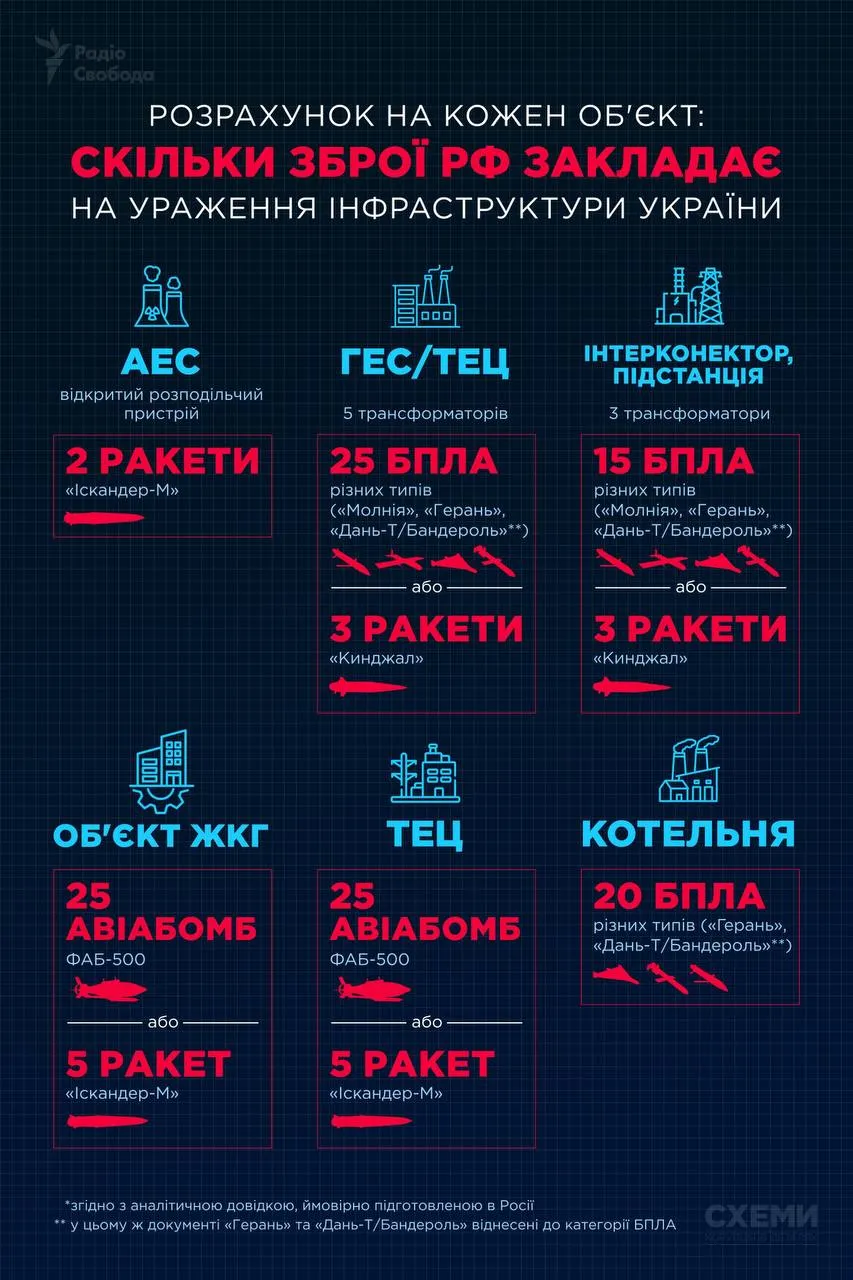
The Russian plan also specifies the total amount of weaponry required to paralyze Ukraine’s energy sector and critical infrastructure.
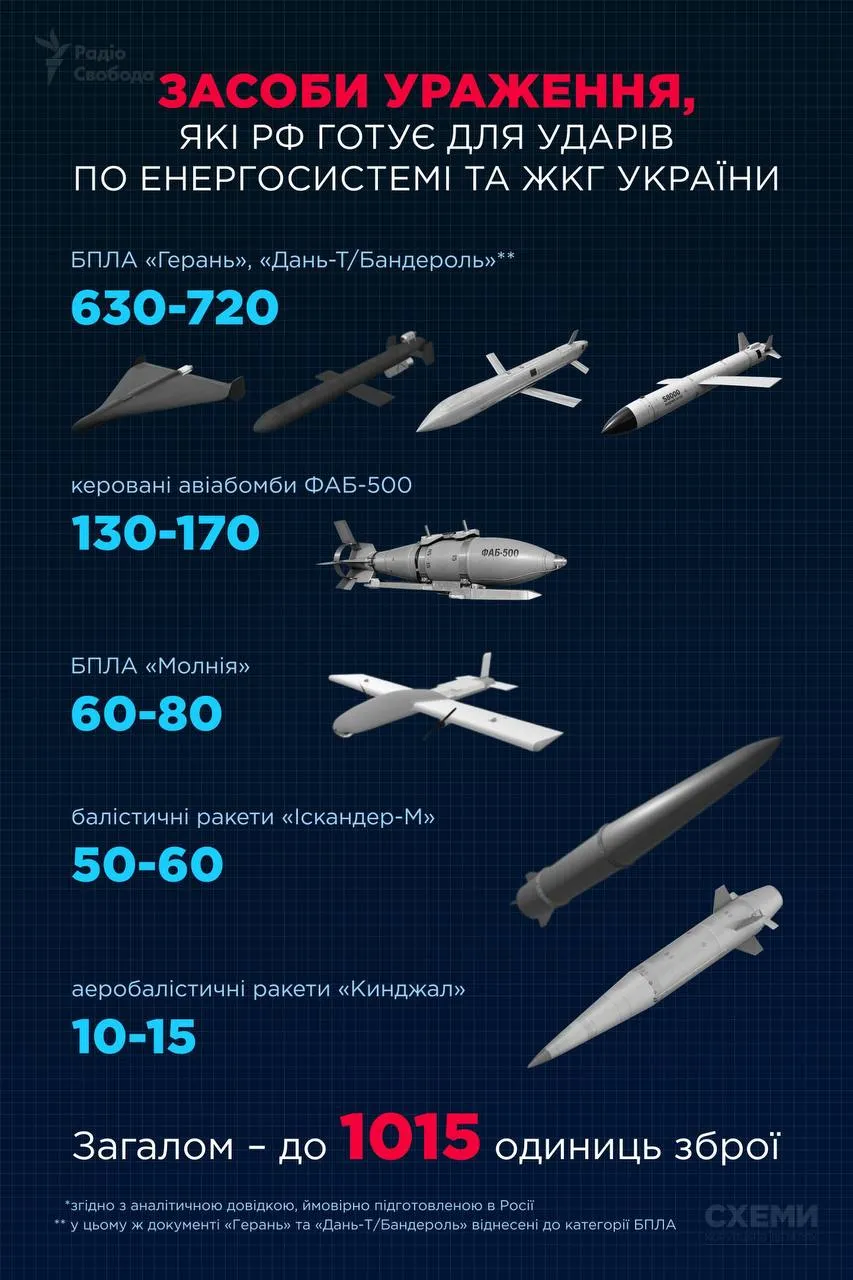
Attempts to destroy Ukraine’s power grid are part of Russia’s overall military strategy. According to energy experts, similar reports have been emerging consistently since the start of Russia’s full-scale invasion. Since 2024, these plans for energy terrorism have not changed significantly.
As early as November 2022, Ukraine’s National Security and Defense Council warned of a plan for the large-scale destruction of Ukraine’s power grid, masterminded by Sergei Kirienko, deputy head of Putin’s administration. From 2005 to 2016, Kirienko worked at Rosatom and is well aware of the energy sector’s vulnerabilities.

Kyiv’s Fragile Power Grid
Massive attacks on the power grid in Kyiv and the surrounding region on the nights of September 30 and October 7 demonstrated the air defense forces’ actual readiness and the grid’s ability to recover from such strikes. In Kyiv, rolling blackouts were implemented even during warm, sunny weather.
The main reason was the reduction in capacity at the capital’s thermal power plants, which generated about 1.3 GW before the full-scale war but only 500 MW in the fall of 2026. On October 14, all three thermal power plants in the capital came under ballistic missile attack, after which they ceased generating electricity. As a result, Kyiv became entirely dependent on power supplies from other regions.
At the same time, Russia began “taking out” the infrastructure that transmits electricity to Kyiv residents. These are the main substations of the power system operator “Ukrenergo,” which transmit electricity from large power plants—including the Rivne Nuclear Power Plant—to the capital. Attacks on these facilities also cause power outages.

“The Kremlin’s
tactic of attacking substations that distribute electricity generated by nuclear power plants is not new. Such strikes can trigger the nuclear power plant’s automatic safety systems, which shut down the power units—and a blackout may occur. Ukraine experienced its only blackout on November 23, 2022. Ukrainian energy workers know how to restore power after such a system-wide failure, but there may be no electricity, communications, or internet for several days,” notes Maria Tsaturyan, an expert at the Ukraine Facility Platform.
However, prolonged blackouts and damage to the heating system during cold spells can make living in some homes impossible, as was already the case last winter in the Troieshchyna residential district. If pumps, elevators, parts of the water supply systems, and electronic payment systems all stop working at the same time, problems will arise even where there is no physical damage.
Reporting on preparations for the heating season, Kyiv Mayor Vitali Klitschko stated on October 14 that Kyiv had already completed its priority energy resilience measures. According to him, nearly 700 generators, 70 mobile boiler rooms, 3 diesel power plants, and a backup water intake have been installed for heat and water supply facilities, and “Kyivvodokanal” has received 103 generators.

Kharkiv Is Building an Energy
Island
Due to constant Russian missile and drone attacks, Kharkiv has completely lost all of its own heat and electricity generation capacity. The city is entirely dependent on power transfers from other regions of Ukraine and on distributed generation.
Kharkiv Thermal Power Plant No. 5—one of the largest in Ukraine—was completely shut down back in the spring of 2024 due to extensive damage. Throughout 2025–2026, it was regularly targeted by Russian strikes, with the latest critical damage recorded in October 2026. Russia also relentlessly attacks local substations and power distribution networks around the city.
At the same time, despite its proximity to the Russian border and regular shelling, Kharkiv has a more well-thought-out and systematic strategy for energy resilience than Kyiv. The city is developing a diversified energy system to get through the upcoming 2026–2027 heating season and is preparing for severe challenges if hostilities and shelling of the city do not cease by then. “
We’re doing everything we can, and we’re doing a great deal. Unfortunately, not everything depends on us. Because no matter how much we reinforce, for example, modular boiler rooms or cogeneration equipment, all it takes is 3–5 missiles, and that’s it... Yes, we’re planning some backup options, such as energy islands, and a competent team is working on this constantly. We know we need to prepare before winter, and we understand what we’re doing,” said Kharkiv Mayor Ihor Terekhov in an interview.
Critical Energy Supply Situation in Odesa
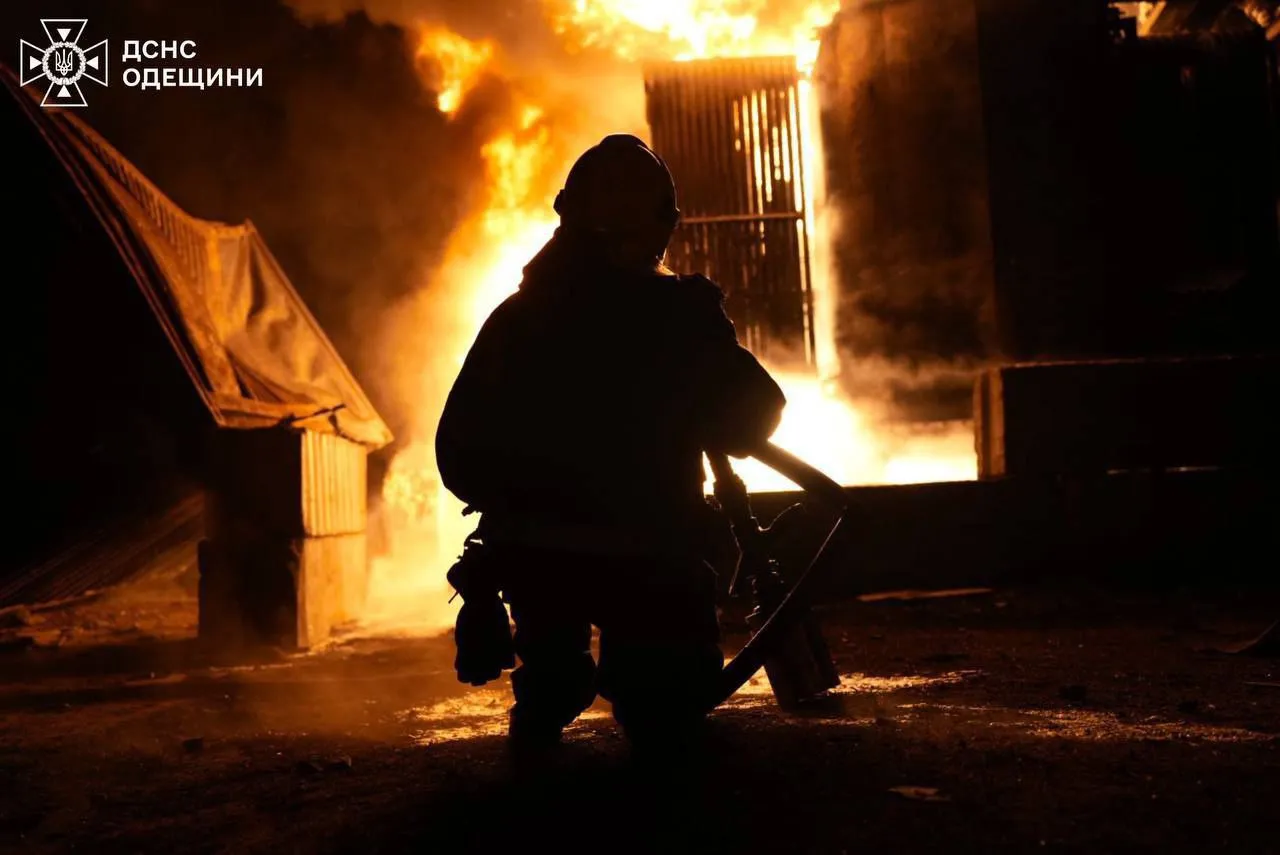
Odesa and the surrounding region are among the most vulnerable areas to Russian attacks on critical infrastructure. Massive attacks have dual consequences not only for residential areas but also for maritime trade and logistics infrastructure. Prolonged blackouts can paralyze the operation of port infrastructure, warehouse complexes, businesses, communication systems, and municipal services.
For Odesa’s economy, prolonged outages will mean increased business costs for generators and fuel, production stoppages, logistics delays, and reduced corporate revenues. If the situation worsens, some workers may leave for other regions, and companies may relocate.
Local authorities report that, as part of preparations for the 2026–2027 heating season, 94.8 MW of new distributed generation capacity is being built in the Odesa region. In particular, the Ukrainian Energy Support Fund has allocated over EUR 130 million for the purchase of critical equipment—cogeneration units, generators, and solar power plants. A significant portion of this equipment has already been delivered to the region.
Alexander Kharchenko, director of the Center for Energy Research, considers the energy supply situation in Odesa to be just as critical as in Kyiv. According to him, if the city has no power generation capacity, and demand is enormous—Odesa consumes 5–7% of the country’s total power generation—then, in the event of intense attacks on high-voltage substations and distribution networks, the city simply lacks the means to prevent power outages.

Vitaliy Kulik: The situation may turn out to be most difficult in Kyiv
I wouldn’t say that all of the Russians’ plans are being carried out. On the contrary, there are reasons to believe that they are failing to achieve all of their stated goals. However, there is no doubt that the situation could be difficult, says Vitaliy Kulik, director of the Center for Civil Society Studies.
“If we analyze the Russians’ actions, we can see that they have concentrated their main attacks on Kyiv and are trying to cause the collapse of the city’s infrastructure and life-support systems. This includes housing and utilities, education, healthcare, transportation, logistics, and food supply.
At the same time, Kyiv differs from Kharkiv, for example, where an emergency response system and a situation center—established earlier by Mayor Terekhov—are already in place. There, clear response protocols are in place, allowing services to operate without waiting for instructions from city hall. Perhaps there is less theft via Prozorro in Kharkiv.
In my opinion, It will be the worst in Kyiv. Not because of the capital’s vulnerability as such, but because of the inefficient management of municipal services and the city government’s lack of preparedness to respond to such challenges. “Thus, the primary issue is the quality of governance and the city authorities’ ability to act effectively in crisis conditions.”
Vitaliy Kulik points out that Kyiv lacks a comprehensive resilience plan—instead, there is a slideshow. Nor are there any alternative scenarios in place in case of serious logistical problems.
“The issue of energy resilience remains unresolved: no network of mini-boiler rooms has been established, and no powerful industrial generators have been installed. There is no adequate support for homeowners’ associations in renovating buildings and preparing for the heating season. On the contrary, we are seeing a restructuring of processes and delays in funding. All of this, in my opinion, creates a difficult situation in Kyiv and will significantly complicate the heating season.
If the necessary decisions had been made in a timely manner, the situation could have been different. Specifically, this involves the decentralization of logistics routes and the systematic coordination of the transition to autonomous heating. In apartment buildings, this remains nearly impossible due to a Cabinet of Ministers resolution and a city council decision. All these factors complicate the city’s preparations for potential crisis scenarios.”
According to Kulyk, a significant portion of Kyiv residents have adopted a survival strategy that involves staying in the city. Some have nowhere to go, some lack the means to leave, and for others, Kyiv remains the place where their basic needs are met: their children’s schools, housing, and jobs.
“People aren’t planning to leave in advance. However, I’m already hearing from neighbors and acquaintances that if the situation takes a critical turn, they’ll look for other options. Some have already started considering them. At the same time, what worries me more is not the fact that people are leaving the city, but the potential losses for the education system. If children are taken out of Ukraine, then, at best, 35–40% of them will return. For me, at least, this is one of the main dangers.
Another problem is the lack of a Plan B in case of large-scale destruction and prolonged power outages. No alternative solutions have been developed, particularly mini-boiler systems and local power generation.
What should be done in the event of a complete power outage in the city? How should we respond if the metro stops running? How will people get around Kyiv? What should be done if there is no electricity for more than 20 hours, especially in homes with electric heating and electric stoves? There must be concrete answers to these questions. However, we do not see adequate preparation for such scenarios.”
Regarding the governance crisis in the capital, Vitaliy Kulik notes that there are not many tools available to resolve it through legal means, and the system is unable to respond quickly enough to the challenges facing the country and its cities.
“Leaders of local governments, state agencies, and the Cabinet of Ministers do not want to take responsibility for making radical decisions that require political will. Instead, they rely primarily on existing legislation, specific algorithms, and approval procedures. They try to distribute responsibility among various institutions and officials. As a result, instead of collective responsibility, what essentially emerges is a lack of accountability.
This also exacerbates the problems we face. Decisions that could be made by executive order are postponed pending a resolution from the Cabinet of Ministers or other formal approval».




