
A former Ukrainian judge has become head of the LPR Council of Judges and is working for the occupying forces
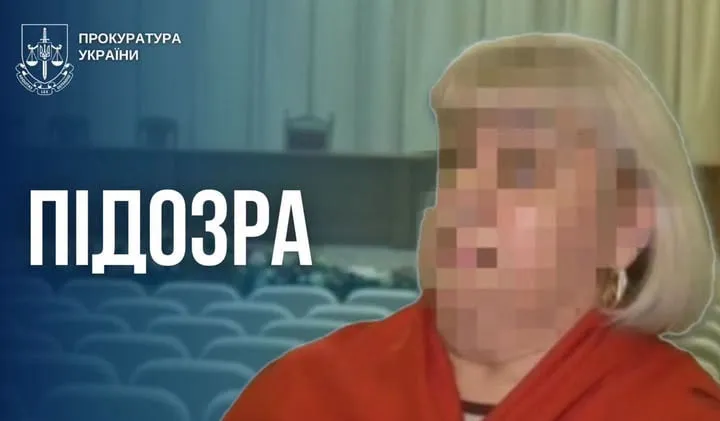
A former Ukrainian judge has been notified of suspicion of voluntarily assuming a position in an illegal judicial body in the temporarily occupied territory of Ukraine. According to the prosecutor’s office, the woman headed the so-called “LPR Council of Judges.”
Prior to the start of Russia’s full-scale aggression, she had worked in the Ukrainian judicial system for a long time. Since 2004, she served as a judge of the Krasnodon City and District Court in Luhansk Oblast, and later became its chairperson.
After the city was seized in 2014, the court ceased operations, but she remained in the temporarily occupied territory.
In 2017, the High Qualification Commission of Judges of Ukraine submitted a motion for her dismissal. The following year, the High Council of Justice rejected the motion and accepted the judge’s resignation.
Subsequently, the suspect began working in the illegal judicial system of the “LNR.” In the summer of 2023, by decree of the President of the Russian Federation, she was appointed a judge of the so-called “Supreme Court of the LNR” and chair of the “Council of Judges of the LNR.”
She systematically participates in meetings regarding the drafting of the so-called “LNR legislation,” hears cases, and issues rulings on behalf of the illegal bodies of the occupying authorities.
Through her activities, the suspect ensures the functioning of the “judicial system” imposed by the aggressor state and contributes to the consolidation of the occupation regime in the temporarily occupied territory of Luhansk Oblast.
In accordance with Article 62 of the Constitution of Ukraine, a person is presumed innocent until proven guilty by a court verdict.
This was reported by the Office of the Prosecutor General.
Earlier, a female officer of the General Staff was detained for accepting a bribe of 14,000 dollars.
In the Chernihiv region, a detained deserter attempted to offer a bribe of 40,000 hryvnias.
The Security Service of Ukraine (SBU) and the National Police uncovered 12 schemes to evade mobilization in eight regions.


