
Russia is facing the worst fuel crisis in its history
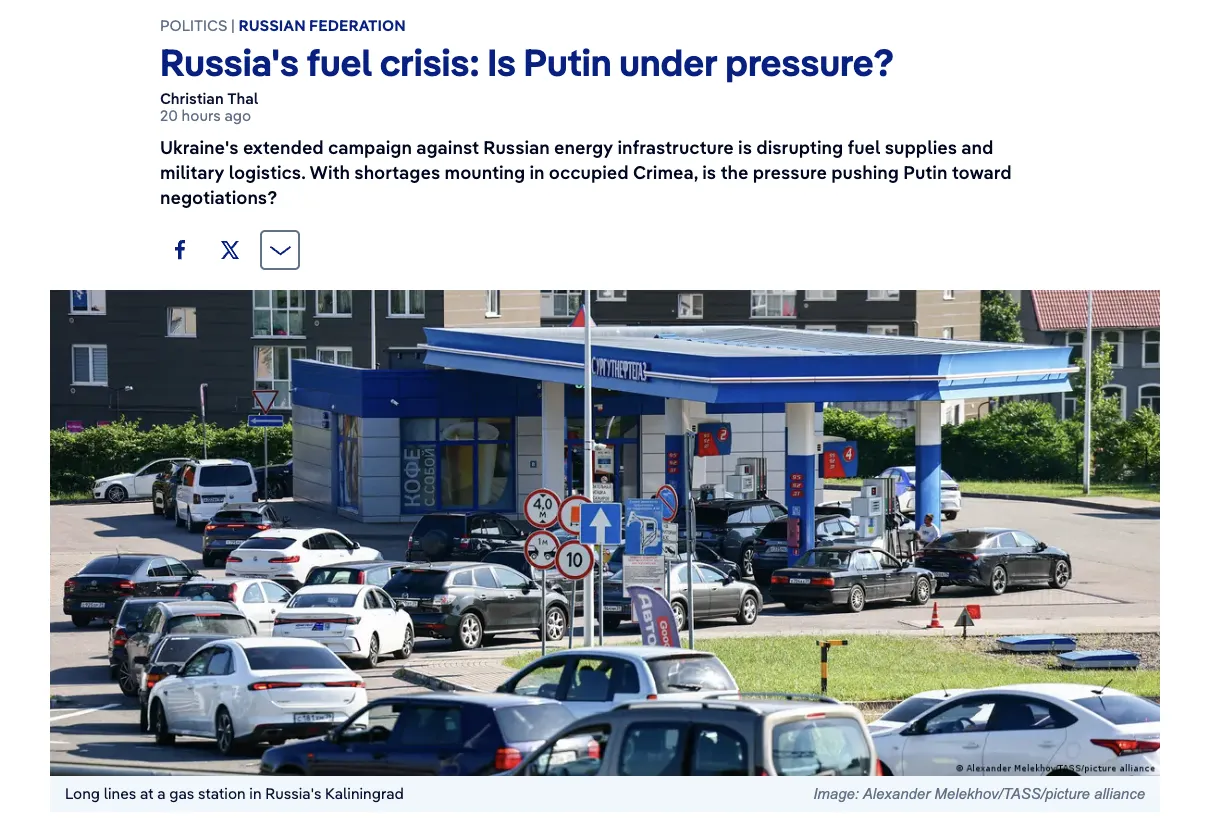
Russia is expected to face its most severe fuel crisis due to attacks on its oil refining infrastructure and logistical problems. According to analysts, this is making it increasingly difficult to supply the country’s military and economy.
For several months now, Ukrainian forces have been attacking energy infrastructure in Russian regions and on the illegally annexed Crimean Peninsula. Russian supply routes in the temporarily occupied territories, as well as key oil refineries within Russia itself, have come under attack.
Russia’s Energy Intelligence think tank is predicting the worst fuel crisis in the country’s history. Gasoline production in the occupying country has fallen by 25% as a result of Ukrainian strikes on refineries. Russia is currently producing only 85,000 metric tons of gasoline per day, while summer demand reaches 110,000 metric tons.
On June 28, Vladimir Putin was forced for the first time to openly acknowledge that a fuel shortage exists and even named the cause of the problem—attacks by Ukrainian drones. Restrictions on fuel sales have already been imposed in 78 Russian regions. Long lines have formed at gas stations in many cities.
Ukraine has significantly intensified its “sanctions” against Kremlin-controlled refineries compared to 2025, improving the quantity, quality, and range of its drones. It is also actively detecting and destroying enemy air defense systems.
As a result of the Defense Forces’ operations at distances ranging from 20 to 200 kilometers near the front line, Russian logistics are beginning to slow down. Analysts say that if Ukraine were able to completely destroy the Crimean Bridge, it would cut off one of Russia’s main supply routes.
A state of emergency has been in effect in the temporarily occupied Crimea and the city of Sevastopol since June 26. The occupying authorities imposed it following a series of Ukrainian attacks that caused fuel and food shortages on the peninsula.
By putting pressure on Crimea, Kyiv hopes to force Putin to take peace talks seriously on its own terms, says British historian Mark Galeotti. He adds that there is a risk the campaign could prompt the Russian dictator to escalate the conflict.
“He could mobilize hundreds of thousands of additional reservists. The use of tactical nuclear weapons is highly unlikely. At present, there is no reason to believe that Russia’s economy will collapse, or that the masses will rise up, or that there will be a coup or any other extreme scenario,” says Galeotti.
At the same time, he notes that Russia is unlikely to be able to continue the war at its current intensity for more than another year, according to Deutsche Welle.
The Northern Front: Will Chernihiv Oblast Become a New Springboard for an Offensive on Kyiv?
On June 30, Ukrainian defenders eliminated another 1,350 Russian soldiers. The General Staff of the Armed Forces of Ukraine also released updated data on the losses of Russian occupation forces in the war against Ukraine as of June 29, 2026.


