
NATO Assesses the Impact of Strikes on Moscow on Putin's Position – The Telegraph
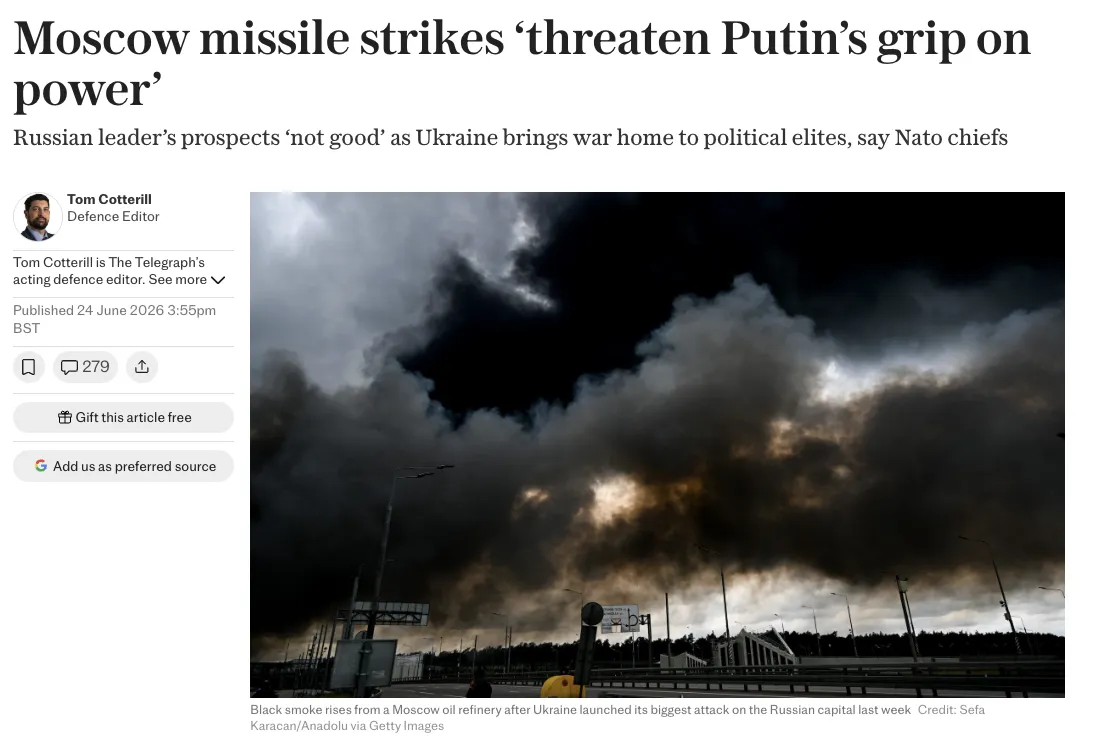
NATO officials stated that Ukrainian strikes on Moscow could pose additional risks to the internal stability of Vladimir Putin’s regime and might force the Russian leadership to reconsider its next steps.
NATO’s Deputy Supreme Allied Commander Europe, Air Marshal Sir Johnny Stringer, said that Putin’s position has become critical. “If I were in his shoes, I would be weighing my options—because they don’t look good,” he said in an interview with The Telegraph during the Royal United Services Institute (RUSI) Land Warfare Conference in London.
According to Stringer, Russia has suffered a “series of setbacks” in the war, which has been ongoing for more than four years. NATO officials rarely comment publicly on Russia’s domestic politics, but they provided The Telegraph with detailed assessments of its military capabilities.
Last week, Kyiv launched an attack on Moscow with a thousand drones—the largest airstrike on the Russian capital in the entire war. The attack destroyed a major oil refinery and forced the Kremlin to redeploy air defense units from the front lines to defend the city. A few days earlier, a similar strike took place in St. Petersburg, where an oil refinery was also damaged.
Putin has spent all these years trying to shield his own people from the realities of war. According to NATO estimates, the war has cost Russia 500,000 lives. Kyiv, on the other hand, claims to be taking out up to 30,000 enemy troops every month.
British Prime Minister Keir Starmer said at the E5 summit that Russians are increasingly turning away from Putin. “There are clear signs that public sentiment in Moscow is turning against Putin’s war,” he said, calling for tougher sanctions and increased military support for Ukraine.
Ukrainian Defense Minister Mykhailo Fedorov, who also attended the RUSI conference, described the wave of drone strikes as part of a strategy to “wear down” Russian forces. “We see that Ukraine is regaining the initiative in this war,” he said, adding that the investments made in recent months “will soon yield results.”
Robert Brovdi, head of Ukraine’s unmanned systems forces, reported that 48 military targets were struck during the attacks, including the main power substation in Sevastopol—the largest city in occupied Crimea. As a result of the strike, the city was left without electricity.
Source: The Telegraph
As a reminder, the fuel crisis in Russia is intensifying: gasoline is running out at gas stations and lines are growing.
Russia has authorized the use of lower-quality gasoline due to the fuel crisis.


