
In Russia, there is talk of a possible short-term war with Lithuania
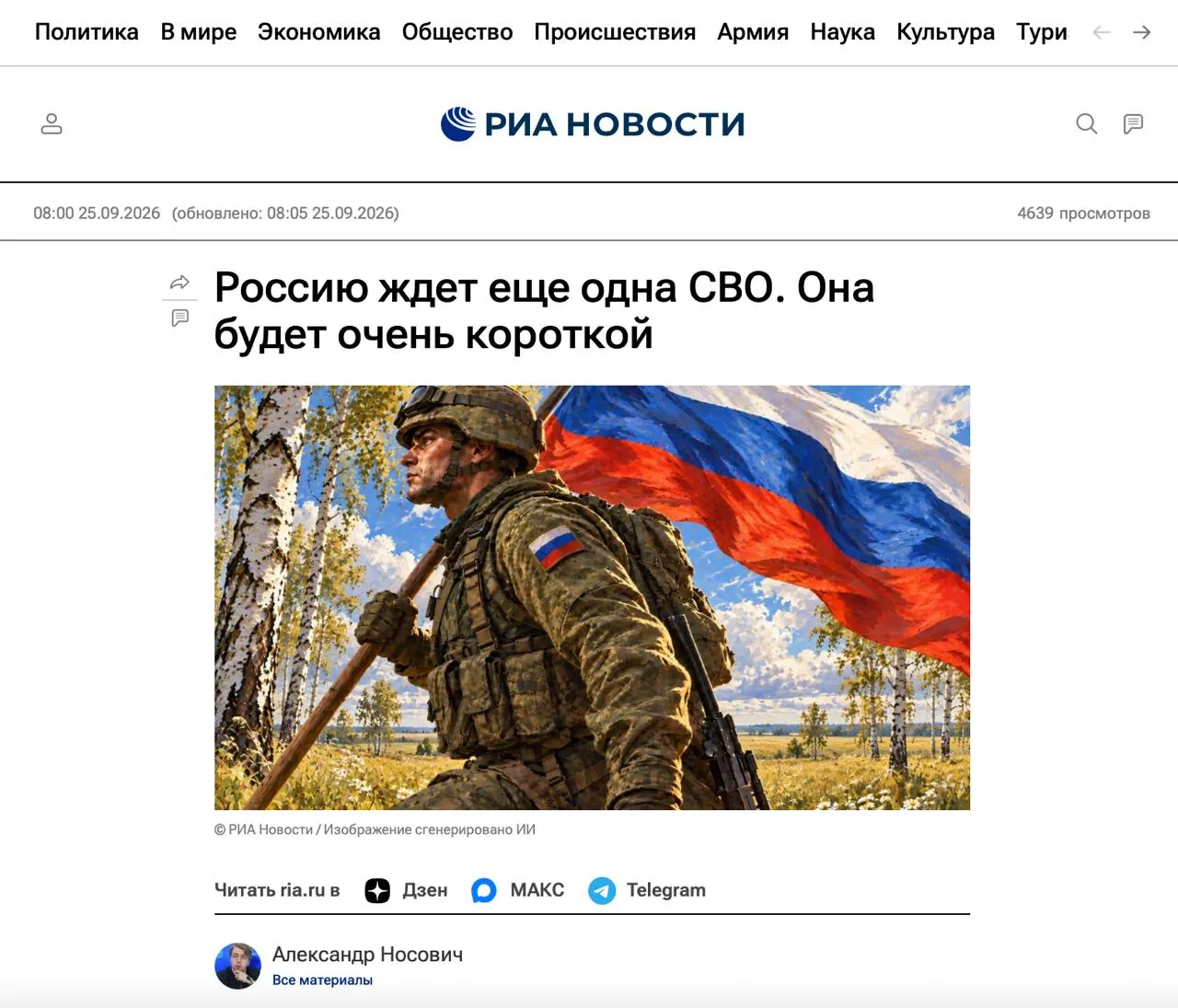
A Russian state agency published an article titled “Another Special Military Operation Awaits Russia. It Will Be Very Short,” which discusses a possible war between Russia and Lithuania. The author of the article is a member of the Council on Foreign and Defense Policy, one of the co-founders of the Valdai Club, where Vladimir Putin regularly speaks.
The article about the new “special military operation” appeared on the publication’s homepage on Friday morning. The article was a reaction to the Lithuanian parliament’s decision, adopted on September 22, to lift the constitutional ban on the deployment of nuclear weapons in the country. Ninety-nine lawmakers voted in favor of the initiative, 13 voted against it, and five abstained.
The author of the article claims that European countries have allegedly reached the stage of searching for a state that would agree to serve as a storage site for nuclear weapons. At the same time, he points out that Poland does not want to host nuclear weapons on its territory.
Nosovich also writes that Lithuania allegedly risks becoming the next site, after Ukraine, where Russian missile forces will conduct combat exercises. In his opinion, this is precisely why the country may find itself in a similar situation.
Separately, the author compares Lithuania to Ukraine. He claims that several years ago, Ukraine was allegedly “sold” to Russia, and he refers to the deployment of nuclear warheads a few hours’ drive from Minsk and Kaliningrad as yet another “commercial offer.”
The article also discusses possible ways Russia could wage war against Lithuania. Nosovich claims that Moscow allegedly has a choice regarding how exactly to conduct hostilities and notes that, due to its geographical location, a conflict in the Baltic states would not unfold in the same way as the war against Ukraine.
The author speculates that Russia could use missiles with nuclear warheads without even deploying ground forces. He links this scenario to the fact that, according to him, Russia’s opponents are the first to frame the confrontation in terms of a nuclear threat.
The author of the article is Alexander Nosovich, editor-in-chief of RuBaltic.Ru. In 2020, the “Dossier” Center linked him to the so-called “Baltic network,” which, according to investigators, was created by Yevgeny Umerenkov, an employee of the Russian presidential administration and a colonel in foreign intelligence. LRT previously published correspondence showing that Nosovich received assignments for RuBaltic from individuals linked to the Kremlin.
The publication came amid statements and reports of a possible Russian attack on NATO countries. The day before, the Danish Ministry of Defense’s intelligence service stated that in the coming months there is a low but growing risk of a limited military attack by Russia against one or more NATO countries. Danish intelligence also warned of a possible intensification of Russian hybrid attacks against the West.
Earlier this week, Michal Koudelka, head of the Czech Security and Information Service, also suggested that Moscow could resort to a limited incursion or other provocation on NATO territory as early as the coming months. Earlier, Polish Prime Minister Donald Tusk stated that intelligence data indicates Russia is preparing possible hybrid attacks using drones and missiles against NATO countries that support Ukraine.
The so-called Suwałki Corridor—a narrow strip of land between Belarus and Russia’s Kaliningrad Oblast—is located on the Polish-Lithuanian border. It is the only land route from Poland to the Baltic states. For many years, military analysts have considered a possible Russian attempt to seize or block the Suwalki Corridor as one of the potential scenarios for a conflict between Moscow and NATO.
At the same time, Russia publicly denies having any plans to attack European countries.
This is reported by Russian propaganda media.
The German foreign minister has spoken of a new level of Russian aggression in Europe.
Earlier, a Starlink ground station in Poland caught fire under suspicious circumstances.
A Russian military helicopter violated Polish airspace.
Also, two airports in Poland were closed again due to a Russian attack.




