
Russia's military spending has reached an unprecedented level
In the first quarter of 2026, Russia’s military spending reached 5.9 trillion rubles (over $83 billion), setting a new record. The share of defense spending in the state budget exceeded 46% for the first time.
This is reported in an analysis by Janis Klug, a research fellow at the German Institute for International and Security Affairs.
According to Klug’s calculations, based on data from the Russian Ministry of Finance, on average, the Russian military machine consumed 2.7 billion rubles per hour (about $38 million) and 65 billion rubles per day (nearly $916 million). Monthly war expenses amounted to approximately 2 trillion rubles ($28.2 billion).
Compared to the same quarter of 2025, spending increased by 29.9%; compared to the first quarter of 2024, by 68.7%; and compared to 2023, by 129%. Since the start of the full-scale invasion in February 2022, spending has increased 4.6-fold. Over the entire duration of the war, Russia has spent a total of 53 trillion rubles—or $746.6 billion.
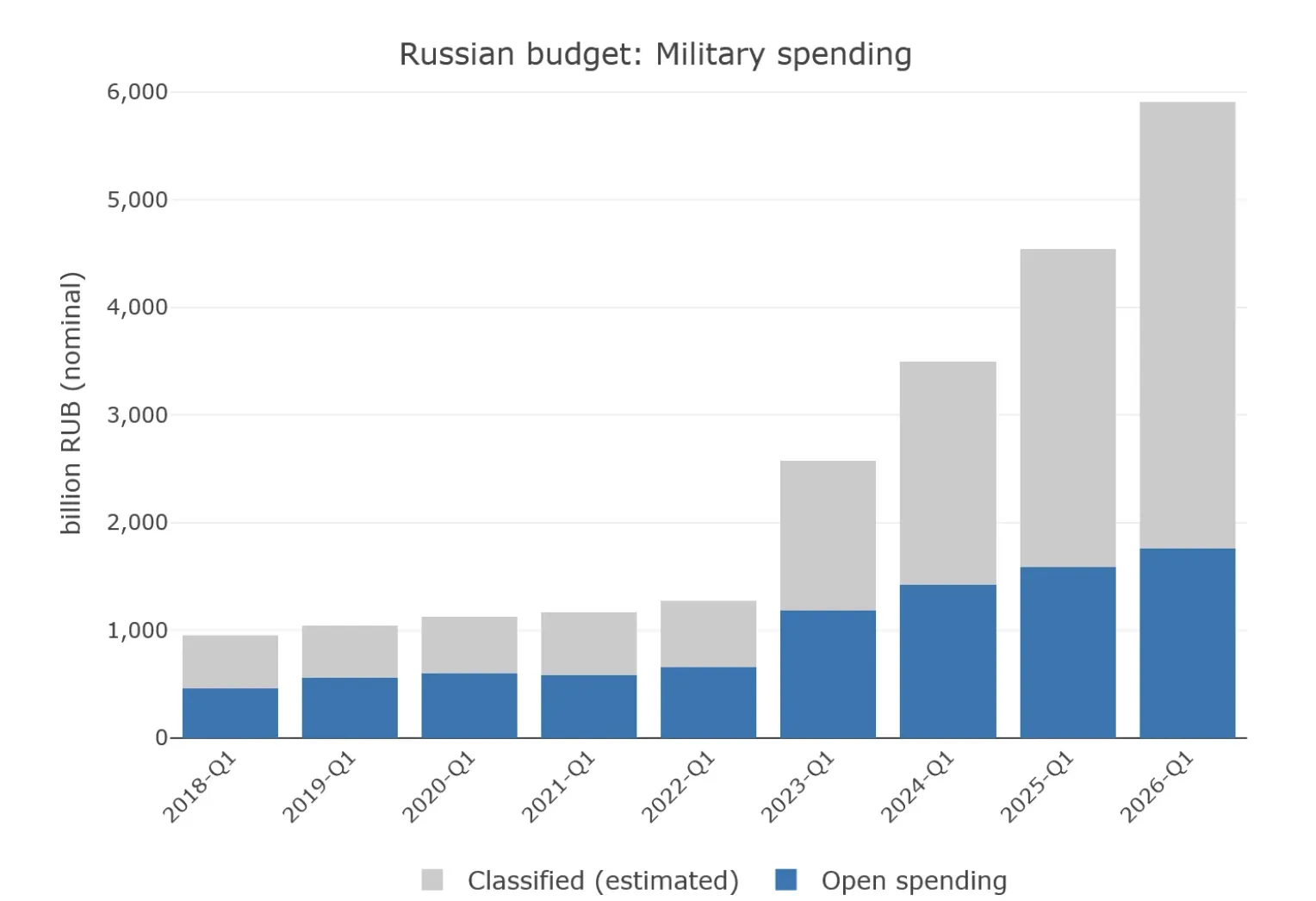
The main factor behind the surge was classified spending: it rose by 43%—from 3.4 trillion to 4.9 trillion rubles. In total, classified expenditures accounted for 38.2% of all federal spending—the highest share since the start of the full-scale war. According to Kluge’s estimates, about 85% of classified expenditures are related to military needs—the procurement of weapons, the production of military equipment, and the support of the army.
This runs counter to the Kremlin’s plans: the 2026 budget law called for a reduction in military spending from 7.8% to 6.2% of GDP. However, in the first quarter alone, they accounted for 2.5% of projected annual GDP and reached 12% of quarterly GDP. If this trend continues, military spending could reach 9–10% of GDP over the course of the year.
Kluge cautions against drawing overly simplistic conclusions: part of the spike may be explained by the carryover of expenditures from the fourth quarter of 2025 to early 2026 in order to avoid exceeding the planned deficit. A more complete picture will emerge after the publication of additional budget data.
At the same time, Ukraine is increasing military spending to a record high.


