
The Ukrainian Armed Forces have disabled more than 42% of Russia's oil refining capacity, according to the General Staff

The Ukrainian Defense Forces have disabled 42.74% of the total designed capacity of Russia’s oil refining industry. This figure is the highest since the start of the campaign of systematic strikes against Russian oil infrastructure.
According to the General Staff, as of early July, the Ukrainian military had significantly increased pressure on Russia’s fuel and energy sector.
In the past month alone, the Defense Forces successfully struck eight oil refineries on Russian territory.
The strikes also destroyed or critically damaged more than 60 fuel storage tanks. Of these, 58% contained petroleum products, and 42% contained crude oil.
The General Staff notes that the cumulative losses of the Russian oil refining industry since August 2025 are already estimated at $13.5 billion.
Among the main consequences for the aggressor country, the military cites a fuel crisis, a reduction in oil production and refining volumes, and delays in repairing damaged facilities due to a shortage of components and technological equipment, as well as the impact of international sanctions.
The General Staff emphasized that the operation to destroy Russia’s oil refining infrastructure is ongoing.
The goal of these systematic strikes remains to weaken Russia’s economic and military capabilities, in particular by reducing its ability to supply military equipment with fuel and finance the war against Ukraine.
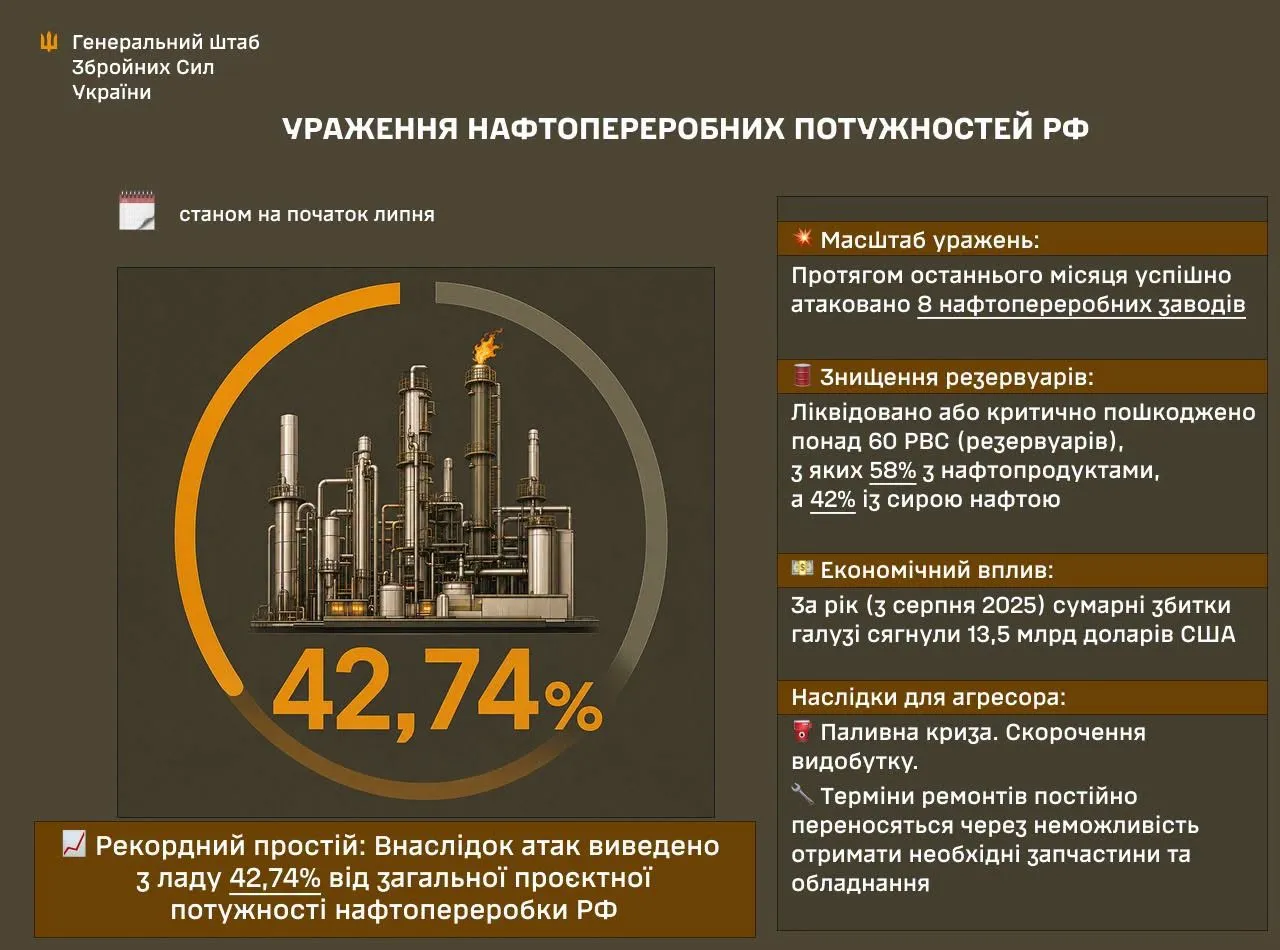
This was reported by the General Staff of the Armed Forces of Ukraine.
In the temporarily occupied Crimea, fires were reported at a number of strategic facilities following overnight attacks. According to monitoring sources, a ferry terminal in Kerch, a military airfield in Dzhankoy, and a power substation in Krasnoperekopsk are on fire.
In St. Petersburg, Russia, a fire broke out on the morning of July 4 at the “St. Petersburg Oil Terminal” following reports of a potential drone attack. At the same time, several regions of the Russian Federation are reporting explosions, fires, and disruptions to electricity and water supplies.
On the night of July 2, drones attacked an oil refinery in Kstovo, Nizhny Novgorod Oblast, Russia. This facility is one of the key elements of Russia’s fuel infrastructure.
On the night of July 1, Russian troops carried out a massive attack with strike drones on the Dnipropetrovsk region.
As a reminder, on the evening of June 30, Russian troops attacked an electric locomotive in the Dnipropetrovsk region with a drone. There were no casualties, as the locomotive crew was warned of the danger in time, and the workers managed to take cover.
Ukrainian drones struck eight of the ten largest Russian oil refineries by processing volume, with some facilities being hit multiple times.


