
Researchers narrow down possible ultraviolet absorbers in Venus’s clouds
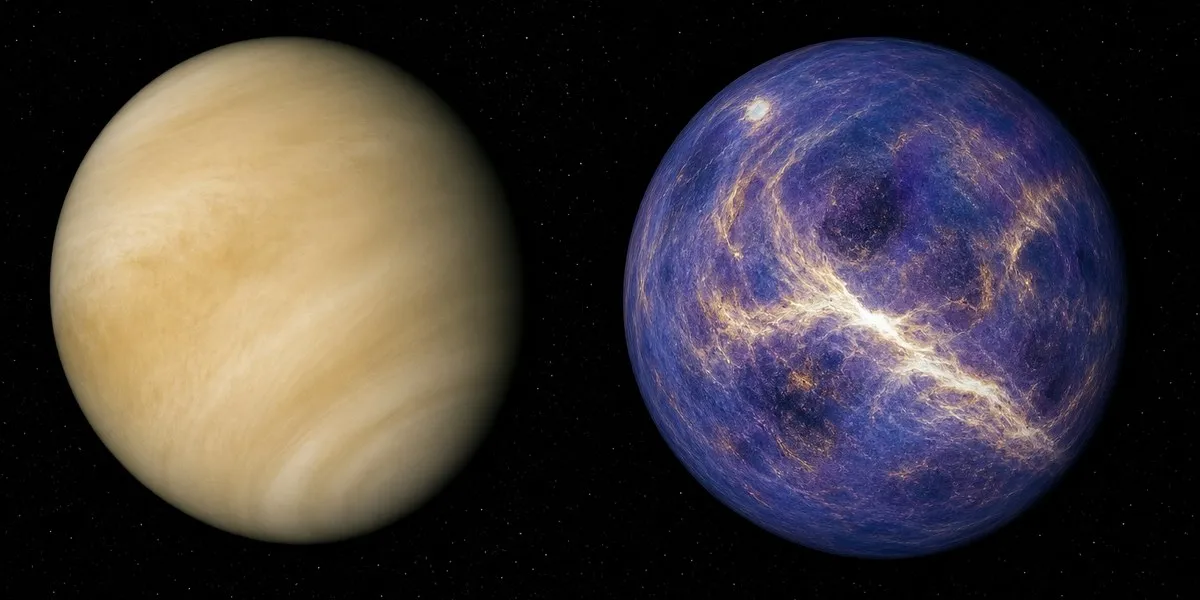
An international group of researchers calculated what properties the unknown substance that creates dark patterns in the ultraviolet range in Venus’s upper clouds must have. It must absorb ultraviolet and blue light very intensely, be present in droplets at a high concentration, or combine both of these properties, ScienceDaily reports.
In visible light, Venus appears pale yellow, but in the ultraviolet range, dark and light structures are visible in its sulfuric-acid clouds. They have been observed for about a century, but the substance responsible for these features, known as the “unknown absorber,” has still not been identified.
A model for cloud droplets
The authors of the study, published in the journal Astrobiology, combined observations of Venus with a radiative transfer model. It accounts for the multiple scattering and absorption of light by cloud droplets and atmospheric molecules. This made it possible to convert astronomical data into a parameter used in laboratory ultraviolet-visible spectroscopy: the absorption coefficient of the liquid from which the droplets are composed.
The researchers considered a hypothetical scenario in which cloud material could be collected in a cuvette and analyzed as a bulk liquid. This approach is important because a cloud may look different from the concentrated material of its particles: small particles scatter light efficiently.
More current news is available on the UA.News Telegram channel Telegram.
Stringent requirements for candidates
In the modeled wavelength range from 365 to 455 nanometers, the required decadic absorption coefficient reaches about 1,278 cm⁻¹ at 375 nanometers. One possible class of substances capable of absorbing light this intensely is conjugated organic molecules—that is, carbon-containing compounds. At the same time, the authors emphasize that an organic nature does not mean an origin from life, and the results do not indicate the existence of life in Venus’s clouds.
For molecules with absorption strength similar to that of efficient porphyrinoid pigments, the required concentration would be about 10 grams per liter. However, Venus’s spectrum shows a sharp drop in absorption between 365 and 455 nanometers, which does not match many dark mixtures that can form from simple organic substances in concentrated sulfuric acid. Inorganic candidates must also meet the requirement of a very high concentration.
These constraints can be tested further in laboratory experiments and through direct measurements in the planet’s atmosphere. The Morning Star Missions to Venus initiative is developing methods to study the chemistry of Venusian clouds, including the Autofluorescence Nephelometer instrument to investigate fluorescence expected to be associated with organic molecules.


