
European scientists develop more detailed climate models — Cyprus Mail
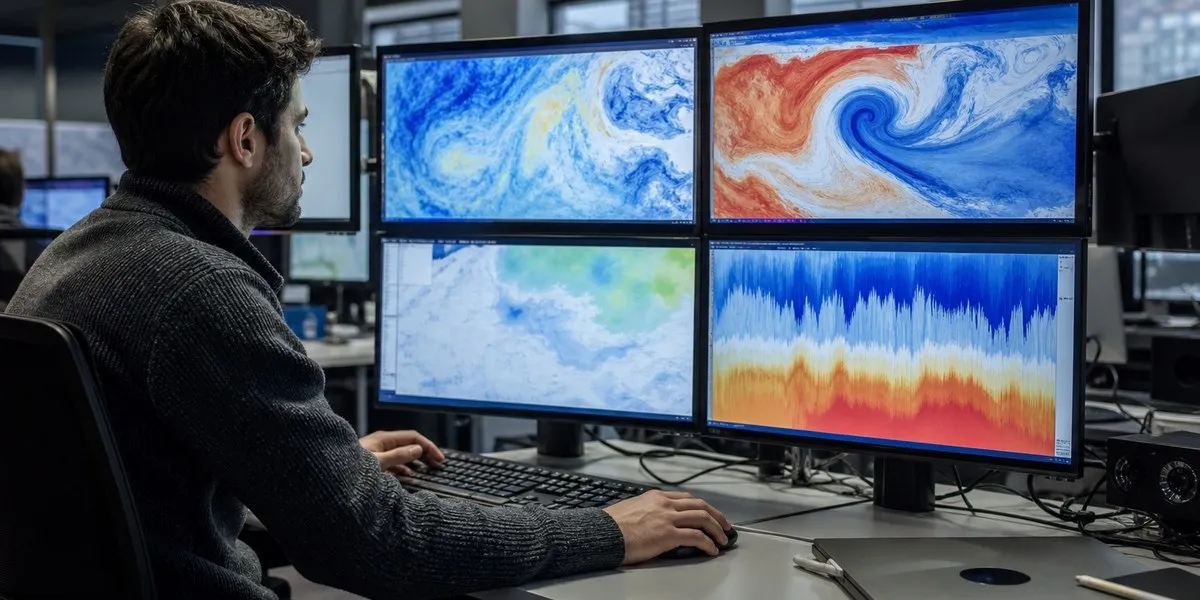
In France and other European countries, researchers are developing a new generation of climate models intended to more accurately reflect the consequences of climate change for individual regions and account for the impact of human activity. This was reported by Cyprus Mail.
Interaction of the atmosphere, ocean and land
As part of the EU-funded ESM2025 project, scientists improved Earth system models to better track how emissions move through the atmosphere, land and oceans. The research covered carbon accumulation on land, ocean circulation, marine ecosystems and carbon transport from land to sea.
ESM2025 coordinator Roland Séférian of the National Centre for Meteorological Research in France noted that the models also make it possible to assess the potential consequences of using technologies to remove CO₂ from the atmosphere. The project involved researchers, including those from the Max Planck Institute, the Potsdam Institute for Climate Impact Research and the University of Reading.
More current news is available on the UA.News Telegram channel Telegram.
One result highlighted by ESM2025 indicates that rivers transport about 20% more carbon to the oceans than was projected by estimates of the UN Intergovernmental Panel on Climate Change in its 2021 report. Researchers also used machine learning together with observations and established theory to more accurately model interactions between climate, carbon and other natural cycles.
Models with detail down to a few kilometres
Another project, NextGEMS, focused on increasing the spatial resolution of global climate simulations. According to Stockholm University professor Frida Bender, traditional models use a grid with cells averaging 150 kilometres wide, while NextGEMS can model climate processes on a global scale with detail down to a few kilometres.
Such models make it possible to study atmospheric and ocean circulation and their relationship with carbon, water and nutrient cycles at the local level in greater detail. NextGEMS participants discussed the results with energy providers, engineers and fisheries managers. Local information may be useful for planning wind and solar energy, as well as assessing the risks of extreme rainfall, heat, droughts, fires and changes in ocean currents.


