
Gravitational lensing may explain black hole merger — Live Science
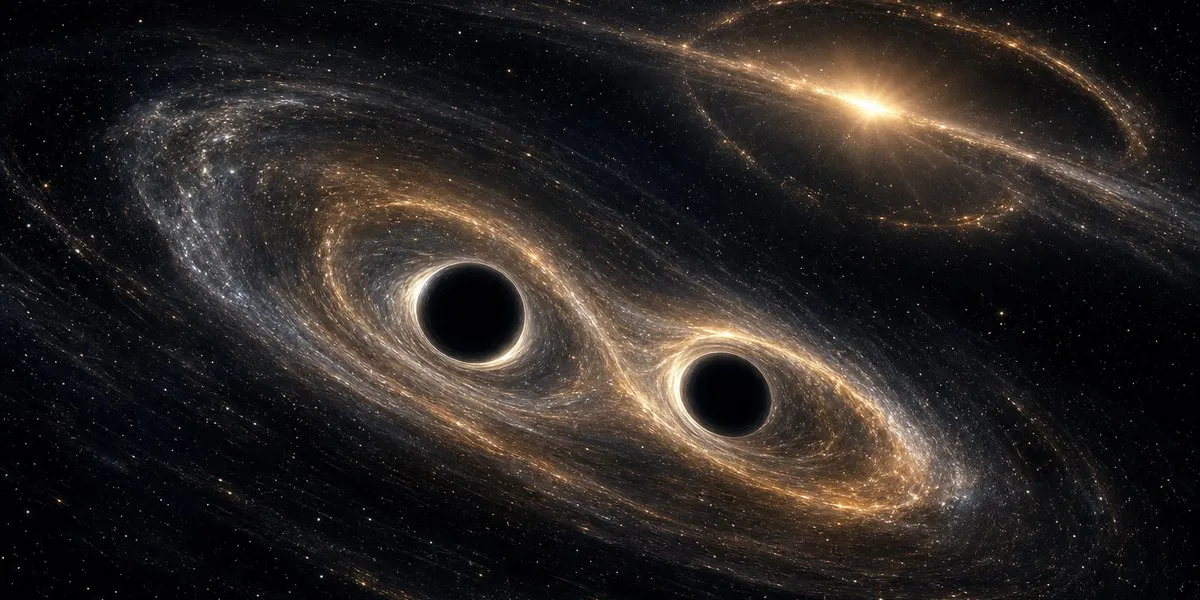
In the United States, detectors at the LIGO observatory registered the GW231123 gravitational-wave signal on November 23, 2023. It was initially linked to the collision of two black holes about 2 billion light-years from Earth. A new study suggests that the signal may have undergone gravitational lensing, which could have led to overestimated object masses, Live Science reports.
The problem with black hole masses
According to initial calculations, the masses of the black holes before the collision were approximately 100 and 130 solar masses, while the mass of the black hole formed after the merger was about 230 solar masses. The event was called the most massive recorded black hole merger, but such parameters are difficult to explain under current ideas about their formation.
The objects belonged to the so-called mass gap: they were too large for stellar-mass black holes formed by the collapse of stars, but smaller than intermediate-mass black holes. Researchers were additionally surprised by the unusually rapid rotation of the black holes before the collision.
More current news is available on the UA.News Telegram channel Telegram.
The lensing hypothesis
In a study published on August 25 in The Astrophysical Journal Letters, scientists modeled how gravitational lensing could have altered the gravitational-wave signal. This effect occurs when radiation passes through spacetime curved by gravity near a massive object.
According to the authors, GW231123 could have been deflected and distorted by a compact object with a mass of between 190 and 850 solar masses or by an extended structure, such as a globular cluster. In that case, the mass of the black hole after the merger could have been about 140 rather than 230 solar masses, and the explanation would not have required assuming unusually high rotation of the original objects. Such a scenario would also mean that the source of the signal is farther from Earth than previously thought.
At the same time, gravitational lensing of gravitational waves has not yet been directly observed. The researchers stress that their work is theoretical and does not provide direct evidence that lensing specifically affected the GW231123 signal.


