
How the Romans built aqueducts hundreds of kilometers long
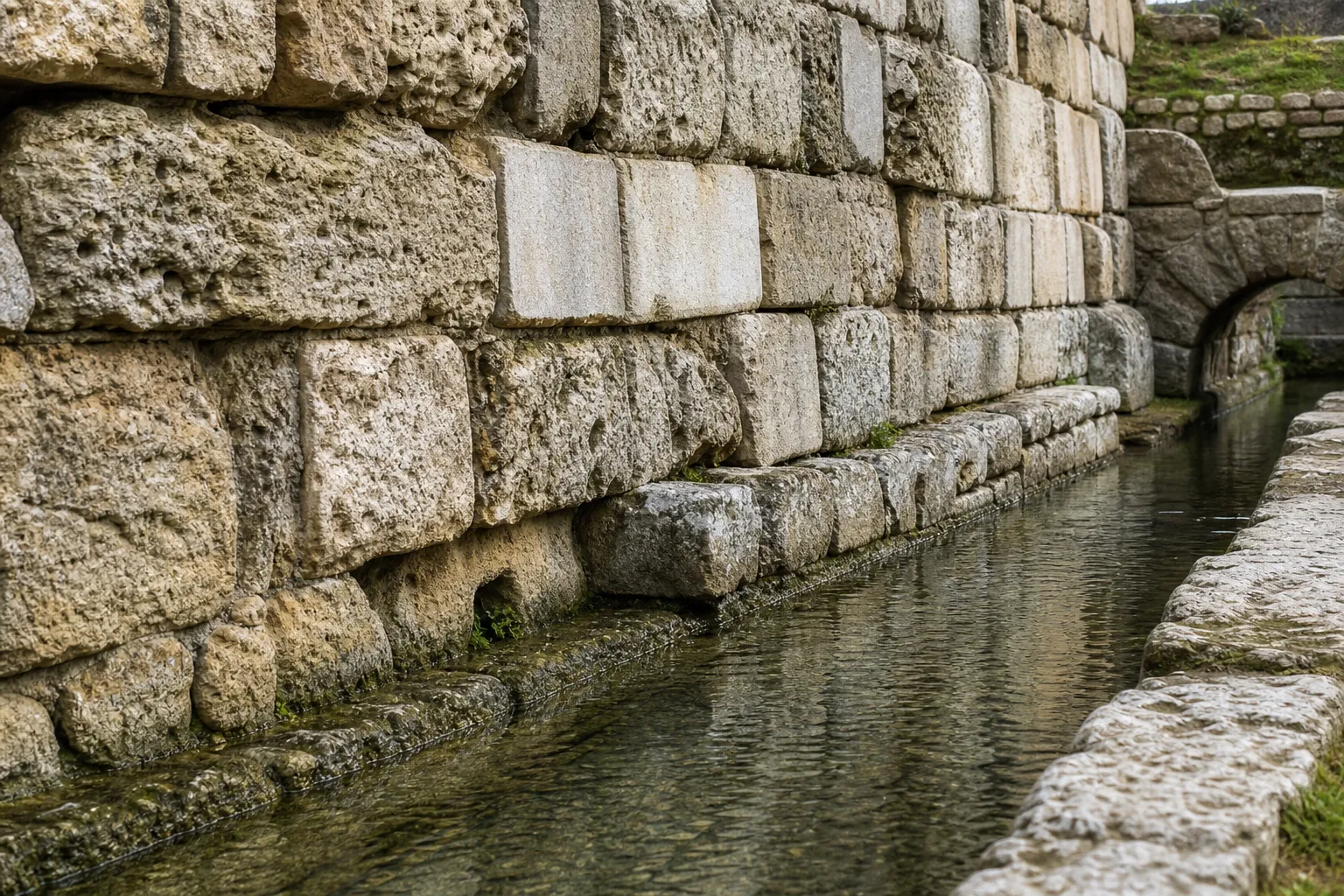
Ancient Roman aqueducts delivered water to cities and settlements, and some of them stretched for hundreds of kilometers. In particular, the Aqueduct of Valens, which supplied water to Constantinople — modern-day Istanbul — was about 400 kilometers long. As Live Science reports, the durability of these structures was aided by precise route planning, the properties of Roman concrete, and regular maintenance.
Route calculation
Before construction, the Romans selected a water source, often favoring natural springs. The route was designed with a very slight downward slope so that water could flow by gravity to a city or settlement. To determine the required gradient, surveyors used the libra and dioptra instruments.
The dioptra was shaped like a disk with a sighting bar in the middle and could be mounted on a stand. Surveyors looked through the bar at measuring rods placed across the terrain to determine differences in elevation. The exact design of the libra is not known for certain, but it is known that the instrument had a suspended plumb line. It was also used together with calibrated rods to compare the height of sections along the route.
Materials and structures
Roman concrete played an important role. It consisted of pozzolanic material, lime, and water. This material hardened under the influence of water. According to Professor Giovanni De Feo of the University of Salerno, concrete was especially important for bridges, arcades, and other structural elements of aqueducts.
More current news is available on the UA.News Telegram channel Telegram.
At the same time, the preservation of these structures is explained by more than concrete alone. The Romans sought to lay routes across stable geological formations and avoid unstable landscapes. Some water channels had long underground sections where above-ground construction was difficult, while others ran on arches over considerable distances.
Cleaning and maintenance
When water approached a city, it was sometimes directed into basins where sediment settled to the bottom. The water then entered a distribution reservoir. Researchers estimated that a team of about 500 workers could complete Hadrian's 20-kilometer aqueduct in Athens in 15 years.
After construction, aqueducts required regular maintenance. Researchers who studied a structure in Divona, France, found that carbonate deposits accumulated on it over time. Workers partially scraped them off before replastering, although in other cases a new layer of plaster was applied over the deposits. The Aqua Virgo aqueduct, built in 19 BCE, still supplies water to Rome.




