
Taipei Times columnist criticizes portrayal of Taiwan as an “alternative China”
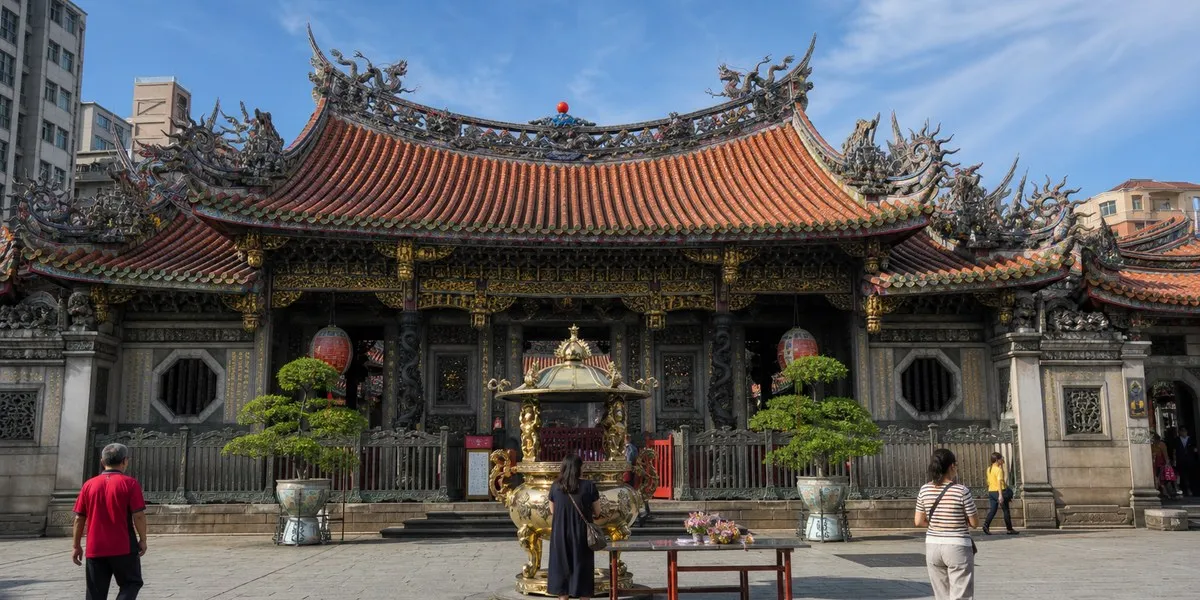
In Taiwan, Taipei Times columnist Michael Turton criticized a Wall Street Journal article about local temples. In his view, portraying Taiwan as an “alternative China” ignores the island’s separate history, its democratic development, and religious diversity.
Criticism of the China-centric approach
Turton described as flawed the approach taken by Wall Street Journal author Wei Lingling, who, in his account, used examples of Taiwanese folk religion to present Taiwan as a model of what China could have been. The columnist believes that such an interpretation reduces local experience to supposedly preserved Chinese tradition and reproduces Beijing’s nationalist vision.
He also drew attention to the use of the term “separation” in the Wall Street Journal article. According to Turton, this wording does not take into account Taiwan’s democratic changes, half a century of Japanese colonial rule, and the differences between religious life on the island and in the PRC.
History of Longshan Temple
As an example, Turton cited Longshan Temple in Taipei, located in one of the city’s oldest districts, which he characterizes as a center of Taiwanese nationalism. In 1986, democratic movement activists held a well-known sit-in protest there against decades of martial law.
More current news is available on the UA.News Telegram channel Telegram.
After democracy and free speech activist Deng Nan-jung took his own life in 1989, his supporters set up a memorial shrine in the temple and honored him for a month. Turton said that Longshan’s connection to the democratic movement was not reflected in the Wall Street Journal publication.
Religious diversity and contacts with the PRC
The columnist also noted that the article does not examine Taiwan’s Christian, Muslim, Mormon, and other religious communities, as well as the syncretic traditions of Indigenous peoples. In his view, the piece also does not mention academic and public discussions about the use of the Mazu cult by the PRC as a tool of influence on Taiwan.
Turton emphasized that after the end of martial law and democratic changes in the late 1980s, religious groups in Taiwan and the PRC maintained active contacts. At the same time, he said, this did not lead to a convergence of their religious practices. In conclusion, the columnist rejected the thesis of Taiwan as a lost or separated part of China, calling it a manifestation of Han ethno-nationalism and expansionism.


