
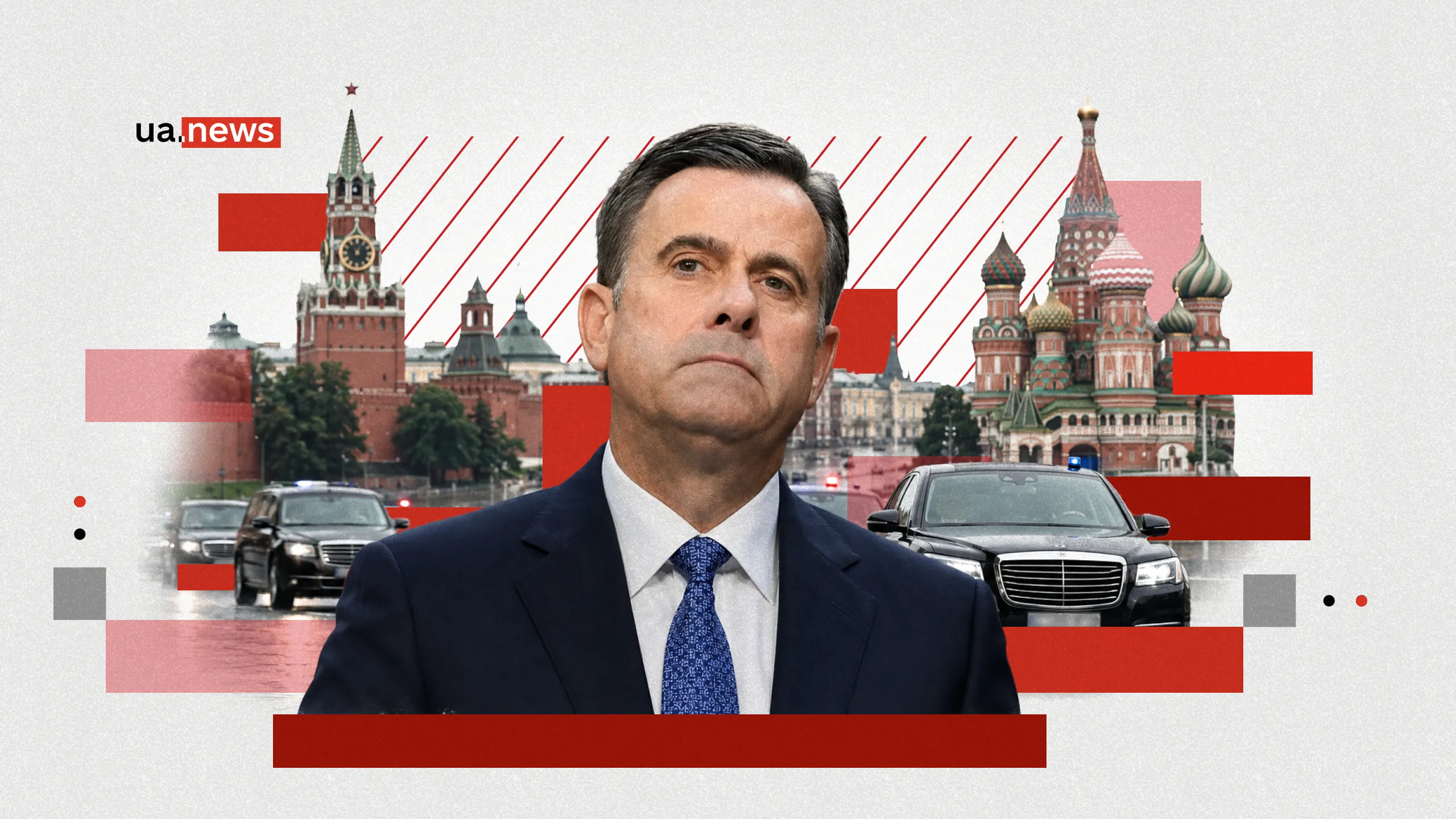
When William Burns, then director of the U.S. Central Intelligence Agency, was leaving the Moscow airport in the fall of 2021, hope was still flickering in Washington that his visit to the Kremlin would serve as the last diplomatic safeguard before the abyss of war. At the time, Burns, in his own words, had come to show the Russians satellite images of their own troops on the border with Ukraine and to convince Vladimir Putin not to take a fatal step—full-scale aggression. The Russian dictator listened politely and, as we know, did exactly the opposite.
Nearly five years have passed since then, during which Moscow’s doors remained closed to American intelligence officials, and relations between the two countries have deteriorated even further than during the Cuban Missile Crisis. And now, John Ratcliffe has entered those very offices—a man who, within the Trump administration, is regarded as nothing less than a “hawk,” that is, a hard-liner and the overseer of intelligence sharing with Ukraine.
The very fact of his unplanned visit—which was initially kept completely secret but later made headlines in the Western press through a series of controversial reports—presents a rather complex analytical challenge. While everyone was expecting the “standard” negotiators, Steve Witkoff and Jared Kushner, to arrive in Moscow, the White House sent Ratcliffe instead.
Does this mean that Washington has decided to speak to the Kremlin in the language of ultimatums? Or have the “hawks” themselves suddenly turned into doves of peace, having realized the scale of the threat posed by a direct confrontation? What messages did John Retcliffe bring to Moscow, and why might this visit prove even more significant than William Burns’s infamous mission on the eve of the full-scale invasion? UA.News political analyst Mykyta Trachuk, along with experts, examined the issue.
“The Bad Cop”: Why Retcliffe, of All People, Came to Moscow
To understand the uniqueness of this moment, it’s worth paying attention to the figure of the visitor himself. John Retcliffe is not just the director of the CIA. He is a man whose professional profile, in the context of U.S.-Russian relations, is built on a foundation of distrust toward the Kremlin.
According to numerous insiders in Western media, it was Retcliffe who became one of the main initiators of a sharp expansion in the exchange of intelligence with the Main Intelligence Directorate (GUR) of the Ukrainian Ministry of Defense. His agency has significantly increased the amount of data on strategic targets within the Russian Federation, which, in turn, has enabled Ukrainian forces to significantly increase the effectiveness of strikes against oil refineries and military depots deep behind enemy lines. In other words, from Moscow’s perspective, Retcliffe is a direct “accomplice” in the attacks on Russian energy infrastructure.
A figure like this does not typically travel for friendly talks. When the White House sends a “hawk” of this caliber to the capital of an enemy state, it almost always means one of two things: either Washington is laying the groundwork for an extremely tough diplomatic move, or the situation itself has spiraled so far out of control that stabilizing it requires someone whose reputation precludes any accusation of weakness. In Retcliffe’s case, the fact that he has a personal line of communication with the Kremlin from the White House may be an attempt by Trump to play the role of the classic “good cop.” While the president himself showers Putin with compliments and promises “big deals,” his chief intelligence officer is tasked with reminding the Russians of the cost of a failed negotiation. This is a classic pattern: the leader’s soft words mask the clang of steel behind them. So perhaps that is precisely why Retcliffe’s visit caused such a stir: it shattered the illusion that the Trump administration had fully shifted to a policy of appeasement toward Russia at Ukraine’s expense.
At the same time, we cannot rule out a purely pragmatic component. No matter how grandly Retcliffe is labeled a “hawk,” he remains a civil servant reporting directly to President Trump. And if Trump has set the goal of reaching an agreement with Russia, it is the CIA director—not Secretary of State Rubio or Advisor Woltz—who may prove to be the ideal conduit for tough demands. Moscow, unfortunately, understands and respects only strength and does not trust smooth-talking diplomats. A conversation between Retcliffe, an intelligence officer, and Putin, an intelligence officer—is a conversation without diplomatic euphemisms, where each side knows the true weight of their words. In this sense, Retcliffe most likely did not come to persuade Putin, as Burns did in 2021, but to clearly define the limits of what is acceptable. The only question is what the consequences will be if those limits are crossed.

Is the
war in the Baltics the main topic of the talks?
If we summarize reports from American media outlets—primarily The Wall Street Journal and Politico—Retcliffe’s main mission in Moscow appears quite alarming. This is not about Ukraine—or, more precisely, not only about Ukraine. It is about the potential threat of a direct Russian attack on NATO countries, particularly the Baltic states.
According to U.S. intelligence, the Kremlin may soon resort to “testing the Alliance’s resolve.” This could take the form of a large-scale cyberattack on the critical infrastructure of Estonia, Lithuania, or Latvia; a border provocation; a covert special operations mission; or even a ground invasion aimed at seizing a small piece of territory to demonstrate NATO’s weakness.
It is quite possible that Retcliffe brought to Moscow not a request, but a demand to stop even considering such scenarios. And this is a unique situation. For the first time since 2021, the CIA director is visiting Moscow not to exchange views, but to issue a direct warning that an attack on Washington’s allies is unacceptable.
It is also important to note the context in which this is taking place. U.S. military analysts are reporting a shortage of critical ammunition in the West, caused not only by the war in Ukraine but also by the recent conflict with Iran. Moscow’s logic—which the Pentagon is trying to figure out—may be based on the assumption that NATO is currently simply not physically prepared for a full-scale response to limited aggression. Especially if Putin assumes that Trump—who is very skeptical of collective defense—will not want to get involved in a war over “some Baltic countries or other.”
In this sense, Ratcliffe’s visit may be an attempt to dispel this dangerous miscalculation by the Kremlin. The CIA director was supposed to personally demonstrate to the Russian side, based on intelligence data, that Washington is prepared for a tough response. This resembles “gunboat diplomacy,” but in a modern, information-based context. The U.S. is pointedly sending a “hawk” to make it clear: any attack on Estonia, Latvia, or Lithuania will be viewed not as a local conflict, but as a challenge to Trump personally. And Trump, despite all his isolationism, cannot afford to lose face on the international stage precisely when he is trying to position himself as a peacemaker and a strong leader. So Ratcliffe took to Moscow not only notes of protest but also very concrete evidence that U.S. intelligence is monitoring all the Russian army’s preparations near the Baltic borders.
The
Ukrainian and Iranian Factors: A Hidden Agenda
Of course, it would be naive to think that the topic of Ukraine was not raised during this secret meeting. Quite the contrary—Ukraine has become the backdrop against which the struggle for the future rules of the game is unfolding. Retcliffe, as we have already noted, oversaw the expansion of intelligence support for Kyiv. And his visit to Moscow could have been part of a complex bargaining process: Washington might offer to limit or completely halt the transfer of intelligence to the Ukrainian military if Russia makes certain concessions.
This does not necessarily mean forcing Ukraine to capitulate, as some media outlets are trying to interpret it. Rather, it could be part of a de-escalation strategy: if the Kremlin abandons its plans to attack NATO, the U.S. is prepared to reduce the intensity of Ukrainian strikes on Russian territory, which Ukraine carries out using American satellite data.
However, there is a huge risk here. The Ukrainian issue is increasingly becoming a bargaining chip in the game of the major players. Retcliffe, who until recently seemed to be Putin’s bitter enemy, may now be the one to convince the White House to sacrifice some of Ukraine’s interests for the sake of stability on the Baltic flank. This is a classic geopolitical dilemma: The West is not prepared to fight for Ukraine indefinitely, but it is equally unprepared to fight for NATO countries if its resources are depleted. Therefore, seeking a compromise with Moscow to de-escalate the conflict may come at the cost of ending military support for Ukraine at its current level. In other words, Washington may try to prevent a major war in Europe by freezing the “small” war in Ukraine.
Iran’s role in this story is no less significant. According to Politico, Ratcliffe demanded that Moscow cease its military and technological support for Tehran. Here, the interests of the U.S. and Israel are tightly intertwined. Russia is already receiving kamikaze drones from Iran, which it is using against Ukraine. In return, Moscow is supplying Tehran with air defense technology and components for its missile program. For Washington, this “Moscow–Tehran” axis poses a strategic challenge, especially given the possibility of a new military escalation in the Middle East. Therefore, Retcliffe may have offered the Kremlin certain easing of sanctions in exchange for severing ties with Iran. However, it is unlikely that Moscow would agree to this.
Expert Opinion
Political scientist and director of the Ukrainian Institute of Politics Ruslan Bortnik recalls: the last time the CIA director visited Moscow was in 2021, just before the Russian invasion of Ukraine.
“At that time, the U.S. was trying to determine whether Russia was preparing an invasion and attempted to warn it against doing so. Moscow completely ignored that warning. Following Burns’s trip in 2021, there was Putin’s well-known letter to NATO and U.S. President Joe Biden. We’ll see what the consequences will be this time.
The visit is very important overall; it’s the first in five years. The visit primarily addresses security-related communication: the military, defense, missiles, and spheres of influence. It is still unclear who he met with: the Russian side says there was no meeting with Putin, although some Russian media outlets claim there was one, and some events at the Kremlin were even canceled because of it. I think it was the Russian intelligence services that served as the main point of contact with Retcliffe. Perhaps this is related to an exchange of detainees; perhaps Iran is involved. It’s less likely that this trip was specifically about the Ukrainian issue. The Western press reports that Retcliffe came to persuade Russia not to attack NATO countries. But it seems to me that this version is too liberal and pro-Western. It comes across as a kind of justification for the visit. I think this is the less likely version. Most likely, there were specific negotiations between the leadership of the intelligence services. And finally, the fact that Retcliffe flew there in person suggests that the parties wanted to discuss something very sensitive—something not even suitable for government-to-government communication. Or perhaps the planes he arrived on brought something with them: people, equipment, documents—I don’t know. In the near future, we should keep a very close eye on the actions of the Russian and American leadership,” Ruslan Bortnik is convinced.
In summary, John Retcliffe’s visit to Moscow is definitely not about peace, but about managing escalation. This is where it differs fundamentally from William Burns’ mission in 2021. Back then, the CIA director tried to convince Russia not to start a war. Today’s CIA director, it seems, came not to ask, but to set conditions. He brought not only a warning that attacks on the Baltic states are unacceptable, but also, possibly, a proposal for an exchange: an end to escalation on NATO’s eastern flank in exchange for a potential scaling back of U.S. intelligence support for Ukraine.
The very fact of the secret visit indicates Washington’s deep concern about the current international situation. U.S. military and intelligence officials clearly consider the scenario of a Russian attack on NATO to be entirely realistic in the near term. And they are trying to prevent it—not by increasing troop presence in the Baltics or through public threats, but through a closed channel of communication, which, according to intelligence logic, is more effective than any diplomatic demarche.
Retcliffe may have been the one tasked with conveying a simple truth to Putin: Trump is willing to make deals, but he is not willing to appear weak. And any attack on NATO allies would automatically make him look weak in the eyes of his own electorate. And that is something the U.S. certainly cannot allow to happen.




