
Model shows how falling water levels further heat the Dead Sea — ScienceAlert
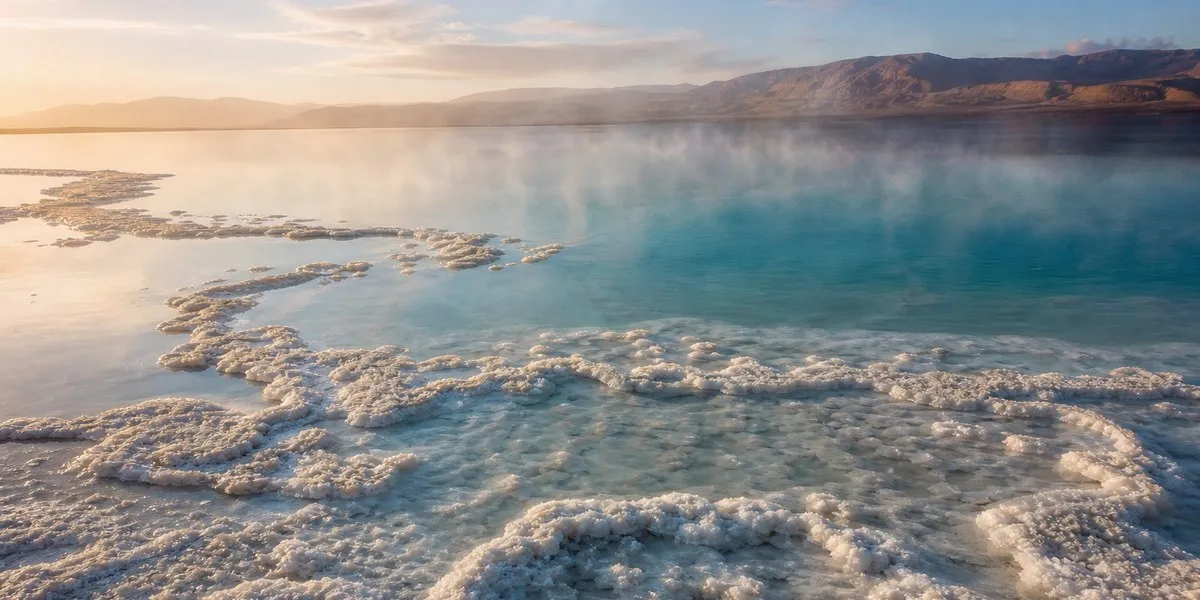
Modeling has shown that falling water levels in the Dead Sea, located between Jordan to the east and Israel and the West Bank to the west, may further warm the body of water. As water is lost, salinity rises, evaporative cooling weakens, and warmer water can sustain further evaporation. ScienceAlert reports on the results of the study, published in the journal Geophysical Research Letters.
From 1979 to 2019, the level of the Dead Sea fell by approximately 34 meters. Over this period, deep waters warmed by 2.8 °C, while the upper layer warmed by about 1.7 °C.
Impact of salinity and evaporation
A team led by geophysicist Emmanuel Guillerm of Germany's GFZ Helmholtz Centre for Geosciences and Binghamton University in the United States created a model combining water loss, salt concentration, and heat exchange. It was calibrated using measurements from 2012–2015; the model reproduced the warming trend and seasonal temperature changes recorded from 1979 to 2019.
Separate simulations showed that by the 2010s, rising air temperatures had caused about 1.3 °C of warming in deep waters, while falling water levels had caused about 1.5 °C. Dissolved salts reduce water's tendency to evaporate at a given temperature. When brine becomes more concentrated, evaporation removes less heat, allowing the water to warm.
More current news is available on the UA.News Telegram channel Telegram.
In summer, warmer and saltier water lies above a cooler, somewhat fresher layer. Because heat spreads faster than salt, flows can carry heat and salt into deeper layers through a process known as “salt fingering.” In winter, water mixing also allows atmospheric warming to reach the depths.
Projections and ancient seas
Under scenarios in which water inflow stops completely, industrial extraction ceases, and the body of water mixes annually, the Dead Sea's level could fall by approximately 85 meters by 2100. Under these conditions, water temperatures could rise by 5–8 °C depending on greenhouse gas emission volumes. The authors noted that groundwater inflow remains an uncertain factor.
The researchers also modeled a fully isolated eastern basin of the Mediterranean Sea. Over approximately eight thousand years, water temperature in the model rose by about 20 °C, while the level fell by 2.5 kilometers. The scientists suggest that the isolation and shrinkage of ancient seas may have contributed to the formation of large salt deposits even without an exceptionally hot or dry regional climate.




