
Moldova has assessed the danger posed by the ammunition depot in Kolbasa
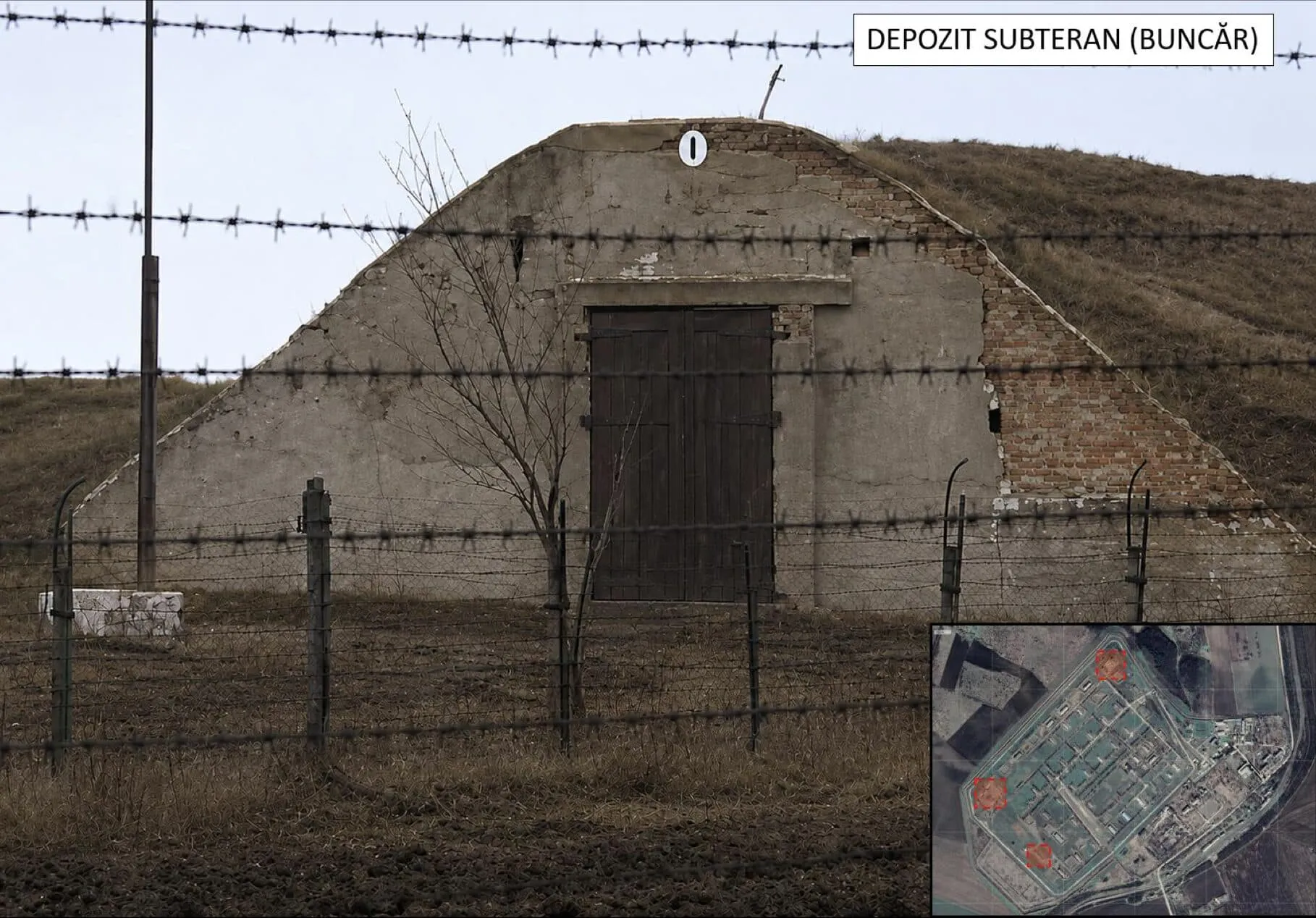
Moldovan security services and military intelligence have provided an assessment of the condition of a large ammunition depot in the village of Kolbasa in Russian-occupied Transnistria. According to their data, there are still about 14,000 metric tons of ammunition there, but the explosives are distributed among dozens of separate storage facilities. For this reason, experts consider the scenario of a simultaneous detonation of the entire stockpile—which has sometimes been compared to the explosion in Hiroshima—to be technically impossible.
A detailed report was prepared by the Moldovan Information and Security Service in collaboration with the Military Intelligence Agency of the Ministry of Defense. To assess the situation, they used official reports from the OSCE mission, satellite imagery, information from open sources, as well as data from classified sources.
According to Radu Kishlianu, director of the Military Intelligence Agency, between 2001 and 2004, approximately 22,000 metric tons of ammunition were removed from the depot or destroyed under OSCE supervision. After that, the process came to a halt, and the Russian side blocked its continuation. In 2006, the OSCE estimated the remaining stockpile at approximately 20,000 metric tons.
In the years that followed, some of the ammunition was used during exercises by the Russian military and security forces of the unrecognized Transnistria. “According to our estimates, there are currently about 14,000 metric tons of ammunition remaining at the complex. However, it is extremely important to distinguish between the total mass of ammunition and the actual amount of explosive substances,” Kishlianu stated.
According to Moldovan authorities, of these 14,000 metric tons, only about 2,800 metric tons consist of explosive substances.
Why the entire depot cannot explode at once
One of the main features of the Kolbasna depot is that its ammunition is not stored in a single large facility. The entire complex consists of 42 separate storage facilities spread across an area of more than 1 square kilometer. The distance between them is approximately 80–200 meters.
The storage facilities are also separated by infrastructure, and part of the area is protected by the natural terrain. According to Moldovan military intelligence, this significantly reduces the likelihood that an explosion in one location would immediately engulf the entire complex.
Therefore, the most realistic scenario for a major accident is considered to be not a single powerful explosion, but a series of separate detonations, fires, and localized explosions. In such a case, the fire could gradually spread between separate zones.
Could Kolbasna Explode Like Hiroshima?
SIB Director Alexandru Mustiace separately commented on claims that an explosion at Kolbasna could allegedly have the force of the nuclear strike on Hiroshima. According to him, the bomb that the U.S. dropped on Hiroshima in 1945 had a yield of approximately 15,000 metric tons of TNT equivalent. By comparison, this is about 1,500 times greater than the yield of the most powerful conventional munition currently stored in Kolbasna.
“For this scenario to become a reality, 1,500 conventional bombs weighing 10 metric tons each would have to explode simultaneously, with microsecond precision. However, this is technically impossible in Kolbasna, given what exactly is stored there and in what quantities,” explained Mustyats. Therefore, Moldovan experts do not confirm a scenario in which the entire depot would detonate simultaneously, creating an explosion comparable to a nuclear strike.
At the same time, this does not mean that the depot poses no danger. A large quantity of old munitions in close proximity to populated areas remains a potential source of serious risk.
Who Controls the Depot
The depot in Kolbasa is considered one of the largest military depots in Eastern Europe. It stores the remnants of ammunition from the Soviet Union’s 14th Guards Combined-Arms Army. Some of the weapons and ammunition were brought there after the withdrawal of Soviet troops from Germany and Czechoslovakia.
The depot is currently located in the unrecognized region of Transnistria. It is guarded by Russian military personnel from the Russian Operational Group of Forces, as well as local security forces. The very presence of Russian troops remains one of the main reasons why Moldova cannot independently carry out the complete disposal of these stockpiles.
Russia has already promised to assist with the disposal
The issue of destroying old ammunition was discussed as far back as 2019. At that time, former Russian Defense Minister Sergei Shoigu met with then-Moldovan President Igor Dodon. Shoigu stated that Russia was ready to provide Moldova with equipment to dispose of ammunition from the depot near Kolbasa.
After meeting with Shoigu in Tiraspol, the leader of unrecognized Transnistria, Vadim Krasnoselsky, also stated that he supported the idea of disposal. At the same time, he insisted that this issue should be resolved only through negotiations between Transnistria and Russia. Ultimately, the large-scale disposal of the stockpiles never took place. Today, according to Moldovan authorities’ estimates, approximately 14,000 metric tons of ammunition remain at the depot.
The Moldovan report was, in effect, an attempt to separate the real danger from years of claims about a potential “Hiroshima” in the heart of Europe. The catastrophic risk has not completely disappeared, but intelligence data indicates that a simultaneous explosion of all stockpiles in Colbasna is an unrealistic scenario. This was reported by NewsMaker.
The foreign ministers of Ukraine, Romania, and Moldova are maintaining contact regarding Russia’s violations of the airspace of neighboring states. They plan to discuss joint countermeasures against Russian attacks during the “Odessa Triangle” summit.


