
Human and animal DNA, as well as traces of food, were found on the Shroud of Turin
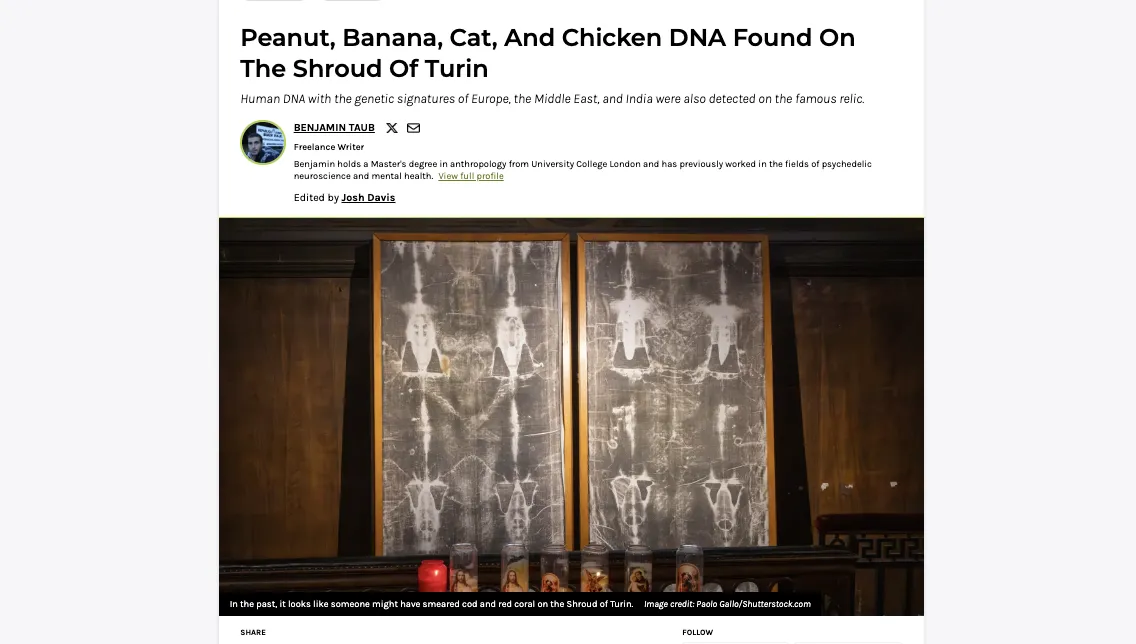
During a new analysis of organic residues on the Shroud of Turin, scientists discovered various biological traces. The study revealed the presence of DNA from 14 people, as well as genetic material from animals and remnants of various foods.
Some of the particles greatly surprised the scientists—they are currently investigating their origin, according to a study published in the journal Scientific Reports, as reported by Iflscience.
The Shroud of Turin is the name given to the linen cloth in which the body of Jesus Christ was wrapped after his crucifixion. However, the exact origin of the fabric has not yet been established.
To study the fabric, scientists took samples of organic residues from its surface in 1978. Now, researchers have reexamined these traces using modern methods of genetic analysis.
As a result, they were able to identify a variety of biological species that had come into contact with the cloth at some point over the centuries. The researchers detected DNA from 14 different individuals. These are likely the people who touched the cloth.
One of the genetic traces belongs to a European scientist of Jewish descent who collected samples in the 1970s. Traces of people from the Middle East were also detected. In total, nearly 40% of the human DNA on the Shroud of Turin originates from India.
According to scientists, this is due to the fact that the linen cloth from which the shroud was made was imported from the Indus River Valley at that time.
However, what surprised researchers the most were traces of agricultural crops—tomatoes, cucumbers, melons, potatoes, bananas, peanuts, peppers, corn, carrots, and nuts. DNA from domestic animals—dogs, cats, chickens, pigs, horses, and cattle—was also found there.
Traces of Mediterranean red coral, which was used to make jewelry in Roman times, were also found among the remains.
“The shroud is a vast archive of genetic information that has accumulated over the centuries through interaction with humans and environmental influences. Although DNA cannot answer all questions regarding the age or authenticity of the fabric, it provides insight into its biological history and demonstrates how advances in forensic science help uncover new information from historical artifacts,” explained study co-author Professor Noemi Prokopio.
It is currently unknown exactly how each of these contaminants ended up on the Shroud of Turin. However, some of the plant species identified are native to Latin America. They likely contaminated the fabric after Christopher Columbus’s voyages and the discovery of the Americas in 1492.
Source: Iflscience
Earlier, a Celtic ruler’s tomb containing golden treasures was discovered in Germany.
Near Halych, archaeologists discovered unique medieval artifacts.
As a reminder, the sunken ship “Delta I,” discovered off the coast of Cádiz, Spain, continues to reveal new secrets. Archaeologists have determined that the ship was carrying Swedish cannons and silver ingots from the territory of modern-day Bolivia, which may indicate large-scale smuggling in the Atlantic more than 300 years ago.


