
Russia is blocking reforms in the diamond market, and this is undermining consumer confidence
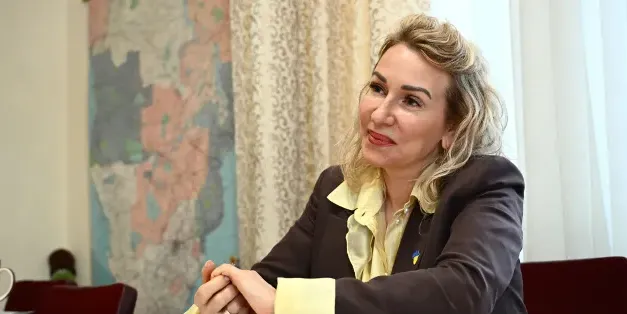
Reputational risks for the natural diamond market are growing worldwide due to Russia’s blocking of attempts to change the rules of the Kimberley Process. Ukrainian diplomats warn that this undermines consumer confidence and affects the entire gemstone trade chain. This was stated by Lyubov Abravitova, Director of the Department of Africa and Regional African Organizations at the Ministry of Foreign Affairs of Ukraine, in an interview with Ukrinform.
Russia is blocking updates to international diamond trade rules, and as a result, new conflicts are emerging on the global market that are gradually changing perceptions of natural gemstones. This was stated by Lyubov Abravitova, Director of the Department of Africa and Regional African Organizations at the Ministry of Foreign Affairs of Ukraine, while commenting on the situation within the Kimberley Process.
This refers to an international initiative that brings together states, the diamond industry, and civil society organizations with the aim of preventing the trade in so-called “conflict diamonds,” which can finance armed conflicts.
According to Abravitova, the problem lies in the fact that current rules do not take into account modern military realities, where diamonds can be used by states to finance aggression but do not formally fall under the definition of “conflict diamonds.”
She emphasized that, due to the consensus-based decision-making system, Russia is blocking attempts to expand this definition, effectively leaving “gray areas” in international regulation. “Thus, the vagueness of the mandate has turned into a mechanism for protecting the aggressor. In this context, the key problem lies in Russia’s blocking of the reform of definitions, that is, the expansion of the definition of ‘conflict’ diamonds,” the diplomat noted.
Experts warn that this situation is already affecting not only the political sphere but also the economy—specifically, consumer confidence in natural diamonds, which are traditionally associated with transparency of origin and ethical mining practices.
Abravitova emphasized that the consequences are being felt not only by major market players but also by countries whose economies depend on diamond mining, particularly in Africa, where mining is a key source of revenue.
According to her, the world is gradually beginning to feel the broader consequences of Russian aggression, and the diamond market is becoming one of the most sensitive to these processes due to its dependence on trust and reputation. “In fact, the world is gradually beginning to feel the broader consequences of Russian aggression, particularly reputational risks for various commodity markets,” the Foreign Ministry representative stated.
Thus, the debate surrounding the Kimberley Process extends far beyond technical trade regulation—it is becoming part of a global struggle for rules, trust, and control over resource markets.
Oil refining has halted in central Russia following drone attacks.
Russia is waging a disinformationcampaign against Armenia ahead of the elections.
Russia is cutting social benefits to increase payments to contract soldiers.
Russia’s economy is contracting despite higher oil prices
Russia changed its polling methodology, and Putin’s approval rating immediately rose
Putin has begun speaking of “ending the war” due to serious problems on the home front and at the front lines


