
Russian propaganda has found new platforms in France — Politico
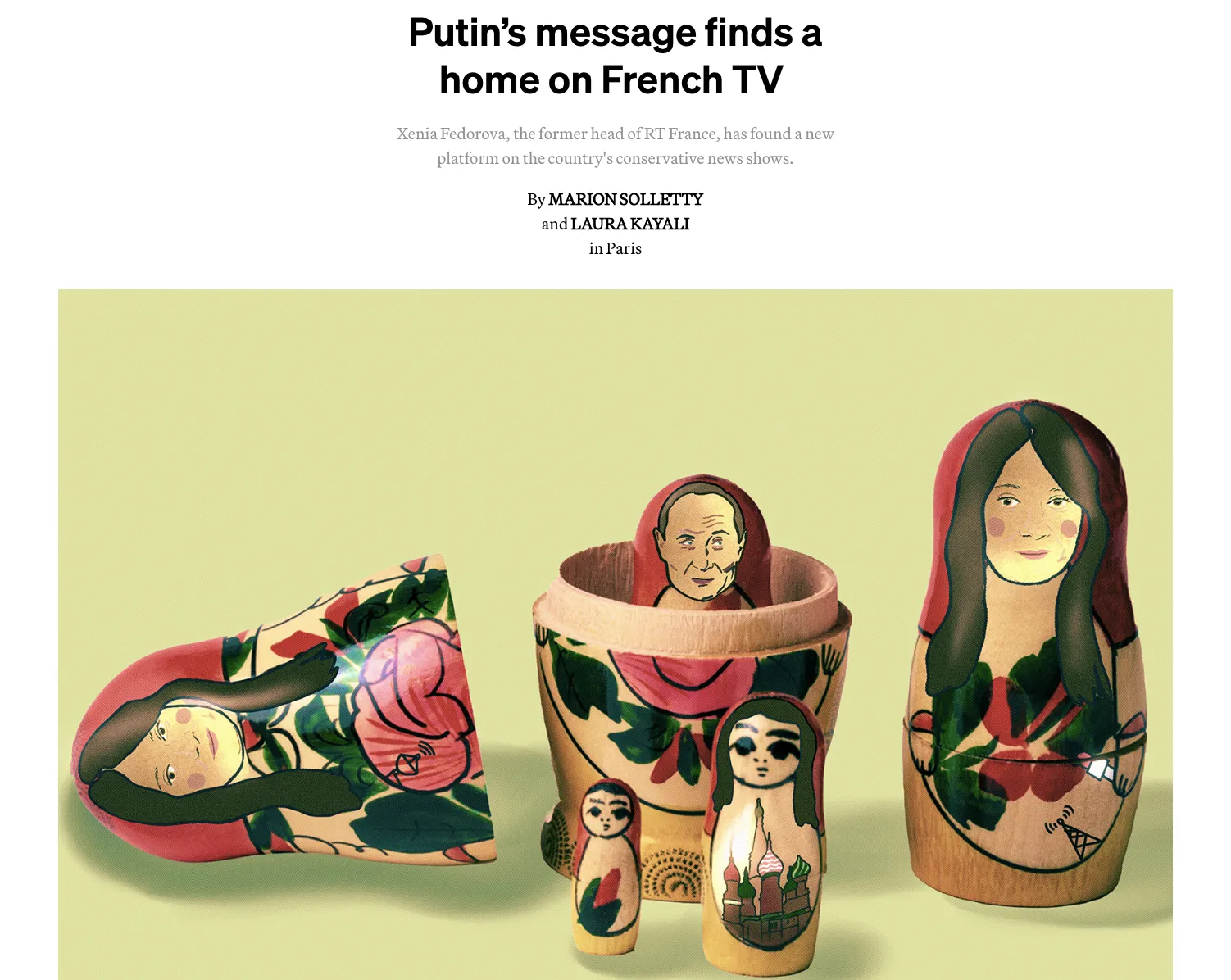
Attempts to circumvent the blocking of Kremlin-linked media outlets have been observed in France. Ksenia Fedorova, the former head of RT France, has begun appearing on conservative news shows in France. This is seen as a way to continue spreading Russian propaganda narratives despite EU sanctions and restrictions.
Politico reports on this.
Ksenia Fedorova, the former president of the banned RT France television channel, has successfully integrated into the mainstream French media, where her openly pro-Russian comments on the war in Ukraine, NATO, and European security are causing growing concern among politicians and experts ahead of the 2027 presidential election.
Fedorova, a protégé of Russia’s chief propagandist Margarita Simonyan, found refuge in the media empire of far-right tycoon Vincent Bolloré after RT France was shut down. She now regularly appears on the popular 24-hour news channel CNews and on Europe 1 radio, where Kremlin narratives are presented with virtually no pushback or rebuttal from the hosts.
A striking example of her new role was her analysis of Vladimir Putin’s speech on Victory Day, May 9, 2026. On CNews, Fedorova openly repeated the Kremlin’s familiar narratives, accusing the West of deliberately prolonging the war in Ukraine and derailing the 2022 peace talks. Instead of refuting these claims or presenting the audience with the facts, the host handed the floor to another guest who supported the Russian woman’s position.
This incident prompted Valérie Ayer, head of the liberal Renew group in the European Parliament and a close ally of President Emmanuel Macron, to file a complaint with the French television regulator. Politicians emphasize that Fedorova’s rhetoric directly touches on issues of France’s national security and bears the “unmistakable mark of the Kremlin.” However, due to the principles of the rule of law and freedom of speech, it is currently extremely difficult to legally influence her presence on the air, as there is no formal evidence of her funding from Moscow.
Fedorova first drew attention in French political circles in 2017 at a press conference with Emmanuel Macron and Vladimir Putin in Versailles. At the time, Macron responded sharply to her question, calling RT and Sputnik not journalists but “tools of influence” and purveyors of slander. Despite this, RT France later went on the air, actively supporting the anti-government “Yellow Vests” protests, which served the Kremlin’s interests.
After the start of Russia’s full-scale invasion of Ukraine and the imposition of EU sanctions in 2022, RT France went bankrupt and was shut down, but Fedorova herself remained in Paris. Her longstanding informal ties with billionaire Vincent Bolloré helped her quickly return to the media landscape. Bolloré’s publishing house released her memoirs, and the channels under his control made her a regular expert.
Former colleagues describe Fedorova as an intimidating figure, comparing her appearance in the studio to “Darth Vader, who silences everyone.” Any attempts to criticize Russia are harshly suppressed. In particular, retired General Bruno Clermont publicly stated that he was dismissed from CNews’s pool of military advisors precisely after making negative comments about Russia that “Ksenia Fedorova didn’t like.”
The situation is complicated by the fact that Fedorova’s talking points are gradually seeping into the rhetoric of French journalists themselves. Recently, CNews’s star anchor Pascal Praud repeated a long-standing Russian myth that NATO’s eastward expansion allegedly provoked the war in Ukraine. Disinformation experts warn: Fedorova’s example proves that sanctions against legal entities are unable to completely stop foreign interference if major local media outlets voluntarily provide a platform for agents of influence.
As a reminder, the European Union has been discussing the possible appointment of a special mediator for contacts with Russia, and Angela Merkel is among the leading candidates. Mario Draghi and Alexander Stubb are also being considered alongside her, but no final decision has been made yet due to disagreements among diplomats. Some countries view such an initiative as a risky concession to the Kremlin, while others see it as a pragmatic tool amid the diminishing role of the U.S. as the primary mediator.


