
AI characters in China are receiving their own identification documents
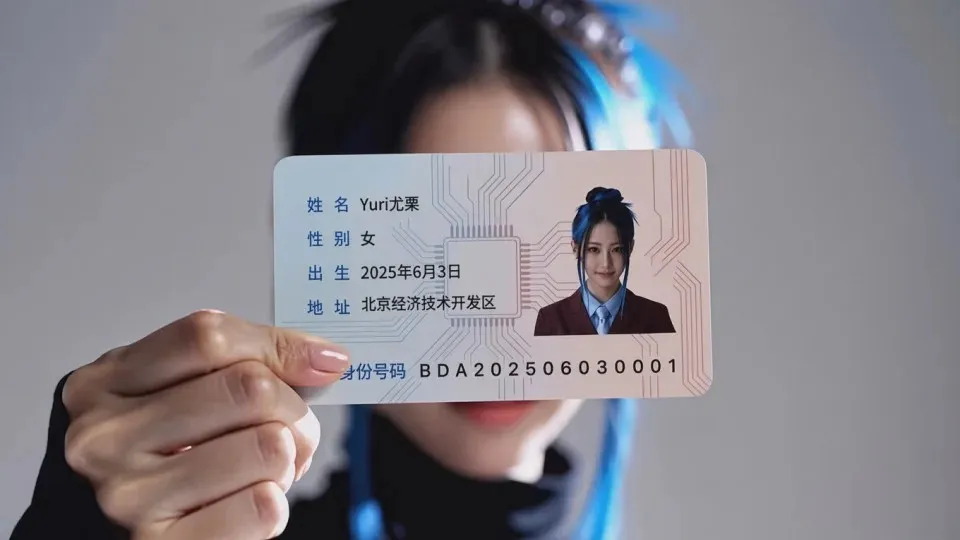
Beijing has begun testing a system that allows virtual characters created by artificial intelligence to obtain official documents. One of the first to receive such an ID was the digital singer Yuri, who has over 100,000 followers on Chinese social media. She exists only in the digital world, but now authorities are trying to formalize her activities in much the same way as those of a real person.
China has launched a pilot program to register so-called “digital humans.” These are virtual characters created using artificial intelligence. Under the program, such characters can be issued official identification cards. The document lists the digital character’s name, date of birth, address, and facial features.
One of the first to receive such a document was the virtual singer Yuri. She already has over 100,000 followers on Chinese social media. Yuri performs at concerts and sings in both Chinese and English. Her appearance and image are entirely created using technology. She can change outfits literally in the middle of a performance. However, Yuri herself does not exist as a real person. Behind the digital character is a team that creates content and manages her activities.
Now Yuri’s team can use an official document for very real-world purposes. Specifically, this includes opening a digital wallet and entering into commercial agreements. Such capabilities are particularly important for collaborating with companies. Digital characters are already active in advertising, fashion, video games, and the automotive industry.
According to the China University of Communications, at least 1.3 million companies in China are involved in this sector. In 2025, the country’s digital human market was estimated at approximately $10 billion. AI characters in China have long since gone beyond the scope of ordinary avatars. They can serve as TV hosts, bloggers, and online salespeople. Some of them even act as virtual government officials and answer citizens’ questions.
One of the main advantages of such characters is that they can work around the clock. For companies, this means the ability to constantly engage with their audience without the costs associated with maintaining a large workforce. At the same time, the rapid development of digital humans is creating new challenges. According to ABC News, Chinese authorities want to better regulate the use of such technologies, protect copyrights, and combat fraud.
There have already been cases in the country where AI characters posed as real doctors and spread false medical advice. The technology has also been used to create pornographic deepfakes featuring celebrities without their consent. Therefore, the authorities are trying to determine who is actually behind a digital character and who is responsible for its actions. Registration could help link a virtual avatar to a specific person or company that controls it.
But there is another side to this. Experts warn that mandatory registration of digital personas could give the state greater opportunities to control online activity. In particular, this could affect the anonymity of users who create and control virtual personas.
For now, this is only a pilot project in Beijing. There is not yet a unified nationwide registration system for digital personas in China. However, the very existence of official documents for characters that do not physically exist shows just how quickly AI is changing our traditional understanding of identity, work, and business on the internet.




