
Sweden has declassified information about an incident involving a Soviet nuclear submarine — SVT
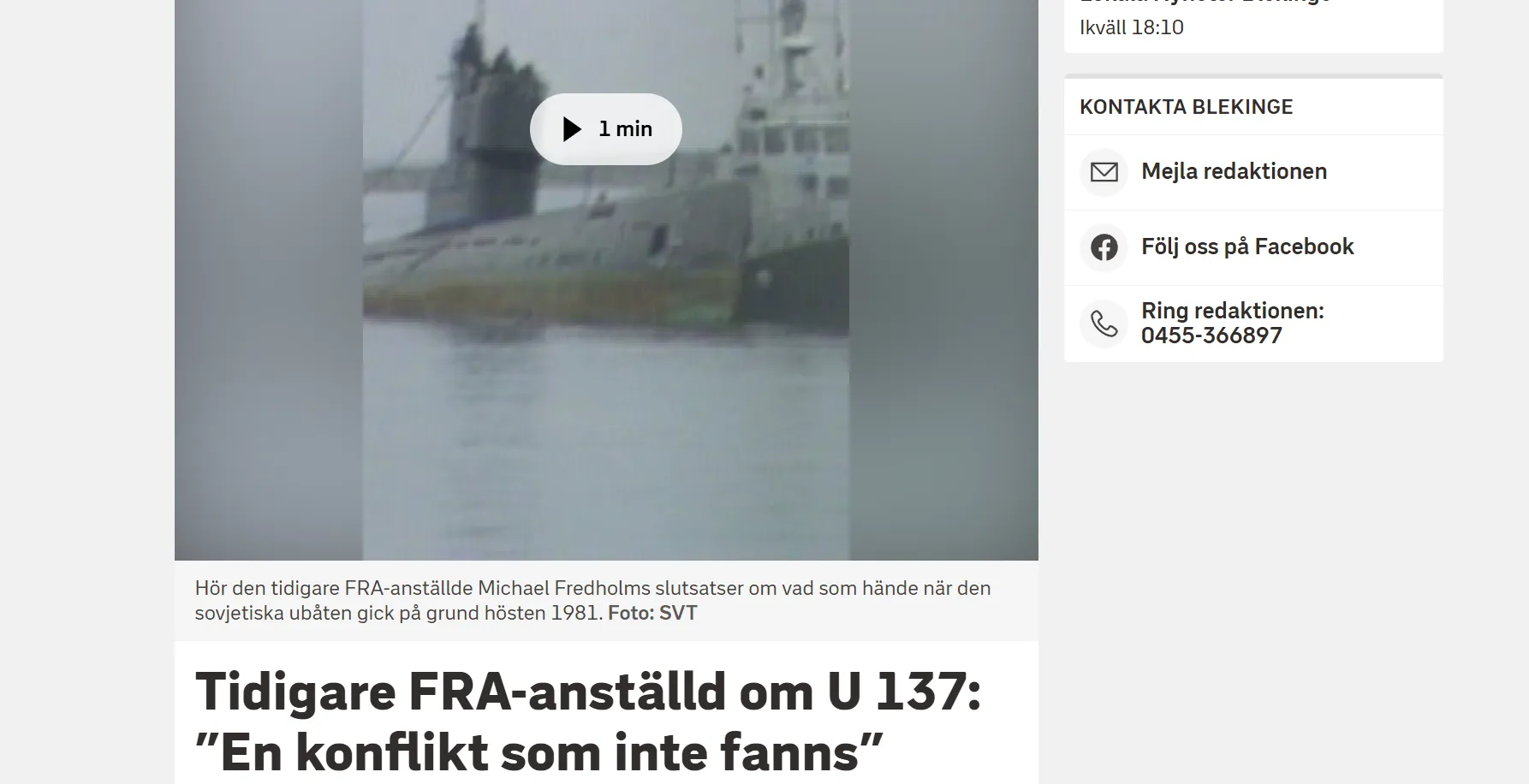
Swedish researchers have revealed previously unknown details of a high-profile incident in 1981, when the Soviet submarine S-363 ran aground near the secret naval base at Karlskrona.
The findings, based on official documents, were published by the authoritative Swedish media outlet SVT.
New data contained in recently declassified archives cast doubt on the long-standing version of events regarding a deliberate provocation by the Soviet Union.
The historic event took place at the height of the Cold War and was considered one of the greatest international crises of that time. The Soviet Project 613 submarine, part of the Baltic Fleet, set out on a training mission in September 1981.
The scale of the danger lay in the fact that there were two torpedoes with nuclear warheads on board.
During the extended voyage, the submarine collided with the trawl of a fishing seiner, damaging its navigation equipment. Specifically, problems arose with the radio direction-finding antenna, the sonar, and the “Decca” system.
According to various accounts, either the captain did not report the incident to headquarters, or he did but was ordered to continue the voyage.
Subsequently, serious errors by the crew and technical navigation problems led to the submarine completely losing its bearings.
On the evening of October 27, 1981, S-363 struck the rocks of a coastal shoal near Turumsher Island, not far from Karlskrona—where Sweden’s major naval base is located—at full speed and ran aground with a list to port.
Sweden immediately surrounded the area with a large military force and accused the USSR of a gross violation of its territorial waters.
After ten days of tense standoff, by mutual agreement, the Swedes questioned the captain, and then a Swedish tugboat refloated the submarine and towed it to the territorial waters boundary, from where it proceeded to meet the Soviet ships.
In Sweden, the prevailing belief for a long time was that the incident was a deliberate provocation, not an accident. In contrast, a Soviet internal investigation placed the blame for the incident on the submarine’s captain, Anatoly Gushchin, and other senior officers.
Michael Fredholm, a former employee of the Swedish National Defence Radio Establishment who personally reviewed the materials, noted that Stockholm’s actions were overly emotional.
The released data suggests that the Swedish side may have artificially escalated the situation surrounding the accident.
“A picture has emerged that differs from the interpretation of the event at the time. It was Sweden’s actions that created a conflict that did not actually exist, thereby increasing the risks for the country rather than reducing them,” Fredholm says.
The released materials suggest that the Swedish government reacted as harshly as possible almost immediately after receiving information about the incident. The authorities made decisions under stressful conditions without properly verifying the facts.
“First and foremost, it is clear that the government made a harsh decision within ten minutes. At that moment, there was no other information available besides the fact that a Soviet submarine had run aground,” the expert says.
Sweden Begins Mass Review of Permanent Residence Permits
Sweden will transfer four islands to private use for one year free of charge


