
The U.S. has begun preparations to decommission the world's first nuclear-powered aircraft carrier, the USS Enterprise
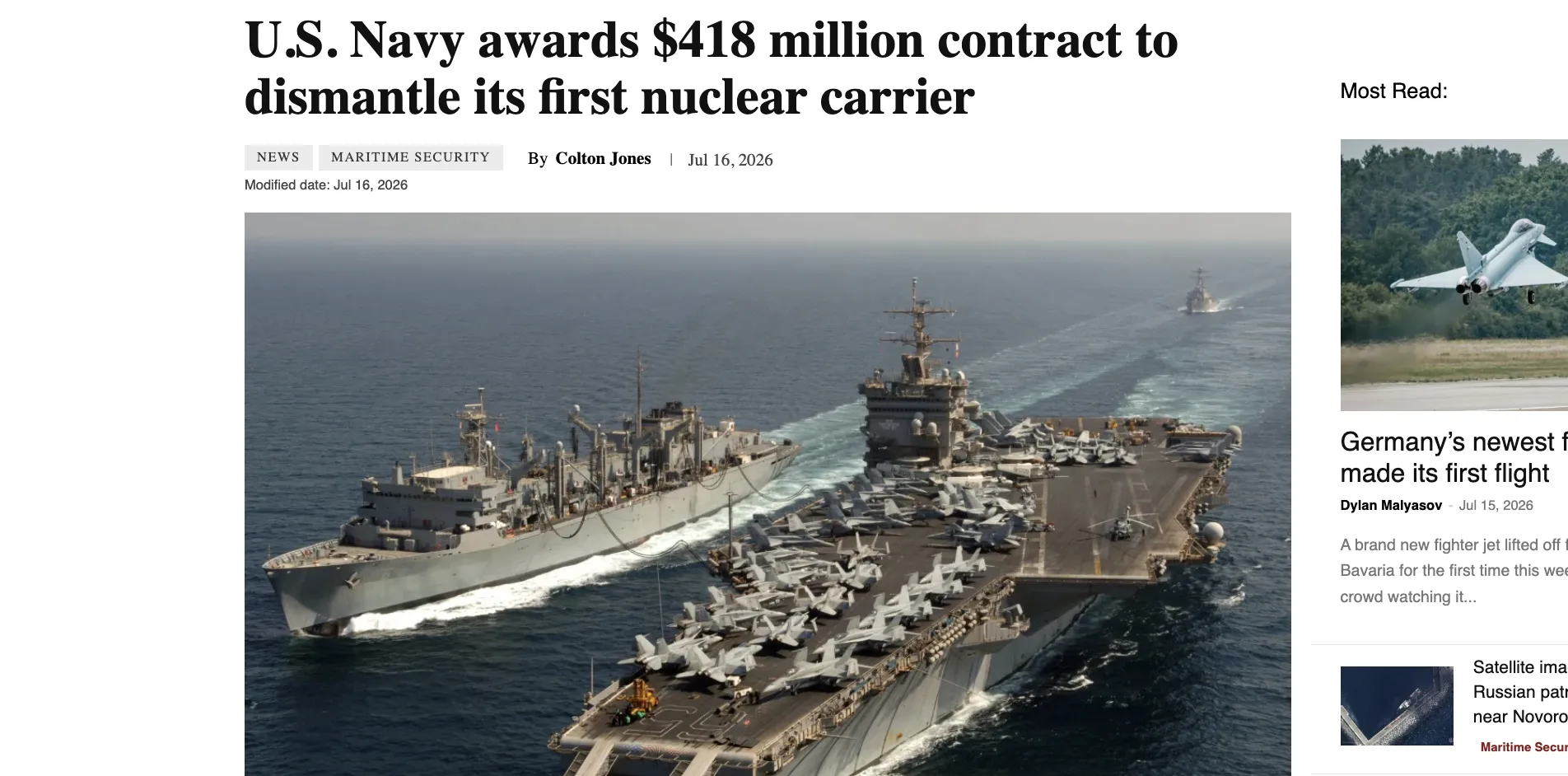
The U.S. Navy has awarded a $418 million contract for the decommissioning of the legendary aircraft carrier USS Enterprise (CVN-65). The ship was the world’s first nuclear-powered aircraft carrier and served in the U.S. Navy for more than half a century.
The contractor is NorthStar Maritime Dismantlement Services, based in Vernon, Vermont. The final cost of the work turned out to be approximately $118 million less than previously estimated.
Commissioned in 1961, the USS Enterprise was a unique ship: it is the only aircraft carrier in history equipped with eight nuclear reactors.
This technical design gave it exceptional performance, but at the same time significantly complicated the ship’s future decommissioning.
Over more than five decades of service, the aircraft carrier participated in key events in American naval history.
It was on combat duty during the Cuban Missile Crisis, carried out combat missions in Vietnam, supported the evacuation during the fall of Saigon, and, following the September 11 attacks, was repeatedly deployed in operations as part of the global war on terrorism.
The Enterprise was officially decommissioned in 2012. By 2017, all nuclear fuel had been completely removed from the ship; however, it remained at the Newport News Shipbuilding yard in Virginia for many years afterward, while the Navy sought the safest and most cost-effective method for its disposal.
Some experts and enthusiasts advocated for preserving the legendary aircraft carrier as a museum exhibit. In 2021, the American Nuclear Society even granted it the status of a “Nuclear Historic Landmark.”
However, the U.S. Navy rejected this idea, concluding that due to the deep integration of the eight reactors into the hull’s structure, it would be impossible to safely dismantle them while keeping the ship suitable for museum display.
Once work begins in Mobile, all materials from the aircraft carrier will undergo thorough sorting.
Ordinary steel and other safe structural components will be sent for recycling, while hazardous materials—including low-level radioactive waste remaining after the dismantling of the reactor units—will be specially packaged and transported to licensed storage facilities and facilities designated for handling such materials.
It is expected that approximately 35,000 metric tons of steel recovered from the dismantling of the USS Enterprise will be reused. Part of this metal is planned to be used in the construction of its successor—the Ford-class nuclear-powered aircraft carrier USS Enterprise (CVN-80).
The U.S. Navy emphasizes that the dismantling of the USS Enterprise will serve as a pilot project, allowing them to refine the technologies and procedures for the future decommissioning of all Nimitz-class nuclear-powered aircraft carriers.
This was reported by Defence Blog.
Earlier, the U.S. released a video of the boarding of a tanker that attempted to break through the blockade around Iran.
As a reminder, Iran claimed to have struck U.S. surveillance systems in Oman.
The IRGC announced a strike on a U.S. base in Syria.




