
The U.S. and Japan have begun large-scale island defense exercises
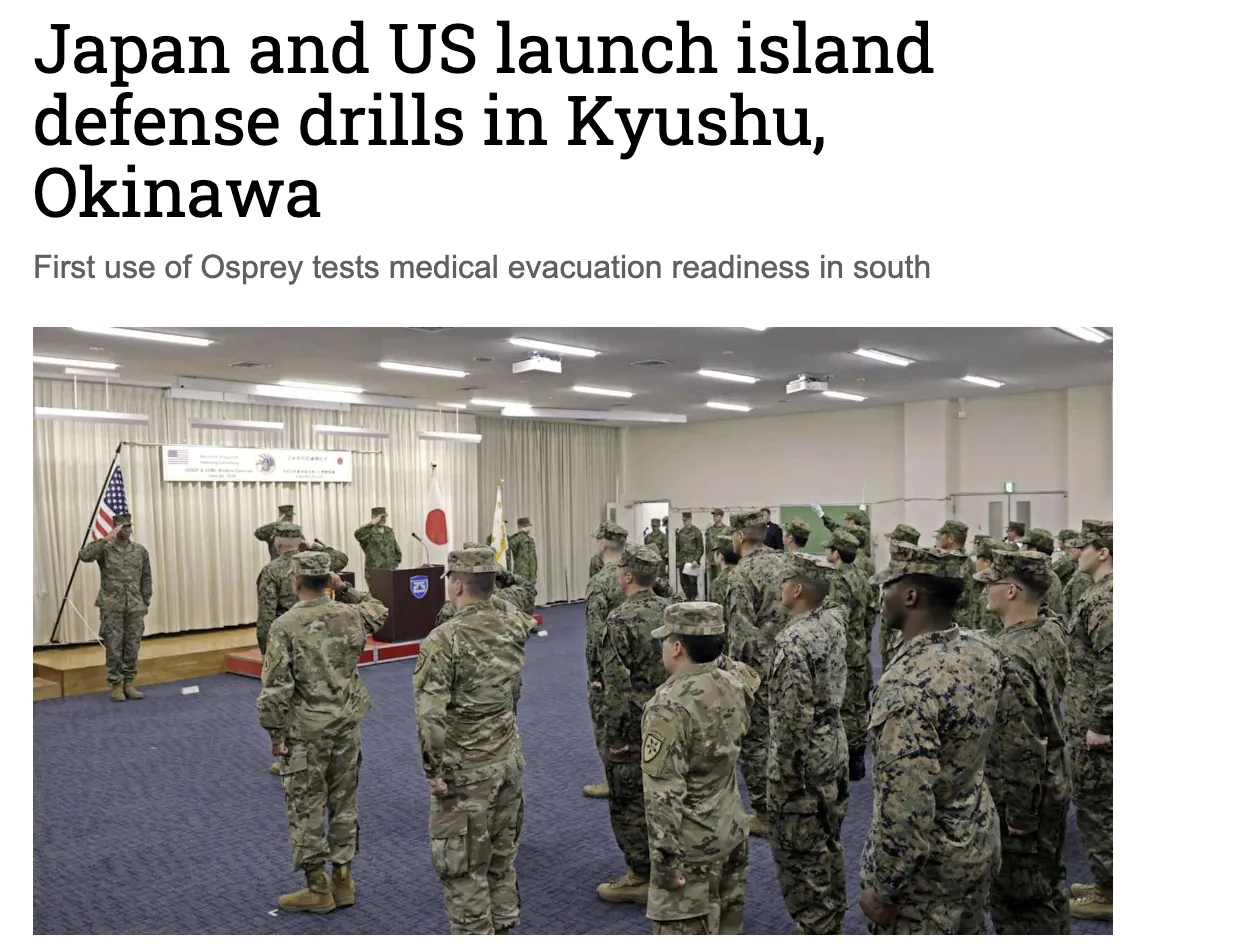
On June 20, Japan’s Ground Self-Defense Force and the U.S. Marine Corps began large-scale “Resolute Dragon” exercises in Okinawa, aimed at practicing the defense of remote southwestern islands. The exercises are designed to coordinate allied actions in the event of threats in the region and to strengthen joint operational cooperation.
The exercises, which will last until June 30, will involve approximately 9,600 military personnel from both countries, and Type 10 tanks will be deployed. Training will also be conducted on the deployment of Type 88 and Type 12 launchers for firing guided anti-ship missiles.
In addition, the Japanese military plans to use the V-22 Osprey tiltrotor aircraft for the first time to practice evacuating the wounded from the island to an airbase in Okinawa.
During the exercises, the military plans to practice transporting missile launchers to remote islands using military transport ships and refueling the missiles. No reports have been made regarding planned live-fire exercises with missile systems.
According to Lieutenant General Seiji Toriumi, commander of the Western Command of the Self-Defense Forces, demonstrating the allies’ defense capabilities is of great importance for peace and stability in the Indo-Pacific region.
Okinawa Prefecture is located at the border of the East China Sea and the Pacific Ocean and occupies a strategic position between the Japanese archipelago, mainland China, and the islands of Southeast Asia.
It is Okinawa that administratively controls the uninhabited Senkaku Islands in the East China Sea, which are controlled by Tokyo but claimed by China. Chinese vessels have repeatedly intruded into Japanese waters around these islands, provoking rising tensions in relations between Tokyo and Beijing, according to Nikkei.
You may be interested in:
Trump stated that Iran will not receive any money under the new agreement.
Iran has proven to be a tough nut to crack for Washington, says the director of the Center for the Study of Modern Iran.
Trump called the deal with Iran an unconditional surrender.


