
Starbucks Korea Fires CEO Over 'Dance Day' Advertising Campaign — BBC
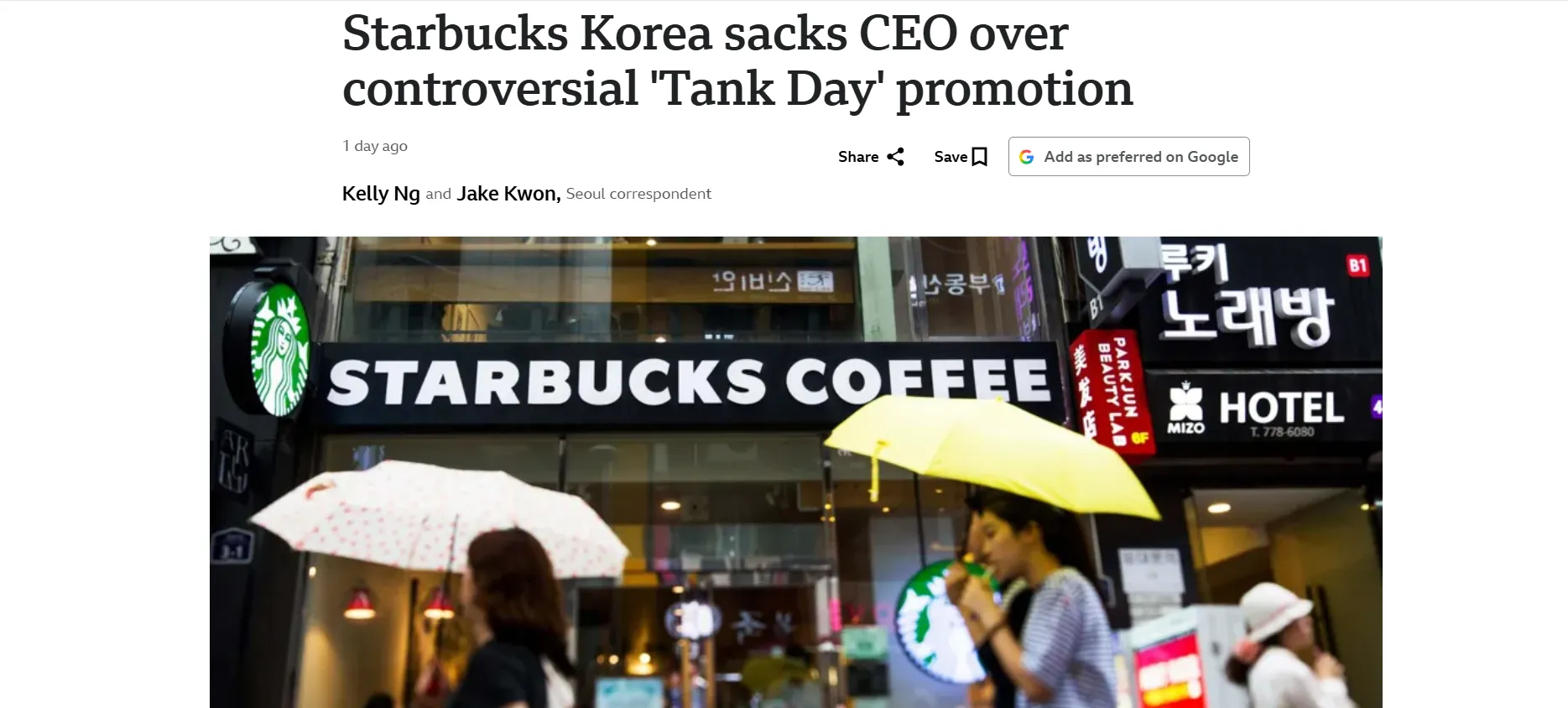
Son Jeong-hyun, the CEO of Starbucks Korea, was dismissed from his position following the launch of an advertising campaign that the public perceived as a disrespectful reference to the country’s bloody historical events.
The BBC reports on this.
The campaign, titled “Dance Day,” launched earlier this week, coinciding with the anniversary of the brutal suppression of a pro-democracy uprising in the city of Gwangju.
The controversial marketing campaign sparked a wave of outrage, calls for a mass boycott of the coffee chain, and sharp criticism from South Korean President Lee Jae-myung.
South Korean society reacted with extreme distress to the appearance of military imagery in the well-known brand’s visual materials.
Many believe that the “tank” motif is a reference to the military equipment used by the government in May 1980 to suppress pro-democracy protests.
The anniversary of this tragedy is sacred to citizens, so the commercial use of such imagery was seen as a desecration of the memory of the dead.
The Korean division of the world-famous chain was forced to respond urgently to a major crisis and customer backlash. The Korean division of Starbucks canceled the promotion just a few hours after its launch.
The Shinsegae conglomerate, which owns a controlling stake in the coffee chain, apologized for the “inappropriate marketing” and fired the chain’s CEO, Song Jeong-hyun.
Company management attempted to justify itself, insisting that the name of the promotion was purely colloquial and referred to the size of the cups.
The “Tank Day” advertising campaign promoted the Tank series of drink cups, which were claimed to have a large capacity for a large amount of coffee.
Starbucks Korea previously reported that this series is one of several cup series the company is releasing as part of a campaign running from May 15 to 26.
The brand’s official representative issued a statement acknowledging responsibility for the oversight and promising to revise its advertising selection criteria.
“We sincerely apologize for the inconvenience and concern caused to our customers. We have immediately halted the campaign and will review and improve our internal processes to prevent similar incidents from occurring in the future,” the company’s statement reads.
The American founders of the global coffee chain also quickly stepped in to address the high-profile international scandal.
Starbucks headquarters in the U.S. also apologized, acknowledging that “while this was unintentional, it should never have happened.” The U.S. office expressed solidarity with the Korean people in their mourning for the victims of the dictatorship.
“We acknowledge the deep pain and offense this has caused, especially to those who honor the memory of the victims, their families, and all who have contributed to the democratization of Korea,” the statement reads.
Despite the apology from top management, social media users and opinion leaders continue to actively criticize the brand for its cynicism.
People are demanding a full investigation into the incident and calling for a boycott of Starbucks Korea and Shinsegae.
“I can’t believe they thought they could pull something like this off and people would just turn a blind eye… it’s completely absurd and outrageous,” wrote one user, X.
The harshest and most uncompromising reaction came from the head of state, who called the marketers’ actions an unacceptable violation of national values.
The South Korean president stated that the advertising campaign “insults the victims and the bloody struggle” of the residents of Gwangju. He published an emotional statement on his official page.
“What were they even thinking, knowing how many lives were taken that day and how seriously this undermined our country’s justice and history? I am outraged by the inhumane behavior of such a low-class merchant who denies our country’s values, such as fundamental human rights and democracy,” he wrote on social media.
The historical context mentioned by the president relates to the bloody events of May 18, 1980, when hundreds of demonstrators were killed in Gwangju.
Subsequent investigations later confirmed that the military regime of Chun Doo-hwan also committed rape and sexual assault.
Since then, May 18 has often been portrayed as a day of national tragedy for South Korea and is also observed annually as a sacred day of democracy.
In addition to tanks, researchers and observant consumers found another offensive historical reference in the coffee shop’s advertising. Some in South Korea believe that Starbucks Korea’s advertising campaign also references the 1987 movement.
The promotional materials for the cup used the Korean phrase “bang on the table!”, which sounds like the sound of an object hitting a table.
This phrase evokes direct associations with the brutality of the police at the time and attempts to cover up the murder of a student during interrogation.
The word “Tak” was also used in a controversial 1987 police statement regarding the death of a student activist who was in custody.
The police claimed that the activist fell and died after an investigator struck him hard against a table, although in reality he died as a result of torture.
The head of the parent South Korean conglomerate personally condemned the actions of his subordinates and called the incident a shameful mistake.
Shinsegae Group Chairman Chung Yong-jin called the Starbucks campaign “an unforgivable mistake that devalued the suffering and sacrifices of all those who dedicated themselves to this country’s democracy.”
In a statement released yesterday, he promised to “thoroughly review” the procedures for approving campaigns and “revise the vetting process” for marketing content across all of its branches.
South Korea is preparing to completely phase out dog meat by 2027
South Korea has warned of a threat to global microchip production due to the war in Iran


