
Holiday on August 15, 2026: Liechtenstein celebrates National Day
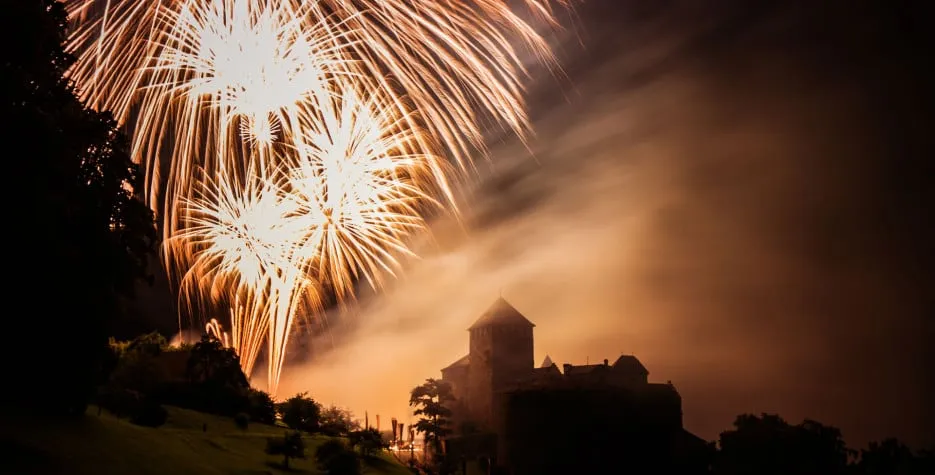
On August 15, Liechtenstein celebrates National Day—one of the country’s major holidays. In 2026, it falls on a Saturday. Interestingly, this date does not mark Liechtenstein’s independence: the holiday was established only in 1940, and its date combined the Catholic feast of the Assumption of the Blessed Virgin Mary with the day before the birthday of the then-Prince Franz Joseph II. Today, it is a major national holiday featuring an official ceremony, festivities in Vaduz, bonfires on the mountains, and a large-scale fireworks display.
Liechtenstein’s National Day, known in German as Staatsfeiertag, is celebrated annually on August 15. It is an official public holiday and one of the most important dates on the principality’s calendar. In 2026, the holiday falls on Saturday, August 15. The Liechtenstein government chose August 15 back in 1940, and since then it has become a permanent part of the country’s life.

For Liechtenstein itself, this is not just another day on the calendar. The holiday is linked to the principality’s history, its independence, the monarchy, and national identity. It is also popularly known as Fürstenfest—“the Prince’s Festival.” However, today the focus is not so much on the monarch himself as on the country, its people, and their shared values.
The Origins of National Day
At first glance, it might seem that August 15 marks the day Liechtenstein gained its independence. In reality, the story is a bit more interesting. The principality became an independent state long before the modern National Day was established. On January 23, 1719, Charles VI, Holy Roman Emperor, elevated the Schellenberg estate and the County of Vaduz to the status of the Principality of Liechtenstein. And in 1806, following the dissolution of the Holy Roman Empire, the principality gained full sovereignty.
Therefore, August 15 should not be called “Independence Day” in the usual sense of the word. It is, in fact, National Day, which was established much later—in 1940. By then, Europe was already engulfed in World War II. Liechtenstein remained a small neutral state, but the situation surrounding the country was very tense. The Nazi regime in Germany was growing stronger nearby, and within the principality itself, there was a movement advocating for annexation by Nazi Germany. Therefore, the authorities sought to emphasize the unity of the population and its readiness to defend the country’s independence.
Why August 15 Was Chosen
The reason for choosing this date is quite unusual. In the Catholic tradition, August 15 marks the Feast of the Assumption of the Blessed Virgin Mary. For predominantly Catholic Liechtenstein, this was already an important religious holiday. And the following day, August 16, was the birthday of Prince Franz Joseph II, who ruled Liechtenstein from 1938 to 1989. So the authorities decided to combine these two closely related dates into a single national celebration.
On August 5, 1940, the government officially declared August 15 a National Day. Just ten days later, the country celebrated the new holiday for the first time. Despite the short preparation time, the first celebration turned out to be quite traditional: church services, speeches, music, houses decorated with flags, and community events. Interestingly, after the death of Franz Joseph II in 1989, the holiday was not abolished. In 1990, it was enshrined in law as a permanent National Day. Thus, the date ceased to be tied to the birthday of a specific prince and definitively became a holiday for the entire country.
What Does the Holiday Mean for Liechtenstein?
Today, August 15 is, first and foremost, a day when the principality’s residents celebrate their country. The holiday serves as a reminder of how this small state managed to preserve its independence during difficult periods in European history. This theme took on particular significance in the 1940s. Liechtenstein was situated between warring powers, and its independence could have been threatened. National Day was intended to demonstrate that the population supported the principality’s existence as a separate state.

Over the years, the meaning of the holiday has changed. While it was initially closely tied to the prince and the monarchy, today the focus is on Liechtenstein itself, its people, its culture, and its shared future. That is why the holiday remains popular even after the death of Franz Joseph II. It has become a kind of day of unity, when residents of all 11 municipalities of the principality come together.
How August 15 Is Celebrated
The main celebrations take place in the country’s capital, Vaduz. The day traditionally begins with an official state ceremony on the lawn near Vaduz Castle. There, Crown Prince Alois and the President of the Landtag deliver speeches, and a solemn blessing ceremony takes place.
After the official part, the city transforms into a large venue for a folk festival. In the center of Vaduz, the Volksfest—a folk festival—takes place, with local communities, musical groups, clubs, and civic organizations participating.

Festive stalls line the streets, and concerts and various entertainment events take place. There are separate areas for children and young people. At the so-called Winzerdörfle, or “wine village,” guests are treated to local wines and regional dishes. The scale of the festivities is impressive for such a small country. For example, in 2024, organizers estimated the number of visitors to the festival at approximately 30,000 people.
Fires on the Mountains and the Torchlight Procession
One of the most famous traditions of National Day begins after sunset. Bonfires are lit on the mountain peaks of Liechtenstein, visible from the valley. There is also a torchlight procession along the Fürstensteg. Another famous symbol of the holiday is the “Crown on Tuas,” a large light installation visible in the mountains. All of this creates a truly extraordinary scene: after dark, the mountains surrounding Vaduz begin to glow.
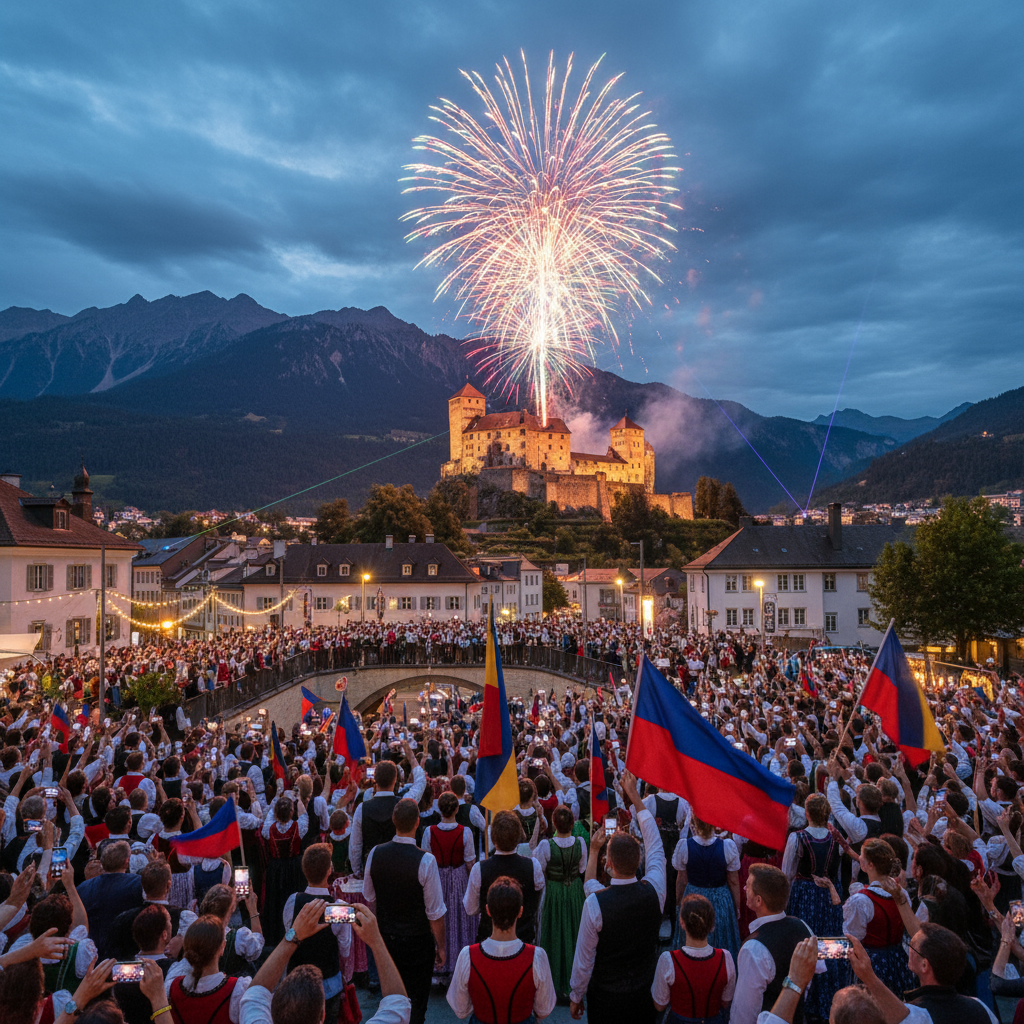
This tradition did not emerge immediately. Fire elements were gradually added to the celebration after the first National Day. The torchlight procession and mountain bonfires became part of the program in the 1940s and have been preserved to this day. In 2024, for example, the first fires on the mountain peaks appeared around 9:00 p.m. Afterward, the main evening event awaited guests—the traditional fireworks display.
Fireworks over Vaduz
The grand fireworks display is the highlight of National Day. It is launched after dark and lights up the sky above Vaduz and the Princes’ Castle. The fireworks have long been one of the most anticipated parts of the celebration. It takes place after the folk festivities and evening traditions involving bonfires. It is the combination of the mountains, Vaduz Castle, and the festive fireworks that makes the evening portion of National Day particularly spectacular.
In 2019, for example, the fireworks display lasted about half an hour. In the anniversary year, it was enhanced with special festive elements.
Interesting Facts About National Day
The holiday was first celebrated in 1940. Although Liechtenstein’s history as a principality dates back much further, the country did not have its own National Day until 1940. The first celebration took place on August 15, 1940.
This is not Independence Day. Liechtenstein gained sovereignty in 1806 following the dissolution of the Holy Roman Empire. Therefore, August 15 is associated not with the declaration of independence, but with the history of the country’s national identity.
Originally, the holiday was tied to the prince’s birthday. Franz Joseph II was born on August 16. That is why the authorities chose the previous day, which also coincided with the Assumption of the Virgin Mary.
After the prince’s death, the holiday was retained. Franz Joseph II died in 1989, but the following year it was enshrined in law that National Day would continue to be celebrated on August 15.
Liechtenstein is very small, but the celebrations draw tens of thousands of people. In 2024, about 30,000 visitors attended the national holiday in Vaduz. For a country with a small population, this is a very large-scale event.
All municipalities take part in the celebration. Liechtenstein consists of only 11 municipalities, and traditionally, they take turns representing themselves at the national festival in Vaduz. This allows them to showcase local traditions, music, cuisine, and culture from different parts of the principality to guests.
The holiday has another name—“the Prince’s Festival.” In everyday life, National Day is often called Fürstenfest. The name dates back to a time when the holiday was more closely associated with the princely family.
How National Day Will Be Celebrated in 2026
August 15, 2026, falls on a Saturday. In Liechtenstein, it will be an official holiday and a day of traditional state and public events. Vaduz will traditionally be the center of the celebrations. First, an official ceremony will take place near the castle, and then the city will come alive with music, festive events, food, and guests from various communities.

In the evening, the focus will shift to the mountains. There, as is traditional, bonfires are lit and torchlight processions take place, and the festivities culminate with fireworks over Vaduz. For Liechtenstein, this is a special day also because it allows the entire country to literally come together. For a few hours, the small principality transforms its capital into one large shared celebration venue.


