
Holiday on September 16, 2026 — Ozone Layer Protection Day: Why It's Important

On September 16, the world observes International Ozone Layer Day—a date that serves as a reminder of the importance of the atmosphere’s invisible protective layer for all life on Earth. It was on this day in 1987 that countries signed the Montreal Protocol—an international agreement that helped significantly reduce the use of ozone-depleting substances. In 2026, the day’s theme is “Global Action for a Cooler Planet,” and it also marks the tenth anniversary of the Kigali Amendment to the Montreal Protocol.
International Ozone Layer Protection Day is observed annually on September 16. It was established by the UN General Assembly in 1994. The date was not chosen at random—it commemorates the signing of the Montreal Protocol on September 16, 1987. This document became one of the major international steps taken to combat the depletion of the ozone layer. Countries agreed to gradually reduce the production and use of ozone-depleting substances and eventually phase them out entirely.
That is why this day is more than just an environmental date on the calendar. It demonstrates how joint decisions by different countries can truly change the situation on our planet. The UN calls on countries to conduct awareness campaigns, educational events, and other initiatives on this day to help people better understand the issue.
What Is the Ozone Layer and Why Is It Important?
The ozone layer is located in the stratosphere—at an altitude of approximately 15 to 35 kilometers above the Earth’s surface. It contains ozone—a gas whose molecule consists of three oxygen atoms. Its main role is to absorb a significant portion of the Sun’s harmful ultraviolet radiation. Without this natural protection, life on Earth would be much more difficult.
Excessive ultraviolet radiation can be harmful to human health. It increases the risk of skin cancer, can cause vision problems, and can affect the immune system. Ultraviolet radiation also harms plants, marine organisms, and entire ecosystems. Therefore, the ozone layer effectively acts as a kind of natural shield for the planet.
How the Ozone Problem Arose
The issue began to be taken particularly seriously in the second half of the 20th century. Scientists discovered that certain chemicals used in refrigerators, air conditioners, aerosol cans, and other equipment could deplete ozone in the upper atmosphere. Among them were chlorofluorocarbons, or CFCs, also known as freons.
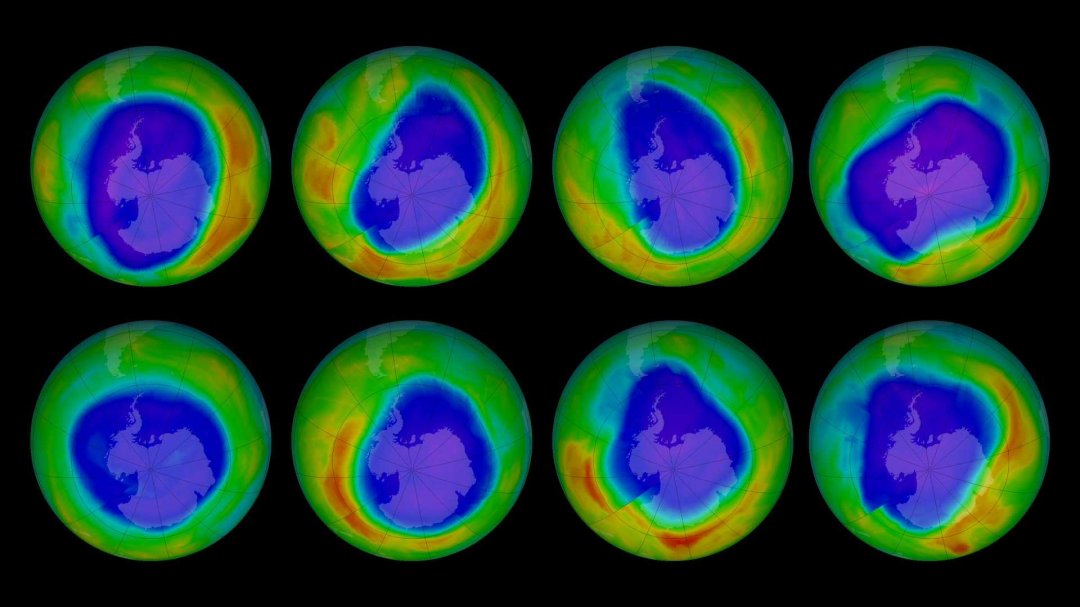
These substances could enter the atmosphere, rise high into the stratosphere, and trigger chemical reactions that destroyed ozone molecules. This process became particularly noticeable over Antarctica. This is how the term “ozone hole” came into use—an area with very low ozone concentration that forms seasonally over Antarctica. The problem became so serious that individual countries began seeking a joint solution. In 1985, the Vienna Convention for the Protection of the Ozone Layer was adopted, followed two years later by the Montreal Protocol.
What the Montreal Protocol Changed
The Montreal Protocol called for a gradual reduction in the production and use of substances that deplete the ozone layer. Moreover, countries did not merely agree on general principles but also established specific phase-out schedules for various groups of chemicals. Over time, the list of controlled substances expanded. Today, the protocol regulates nearly 100 chemicals belonging to various groups of ozone-depleting compounds. Countries gradually phased them out and switched to safer alternatives.
The result is considered one of the most successful examples of international environmental cooperation. In 2003, then-UN Secretary-General Kofi Annan called the Montreal Protocol “perhaps the most successful international agreement in human history.” Another important fact: on September 16, 2009, the Vienna Convention and the Montreal Protocol became the first treaties in UN history to achieve universal ratification. This means that every country in the world has acceded to them.
Has the ozone layer been saved?
The good news is that the ozone layer is gradually recovering. According to UNEP, if countries continue to comply with the requirements of the Montreal Protocol, ozone concentrations could return to 1980 levels by around 2040 for most of the world. For the Arctic, this milestone is projected for around 2045, and for Antarctica, around 2066.
This does not mean the problem has been completely solved. The ozone layer still needs to be monitored, and it is important for countries not to resume the use of hazardous substances. Scientists continue to track changes in the atmosphere and assess how effectively international agreements are working. There is another interesting finding: protecting the ozone layer also helps combat climate change. According to UNEP estimates, measures under the Montreal Protocol prevented a massive amount of emissions, equivalent to approximately 135 billion metric tons of carbon dioxide between 1990 and 2010.
Why is the topic of cooling the planet also being discussed in 2026?
This year’s theme for International Ozone Day is “Global Action for a Cooler Planet.” The year 2026 marks the tenth anniversary of the adoption of the Kigali Amendment to the Montreal Protocol. It was adopted in 2016 in Kigali, the capital of Rwanda. The document addresses hydrofluorocarbons—substances widely used in refrigerators and air conditioners. While they do not deplete the ozone layer as much as previous substances, they are potent greenhouse gases, so it was decided to phase out their use as well.
The UN emphasizes that modern cooling technologies are becoming increasingly important due to rising temperatures and more frequent heat waves. People need air conditioners, refrigerators, and other cooling systems, but these must be safer for the environment and consume less energy. According to UN estimates, full implementation of the Kigali Amendment could help prevent up to 0.5 degrees of global warming by the end of the century. If energy efficiency in cooling systems is improved at the same time, the potential impact could be even greater.
How This Day Is Observed
International Ozone Layer Day does not have any mandatory traditions like those associated with national holidays. It is observed primarily through educational and informational events. Schools, universities, civic organizations, and government agencies can hold lectures, themed lessons, exhibitions, contests, public discussions, and environmental campaigns. Each year, UNEP also prepares informational materials for this date. In 2026, the organization prepared, in particular, fact sheets, social media posts, and posters in several languages. These can be used by organizations and individual countries during their own events.
For the average person, this day can also be an opportunity to learn a little more about what is happening to the atmosphere. For example, you can pay attention to the energy efficiency of your air conditioner or refrigerator, properly dispose of old appliances, and avoid releasing refrigerants into the atmosphere during repairs. Such steps may seem small, but the overall result depends precisely on millions of similar decisions.
Interesting Facts About the Ozone Layer
The ozone layer cannot be seen with the naked eye, but its importance for life on Earth is immense. Ozone itself consists of only three oxygen atoms, yet it is this molecule that is capable of absorbing a significant portion of harmful ultraviolet radiation.
Another interesting fact is that the ozone layer crisis demonstrated that an international environmental agreement can yield tangible results. Countries agreed to restrict hazardous substances, industry began transitioning to alternatives, and the condition of the ozone layer gradually began to improve.
However, the “ozone hole” is not a literal hole in the atmosphere. It is the name given to an area where ozone concentrations are significantly lower than normal. The best-known example is the seasonal region of severe ozone depletion over Antarctica. Therefore, September 16 is not just a reminder of an old environmental problem.
It is also an example of how humanity can reverse a dangerous trend if countries reach agreements, adhere to common rules, and use scientific data to make decisions.


