
Tikhanovskaya warned of new provocations by Russia from Belarusian territory
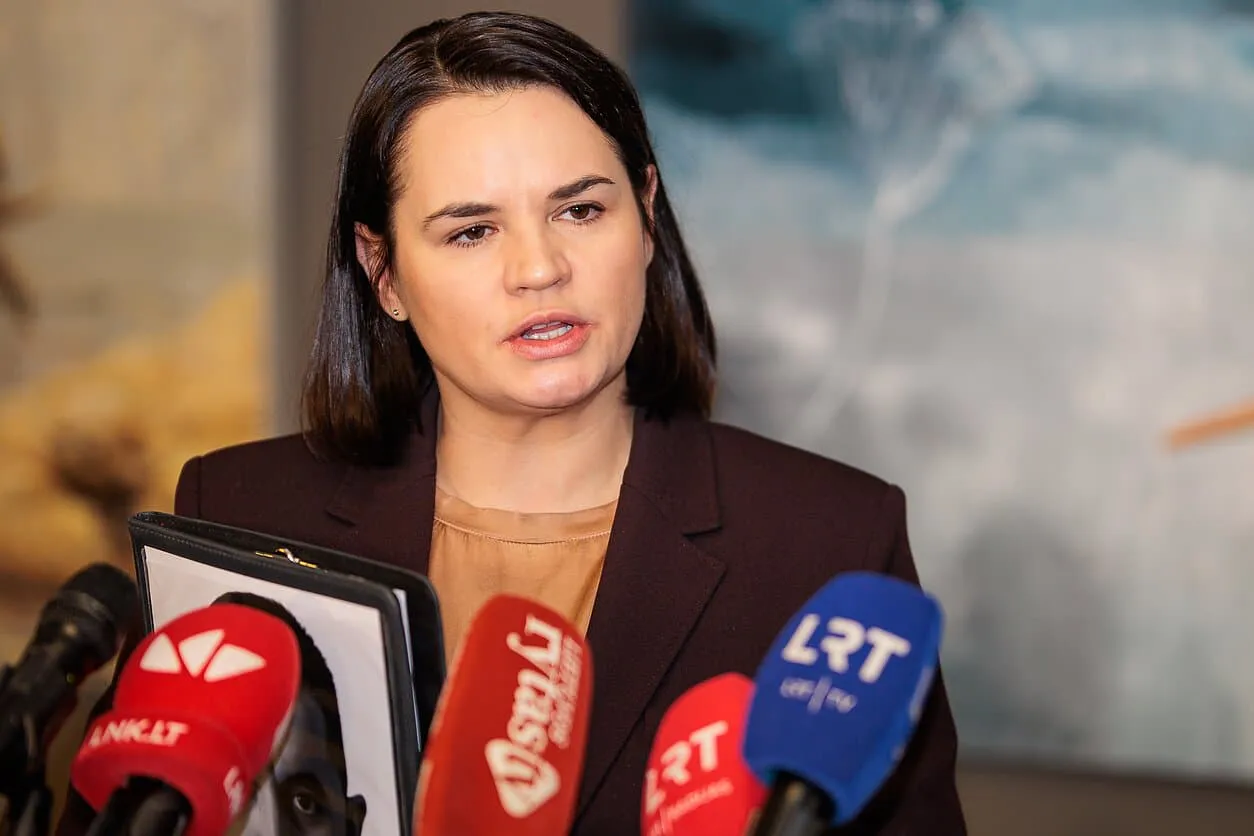
Belarusian opposition leader Sviatlana Tsikhanouskaya stated that Russia could use Belarusian territory for new provocations against NATO countries. She also claims that Minsk continues to provide Moscow with access to its military infrastructure, and that new military facilities are reportedly appearing near Belarus’s borders.
Sviatlana Tsikhanouskaya warned of a possible escalation of Russia’s military and hybrid activities from Belarusian territory. According to her, Belarus’s self-proclaimed president, Alexander Lukashenko, remains ready to provide Russia with the country’s territory and infrastructure. Tikhanovskaya believes that Moscow may use Belarus not only to deploy military facilities but also to conduct operations aimed at intimidating or provoking NATO countries.
“We must be very cautious—we see that infrastructure for ‘Oreshnik’ missiles is being deployed in Belarus; they are threatening and blackmailing us with nuclear weapons,” Tikhanovskaya stated. At the same time, her remarks reflect the assessment of the Belarusian opposition. She did not provide any information about Russia preparing a specific operation against NATO or about immediate preparations for a strike from Belarusian territory.
What’s Happening with the Military Infrastructure
According to Tikhanovskaya, she has received information about the construction of new military infrastructure on Belarusian territory. Specifically, this concerns areas near the border with Ukraine. The opposition leader also mentions activity along Belarus’s borders with European Union countries. These territories are of particular significance, as Lithuania, Latvia, and Poland are all NATO members.
Tikhanovskaya did not specify publicly exactly what facilities are being built or on what scale. Nor does her statement imply that each of these facilities is directly linked to Russian missiles. However, the opposition leader believes that the strengthening of military infrastructure poses additional risks to neighboring states. In her view, Belarus is increasingly being used by Moscow as a military springboard.
What Is “Oreshnik”?
Tikhanovskaya specifically mentioned the Russian “Oreshnik” missile system. It is precisely the system’s possible deployment in Belarus that has recently been the subject of numerous statements from Moscow and Minsk. Russian authorities describe “Oreshnik” as a new medium-range ballistic missile. Moscow claims that the system is capable of covering significant distances and can employ various types of warheads. Russia first announced the use of the “Oreshnik” against Ukraine in November 2024. At that time, the Russian military launched a strike on Dnipro.
Later, Vladimir Putin announced plans to deploy such missiles in Belarus. Minsk also reported that it was preparing to host the Russian missile system on its territory. This is why Tikhanovskaya’s mention of infrastructure for the “Oreshnik” has a broader context. She links a possible strengthening of Russia’s military presence in Belarus to risks for neighboring NATO countries.
Why Belarus Is Important to Russia
Belarus is of strategic importance to Russia because of its geographic location. The country borders Ukraine, Poland, Lithuania, and Latvia. After Russia launched its full-scale invasion of Ukraine, Belarusian territory was used by Russian troops. Russian forces entered Ukraine from Belarusian territory at the start of the full-scale war.
Belarus also allowed Russia to use its military infrastructure—including airfields, training grounds, and other facilities that could be of importance to the Russian military. For this reason, Ukraine and NATO countries are closely monitoring military activity on Belarusian territory. Any significant buildup of forces or the appearance of new weapons systems could affect the assessment of the security situation in the region.
However, the mere presence of Russian military equipment or infrastructure in Belarus does not necessarily mean that a new offensive is being prepared. Additional confirmation and intelligence data are needed to reach such a conclusion.
Tikhanovskaya Also Mentions Hybrid Attacks
In addition to the military threat, Tikhanovskaya stated that Russia and Belarus are already carrying out hybrid attacks against NATO countries. According to her, the states that could be targets of such actions include Lithuania, Poland, and Latvia. She links these threats not only to military activity but also to other forms of pressure. “Hybrid” refers to actions that may combine various tools—cyberattacks, disinformation, political pressure, sabotage, the use of migration flows, or other methods of destabilization.
The Baltic states and Poland have repeatedly warned of the risks associated with Russian and Belarusian activities. In recent years, particular attention has been paid to cyberattacks, information campaigns, and provocations along the borders. Drones have become a separate issue. Poland and the Baltic states are tightening control over their airspace due to border violations and the activities of Russian and Belarusian forces.
Therefore, Tikhanovskaya’s warning came against the backdrop of existing tensions in the region. At the same time, specific allegations regarding Minsk’s or Moscow’s involvement in each individual incident require confirmation.
Why NATO Countries Are Monitoring Belarus
Belarus is important to NATO because of its immediate proximity to the Alliance’s eastern flank. Poland, Lithuania, and Latvia share a border with Belarus, and Belarus itself cooperates closely with Russia in the military sphere. Of particular importance is the so-called Suwałki Corridor—the stretch of land between Poland and Lithuania that connects the Baltic states with other NATO countries. Belarus lies on one side of it, and the Russian Kaliningrad region on the other.
For this reason, any significant military activity in Belarus could have implications for NATO’s defense planning. The Alliance is strengthening its eastern flank and conducting exercises to prepare for various scenarios. At the same time, NATO countries have not claimed that a Russian attack from Belarusian territory is imminent. The focus is primarily on the need to be prepared for potential threats. That is precisely why intelligence agencies of neighboring states are closely analyzing information about new military infrastructure or the movement of Russian forces in Belarus.
What Role Does Lukashenko Play?
Alexander Lukashenko has effectively made Belarus one of Russia’s closest military partners. Following the 2020 political crisis, his dependence on Moscow has significantly increased. Russia supported Lukashenko following the mass protests in Belarus, and military cooperation between the two countries subsequently deepened. Belarus became a venue for Russian military exercises and the deployment of Russian military equipment.
After the start of the full-scale invasion, Moscow gained the ability to use Belarusian territory in the war against Ukraine. Lukashenko himself has repeatedly spoken of military cooperation with Russia. For Tikhanovskaya, this policy means that Belarus is losing a significant portion of its autonomy in security matters. She regularly calls on democratic countries not to view Minsk and Moscow as two parties that are completely independent of one another.
What This Means for Ukraine and Its Neighbors
If Russia does indeed continue to expand its military infrastructure in Belarus, this could create additional risks for Ukraine. This is particularly true for the northern regions, which were already under attack by Russian troops from Belarusian territory at the start of the full-scale war. For Poland, Lithuania, and Latvia, the risks stem primarily from their immediate proximity to Belarus and Russia. Any new military infrastructure in this region could force neighboring states to strengthen their own defenses.
However, Tikhanovskaya’s statement alone is not proof that Russia is already preparing a specific provocation against NATO. It is a warning that must be considered alongside other intelligence regarding the military activities of Russia and Belarus. Currently, the main focus remains on exactly what facilities are being built in Belarus, what Russian forces are stationed there, and what weapons Moscow might deploy on Belarusian territory.
Tikhanovskaya urges people not to underestimate these developments. In her view, the use of Belarus as a Russian military base could become one of the factors contributing to a further escalation of the situation in Eastern Europe. This was reported by LRT.
Poland has extended the buffer zone on the Polish-Belarusian border for another 90 days—until November 29, 2026.


