
Thousands of students took to the streets to protest in India
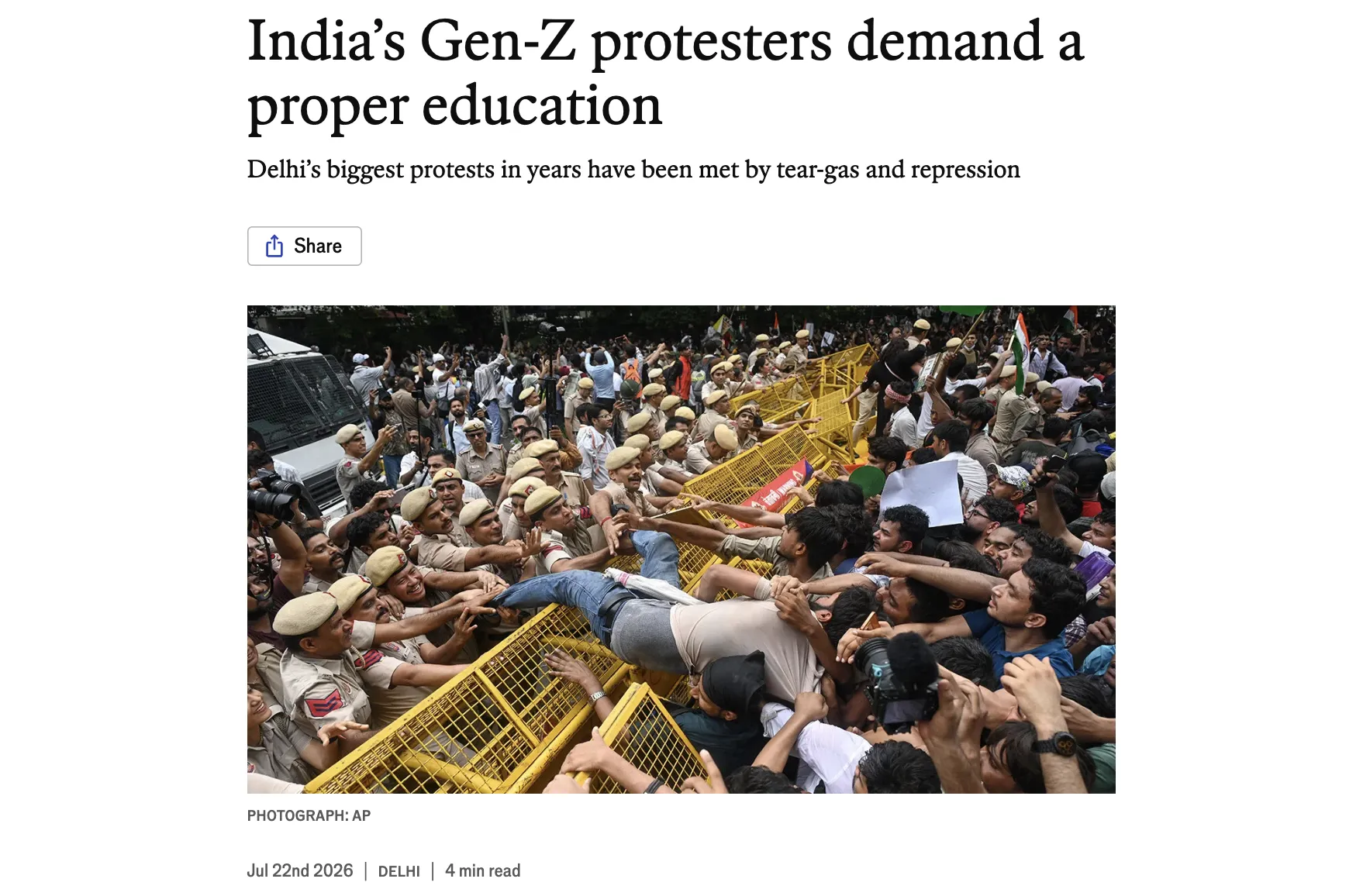
India’s capital has been swept up in the largest student protests in recent years. Protesters are demanding the resignation of Education Minister Dharmendra Pradhan following a scandal involving the leak of entrance exam questions.
The youth movement began back in May, when questions from the nationwide NEET entrance exam—which determines which students will be admitted to the country’s medical schools—were leaked online. Due to the leak, the results were annulled, and more than 2 million applicants had to retake the exam.
On July 20, tens of thousands of demonstrators marched toward the parliament building on the first day of the Monsoon session—the police responded with tear gas and batons, injuring more than 100 people. One of the movement’s participants, 18-year-old Anshul Dev, told Al Jazeera that the authorities “are treating them like terrorists and criminals.”
A multi-day hunger strike near the 18th-century Jantar Mantar observatory in Delhi became a symbol of the protest. Activist Sonam Wangchuk was among the first to begin the hunger strike on June 28, and on July 18, police forcibly hospitalized him due to his deteriorating health. Other students joined the protest, including Jawaharlal Nehru University graduate students Neha Bora, Manish Kumar, and Amin Amitoj.
The movement also gained a public face in the form of the satirical “Cockroach Janata Party,” which was founded as a joke but eventually came to be taken quite seriously. Its founder, Abhijit Dipke, stated that the activists will not back down until Pradhan resigns.
One of the protesters, 28-year-old Yash Mishra, continues his hunger strike, lying next to his backpack near a structure that has become a popular gathering spot for demonstrators. “Education is like water: a basic necessity that must be accessible to everyone,” he says.
On July 21, Pradhan wrote on X that he had promised “answers, reforms, and accountability,” but did not offer to resign. That same day, Rahul Gandhi, leader of the opposition Congress Party, who is also demanding the minister’s resignation, staged a protest outside Prime Minister Narendra Modi’s residence—the police briefly detained him along with his sister Priyanka Gandhi Vadra and several other opposition leaders.
The protests forced a temporary suspension of parliamentary sessions, and the Delhi Metro Rail Corp. closed 16 stations in central areas of the city for security reasons. Pradhan accused the Congress Party of “artificially stoking tensions,” while Gandhi called on Modi to apologize to the students and reform the exam system as soon as possible.
This is reported by The Economist and the AP.
In Delhi, thousands of supporters of the youth movement Cockroach Janta Party marched to Parliament demanding the resignation of India’s Education Minister Dharmendra Pradhan. The demonstration took place despite a police ban and was a continuation of protests over alleged leaks of exam materials.
As a reminder, India blocked the Telegram messaging app to combat cheating during exams.
On June 17, Telegram filed a lawsuit challenging the Indian government’s decision to temporarily block the platform.


