
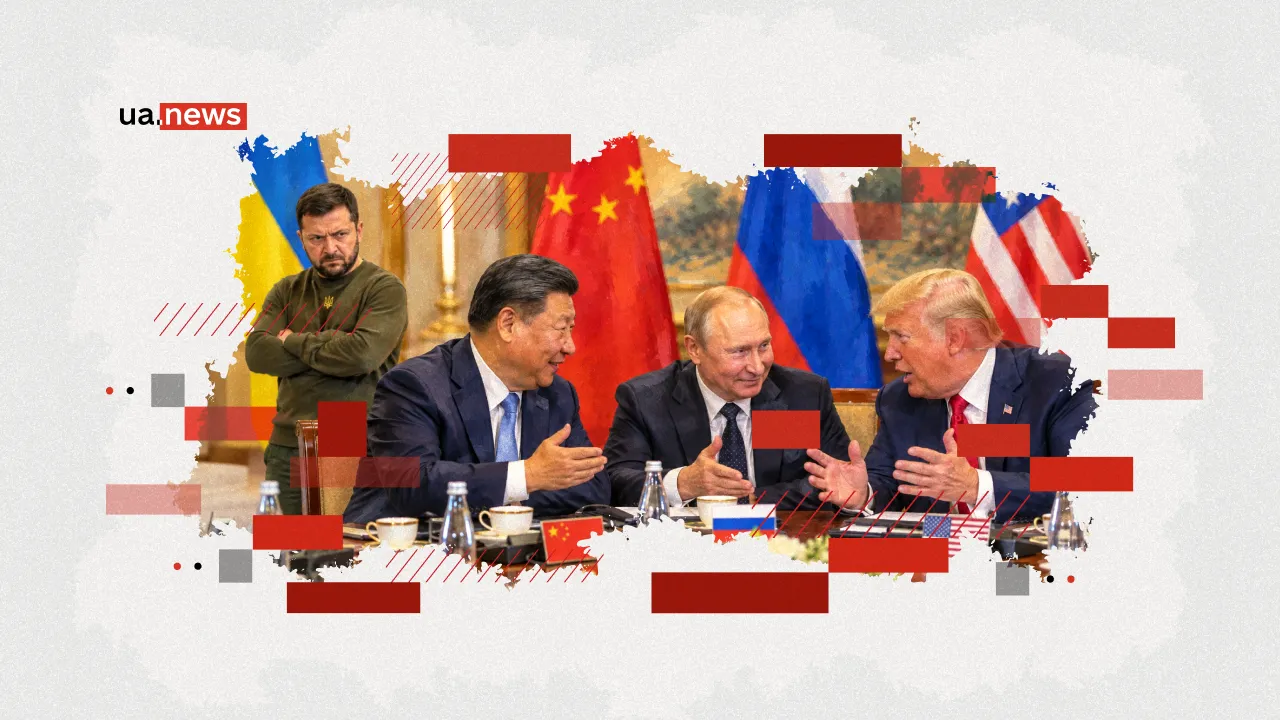
According to *The Wall Street Journal*, a few weeks ago Russian President Vladimir Putin allegedly proposed to U.S. President Donald Trump and Chinese President Xi Jinping that they hold a trilateral summit on the war in Ukraine and its potential outcome. This meeting could take place in late November in Shenzhen, China, where the APEC summit is scheduled to be held. However, neither Ukraine nor the Ukrainian president has been invited to the event.
Kremlin Press Secretary Dmitry Peskov has already confirmed that such a meeting is being discussed, although no specific agreements have been reached yet. Trump himself later stated that he is ready for a trilateral meeting with Putin and Xi.
How likely is such a meeting, what can we expect from it, and can they really reach an agreement on peace in Ukraine—without even the formal participation of Ukraine and its president? UA.News posed these questions to political experts. Read more in our article.
Russia remains a junior partner dependent on China: Volodymyr Fesenko, head of the “Penta” Center for Applied Political Studies
A myth has emerged in our media that this potential meeting between Trump, Putin, and Xi Jinping in China at the end of November is about Ukraine. That’s not the case. The topic of Ukraine will certainly be one of the topics. But this initiative by Putin emerged back in the summer. It’s his attempt to create a sort of “new Yalta,” where he—along with Trump and Xi—is one of the world’s leaders, which isn’t quite the case.
Of course, Putin wants to negotiate on Ukraine, to prove that it’s within his sphere of influence. But in reality, it’s not just about Ukraine. Take note: Trump wants to talk about denuclearization, about nuclear disarmament. He won’t reach an understanding with either China or Russia. And that’s a very good thing, because it could get in the way of agreements on other issues. There are plenty of issues to discuss: Iran, Taiwan, and so on.
I don’t have any apocalyptic expectations regarding this meeting. Besides, it’s not even certain that this meeting will take place at all. And it’s important to understand that this won’t be a separate summit; it will be a “side meeting” on the sidelines of APEC. How long will it last? Well, an hour, maybe an hour and a half or two. It won’t be a very lengthy conversation, even though there are plenty of problems and disagreements between the parties. For Putin, though, the main thing is the image—the idea that this is a “new Yalta.” An attempt to turn all of this into some kind of alternative to the G7 and G20. But Beijing wants to negotiate separately with Trump. Why would they include Russia—a junior partner dependent on China—in this club? Why elevate Putin’s status?
In the U.S., by the way, there is concern that, from a purely tactical standpoint, it is not in Trump’s interest to attend a trilateral meeting. It’s better to negotiate separately. Trump considers himself a negotiating genius, but here we have two geopolitical allies who, together, could outmaneuver Trump if they agree on a coordinated position. So, overall, I am skeptical about the outcome of this meeting.

The Trump
administration is in the home stretch of developing a peace plan: Ruslan Bortnik, director of the Ukrainian Institute of Politics
The possibility of a meeting between Trump, Putin, and Xi Jinping at the APEC summit in Shenzhen on November 18–19 has been under discussion for at least a month. The first such proposal emerged after Xi’s meeting with Trump in September. At that time, the Chinese leader visited the U.S. in the second half of September, during the UN General Assembly. It was already announced then that Trump would likely attend the APEC summit in Shenzhen on November 18–19.
The report in The Wall Street Journal—that Putin himself is allegedly proposing this meeting—may be intended to discredit the meeting itself and create a toxic atmosphere around it. Especially since the Russian side has not yet definitively confirmed this meeting. But this event could indeed prove to be largely decisive. Today, we see that the Trump administration has entered the home stretch in developing a peace plan, which is currently being actively discussed between the U.S., Ukraine, and Europe. A meeting took place in Miami during which specific documents and components of the peace plan were discussed: security guarantees for Ukraine, as well as guarantees for its recovery and integration into the EU. Just like the results of the U.S. election, these negotiations will be two key events that will shape the agenda of the APEC summit. After that, Kushner is expected to travel to Moscow.
In fact, two processes are expected to be completed before the APEC summit. The first involves negotiations between the U.S., Ukraine, and Europe regarding U.S. proposals, as well as negotiations between the U.S. and Russia. The second is the determination of the balance of power in the United States before the end of Trump’s presidential term. The election will take place on November 3, 2026, and his presidential term will end in January 2029.
With these two key outcomes—the results of the negotiations and the U.S. election results—Trump may be more open to a deal with Moscow and Beijing, or with Moscow with Beijing acting as a mediator. The summit in Shenzhen could be the venue where Trump strikes a framework agreement with Putin and Xi Jinping. The likelihood of such a scenario is quite high—especially if, by that time, Trump has not reached a compromise with Ukraine and Europe and loses the U.S. election. This could pave the way for an agreement between the United States, China, and Russia.
After all, if Trump loses the election and fails to reach a compromise with Ukraine and Europe, he may conclude that there are not enough strong allies in Europe capable of shaping its policy. It will also become clear that Ukraine is unlikely to agree to any peace settlement based on the American model and may decide to wait for the next U.S. president. Faced with these two outcomes, Trump may agree to some kind of deal with Moscow and Beijing. After all, he has traditionally maintained friendly relations with the leaders of Russia and China; they are on good terms with one another. Trump views them as equals and may even partially consider them his allies in the fight against Democrats within the U.S. and against liberal governments in Europe.
Therefore, the APEC summit could prove to be extremely interesting and have far-reaching consequences for geopolitics, although for Ukraine these consequences may manifest themselves later than expected. That is precisely why Ukraine needs to secure its participation in this summit today, especially if issues that concern us are to be discussed there. It is essential to insist on an invitation and to negotiate with the Chinese side and other APEC countries involved in organizing this summit.

The issue of the war in Ukraine cannot be
resolved at the APEC summit: political analyst Andriy Vihirinsky
A trilateral meeting between Putin, Trump, and Xi has been under discussion for at least a quarter. Why? Because the APEC summit is coming up, and all parties have so far confirmed their participation in the event. The agenda is being finalized today. Depending on which key issues remain unresolved, those will be discussed at the summit.
By November, it will be clear what kind of U.S. Congress Donald Trump will have. They will be able to communicate with a clear understanding of what commitments the United States can and cannot make, and how to structure their cooperation during the remaining years of Trump’s presidency. This concerns Russia’s and China’s trade and economic relations, as well as factors that could be used to restrict China’s foreign economic activities in the sphere of trade or to impose sanctions. It concerns spheres of influence, which cannot be fully resolved in a single meeting. It concerns Taiwan, the security of shipping in the Indo-Pacific region, joint development of the Arctic, relations between nuclear powers, technological restrictions that the United States imposes on Chinese goods and products, as well as China’s presence in the Western Hemisphere.
In addition, there is the issue of nuclear weapons, which has practical implications for all of us. Although the U.S. wants to engage in such a dialogue with China, China will only be ready for dialogue once it achieves nuclear parity with the United States. This could happen in about three to four years, so it is unlikely that they will be able to reach an agreement on anything at this time. In general, the goal is rather to establish rules for interaction and to avoid conflict over the next few years or even several decades in relations between the major powers.
Now regarding Ukraine. Ukraine did not receive an invitation to the APEC summit. Ukraine is not an APEC member country, so its participation in this summit is hardly expected. Therefore, the answer to the question of whether this meeting is possible without Zelenskyy is undoubtedly yes. The parties will certainly address the war in Ukraine. They will view it as a conflict that is nearing its end. China and Russia share a common position on this matter. They are strategic partners and assert that the war must be resolved on a long-term basis, which entails addressing the root causes of the conflict. This refers to the presence of the United States and its troops in Europe, as well as what Russia considers to be NATO’s encroachment on its sphere of influence in Eastern Europe. It is unlikely that China and Russia’s position on this issue will change.
The United States, for its part, states that it has taken this position into account. Official statements regarding Ukraine’s NATO membership have already been made, and the redeployment of troops and the military autonomy of Europe are taking place as part of the U.S. review of its security policy and NATO policy in the European region. Can the issue of the war be resolved during this meeting? No, it cannot. The leverage Trump is using has its limits.
Europe is shouldering the bulk of the financial burden. The continuation of the war depends largely on Putin’s decision. Hostilities could indeed come to an end, but the Russian side is unlikely to agree to this… Therefore, an agreement to end the war as a result of a meeting between three nuclear powers is unlikely. We are not ready to end the conflict without achieving our own goals, which relate, in particular, to security guarantees, reconstruction, compensation for damages, and so on.
Given that European countries have not yet presented a united front and have not been invited to this format, Ukraine is also not participating in it. Consequently, all we can hope for are potential agreements reached by the parties, whose terms they can then convey to the coalition of the resolute and to Ukraine. We will be able to review them and say whether we agree with them.
Russia seeks to undermine Ukraine’s sovereignty and “put the EU in its place”: Yevhen Magda, director of the Institute of World Policy
Possible trilateral talks between the U.S. and Russia are more of a whim on the part of the Kremlin. This is Russia’s attempt to boost its prestige, to show that it has influence in the modern world—and that the Kremlin can convene a meeting to discuss the fate of the world after the war ends.
But there are a few points to understand. First, I’m not sure China is interested in having its vassal, Russia, sit down at the negotiating table with Trump to divide up the world. Second, in parallel with the public narrative, Russia is telling Trump about the potential for huge profits, enormous benefits, and so on. And third: the desire to hold this three-way meeting—without Ukraine, without European representatives—is a clear attempt by Russia to undermine Ukraine’s sovereignty and to “put in its place” the European Union, which supports Ukraine. And this desire, in one way or another, unites Russia with the U.S. and China.

The
world is much harsher and more cynical than some in Ukraine realize: Andriy Zolotaryov, director of the “Third Sector” Center
The likelihood of a meeting between the leaders of the U.S., Russia, and China in Shenzhen during the APEC summit is very high. Trump and Putin have already expressed their willingness to hold such meetings, and some have already described this as a “new Yalta,” where they will attempt to divide the world into three parts. Xi is still waiting and remaining silent, but I think that as the host of this forum, he may indeed meet Trump and Putin halfway and the three of them may discuss the future world order. Also, given Trump and Putin’s agenda, they will definitely discuss Ukraine.
Unfortunately, this is a case where the principle of “nothing about Ukraine without Ukraine” will not apply. This could mean that terms similar to those agreed upon in Anchorage will be worked out, and we’ll simply be presented with a fait accompli. In fact, we are currently witnessing this kind of “arm-twisting” by the United States, pressuring Ukraine to accept the terms for ending the war agreed upon between the U.S. and Russia. But we’ve driven ourselves into a corner: we’re dreaming that the United States will continue to help Ukraine, that “they’re not going anywhere,” so to speak. But the world is much harsher and more cynical than it seems to some in Ukraine.
The U.S. is guided solely by its own interests. And given that a significant percentage of Trump’s team consists of so-called “dealmakers,” they are also driven by the temptation of windfall profits from economic cooperation between the U.S. and Russia.




