
Cambodia confirms birth of six dolphin calves — Mongabay
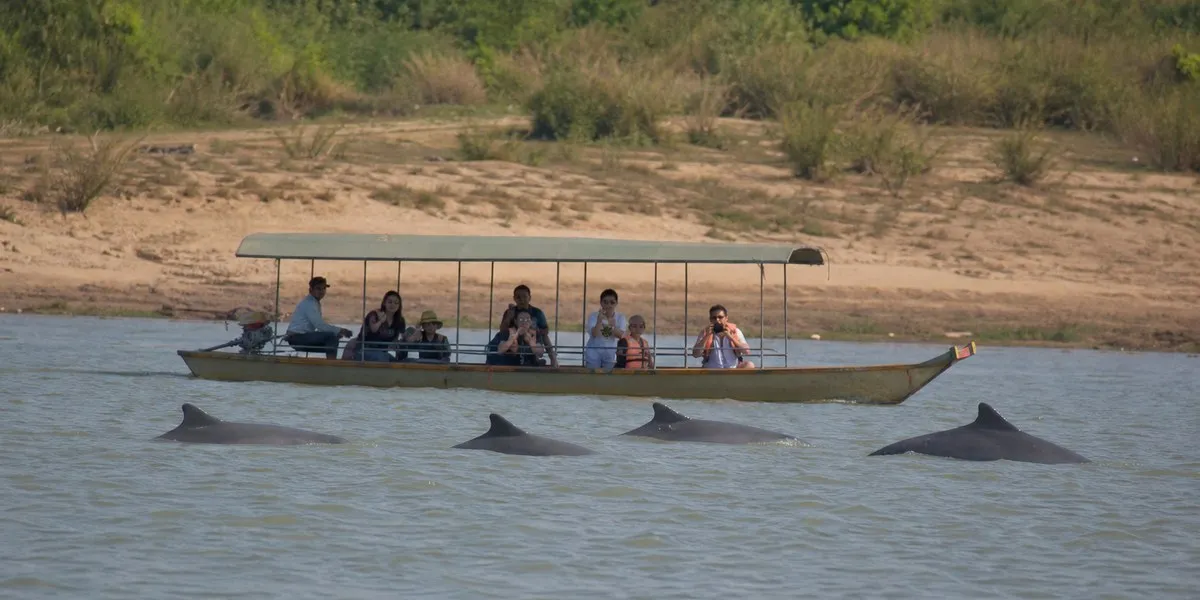
In the Cambodian section of the Mekong River, the birth of at least six Irrawaddy dolphin calves has been confirmed this year. Five were recorded in Kratie province and another in Stung Treng. This has increased the estimated local population to 118 individuals, Mongabay reports.
Irrawaddy dolphins are the Mekong’s only cetaceans. In Cambodia and Laos, they are regarded as sacred animals, and for communities along the river they are also a source of ecotourism income. The dolphin population in the Cambodian section of the Mekong has declined from about 200 individuals in the late 1990s to the current estimate of 118.
Illegal fishing and dams
Veang Tino, a ranger at the Kampi Nature Conservation Center, said the main cause of dolphin deaths is not hunting but accidental entanglement in fishing gear. This primarily concerns gillnets and hook gear that are illegally set in key animal habitats. Calves are especially vulnerable: they may die if their mother becomes entangled in a net or if they themselves get caught in fishing gear.
Electrofishing is banned throughout Cambodia. Gillnets are not permitted in protected zones along a 180-kilometer stretch of the Mekong in Kratie and Stung Treng provinces, created in 2012 to protect dolphins. That same year, the fisheries authority deployed 72 river guards to patrol this section of the river. According to officials, in 2022, about 36 kilometers of gillnets, 7,000 hook fishing devices and 500 meters of other types of nets were confiscated and destroyed in protected areas.
More current news is available on the UA.News Telegram channel Telegram.
Dams also affect the river’s ecology. More than 160 dams operate on the Mekong and its tributaries, including 13 on the main channel. Ian Baird, a geography professor at the University of Wisconsin–Madison, noted that upstream dams are not linked to direct dolphin deaths, but they alter the river’s hydrology, worsen the condition of seasonally flooded forests and change fish communities on which the dolphins depend for food.
Losses for communities
An example of the consequences for local residents was the Anlong Chheu Teal deep pool on the Laos-Cambodia border. The last dolphin there died on February 15, 2022, after becoming entangled in illegal fishing gear. According to community leader Phoi Vanna, tourist numbers dropped sharply afterward. In 2007, eight dolphins were counted in this area, while by 2018 only three remained.
Kampi fisheries chief I Sanaroth said that gillnets are still used in protected zones, although on a small scale. The population is protected by Cambodia’s Fisheries Administration with financial and technical support from WWF-Cambodia and other partners. Since 2014, the agency and WWF-Cambodia have implemented a program aimed at reducing fishing households’ dependence on catching wild fish and involving communities in protecting aquatic ecosystems.




